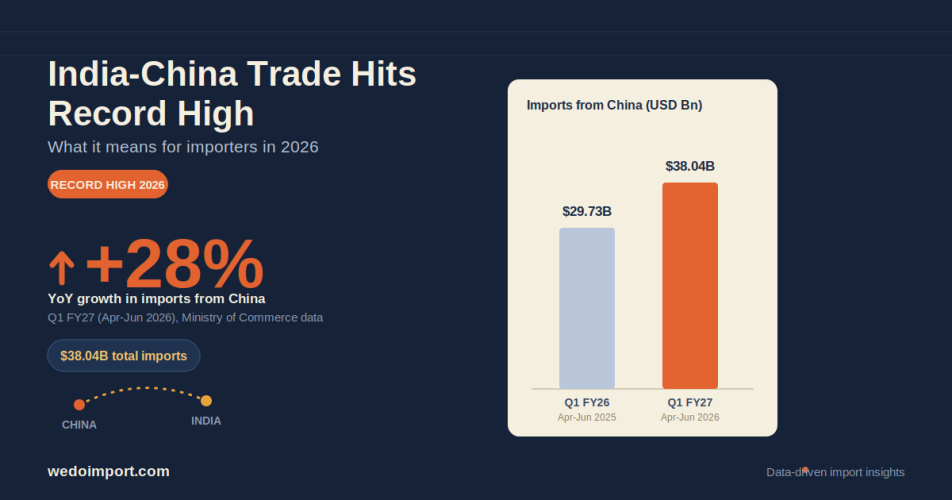
India-China Trade Hits Record High in 2026: What It Means for Importers
India imported more from China in the first quarter of FY27 (April–June 2026) than in any comparable quarter on record a 28% jump in dollar value over the same period last year. If you’re importing from China right now, this isn’t background noise. It’s the clearest signal yet that the market you’re operating in is getting bigger, more competitive, and more closely watched by regulators, all at the same time.
Here’s the actual data behind the headline, where it comes from, and based on what we’re handling for import clients at We Do Import every week what it actually changes for you as an importer.
The Numbers: How Big Is the Increase, Actually?
| Metric | Latest Period | Prior-Year Period | Change |
|---|---|---|---|
| India’s imports from China | $38.04B (Apr–Jun 2026) | $29.73B (Apr–Jun 2025) | +28% |
| India’s electronic goods imports (largely China-sourced) | $38.46B (Apr–Jun 2026) | $26.75B (Apr–Jun 2025) | +43.7% |
| India’s exports to China | $5.6B (Apr–Jun 2026) | $4.39B (Apr–Jun 2025) | +27.5% |
| India’s overall merchandise imports (all countries) | $216.18B (Apr–Jun 2026) | ~$180B (Apr–Jun 2025) | +19.89% |
| India-China bilateral trade | $137.0B (Apr 2025–Feb 2026) | – | Ahead of India-US trade ($127.8B) by ~$10B |
Figures for India’s overall goods trade deficit (which widened from $68.7B to $86.86B over the same quarter) reflect India’s total trade position across all countries, not the India-China deficit specifically.
*Source: Ministry of Commerce and Industry trade data, via ThePrint
The short version: China is now India’s single largest trading partner, ahead of the United States, and the gap widened through early 2026 rather than narrowing.
*Source: The Tribune – “China remains India’s top trading partner in early 2026”
Why Is This Happening?
Electronics is doing the heaviest lifting. Electronic goods imports grew 43.7% year-on-year the single largest driver of the overall increase. This tracks with what’s happening at ground level: components, sub-assemblies, and finished electronics remain difficult to source competitively outside China at comparable cost and lead time, even as India’s PLI (Production Linked Incentive) scheme pushes domestic electronics manufacturing forward.
Machinery imports are climbing too, but more gradually. Machinery imports from China rose from $14.09B to $16.68B quarter-on-quarter meaningful growth, but far more modest than electronics, suggesting industrial buyers are diversifying somewhat faster than electronics importers are.
This is happening despite active policy efforts to reduce China dependence, not because those efforts have failed outright Make in India and PLI incentives are still expanding domestic capacity in several sectors. The data clearly indicates that the current demand is exceeding the capacity expansion, especially in the sectors of electronics and industrial components.
*Source: ThePrint – “India’s China Imports grew by 28% in Q1 of FY27”
What This Means for Importers
Expect more competition for factory capacity and pricing. Record-high import volume means more buyers Indian and international competing for the same manufacturing capacity, particularly in electronics and consumer goods categories. Suppliers with strong track records are increasingly able to be selective about who they prioritize, which favors buyers who show up as reliable, well-documented, repeat customers rather than one-off bargain hunters.
Expect tighter customs scrutiny, not looser. Rising import volume typically brings increased enforcement attention, not reduced enforcement. Misclassified HS codes, missing BIS/WPC certification, and incomplete documentation are more likely to get caught not less as customs authorities process higher shipment volumes overall.
Anti-dumping duty exposure is a live risk, not a one-time check. India has active anti-dumping duties across multiple product categories sourced from China – steel, chemicals, solar glass, and several others and these get extended, added to, or revised on an ongoing basis (a duty on Chinese tubes and pipes was just extended to January 2027). If your product category has ever been near an anti-dumping investigation, this is worth checking before every order, not just your first one.
*Source: Business Standard – “Centre extends anti-dumping duty(ADD) on Chinese tubes, pipes till 2027 Jan”
Diversification conversations are becoming more common, not less. Even as absolute import volume from China rises, more Indian businesses are having “China+1” conversations keeping China as a primary source while building a secondary supplier relationship elsewhere. This isn’t necessarily about the numbers above directly; it’s a parallel risk-management trend worth being aware of if you’re planning your 2026–2027 sourcing strategy.
Wondering if your product could face customs issues?
Send us your product name on WhatsApp.
We’ll tell you if it needs BIS, WPC, anti-dumping checks or any special compliance before you import.
How We Do Import Helps You Navigate This Shift
The four shifts above aren’t hypothetical they’re the exact problems we’re actively solving for clients as import volumes climb. Here’s how each one maps to what we actually do.
Rising competition for factory capacity and pricing.
As more buyers compete for the same manufacturing slots, suppliers increasingly prioritize buyers who show up as reliable, well-documented, and repeat. We at We Do Import handle supplier verification and factory vetting before you commit checking business licenses, production capacity, and track record so you’re not competing on price alone, you’re showing up as the buyer a good factory actually wants to work with.
Strict customs scrutiny on HS code classification and documentation.
Our team at We Do Import spend most of our time here. We map every product to its precise HS code before production even starts, file Bills of Entry pre-arrival through India’s ICEGATE system to avoid port delays, and build a compliance roadmap BIS, ISI, WPC, whatever your product category needs before your goods ever leave the factory. The goal is catching a missing certificate at the sourcing stage, not at the port, where it costs you weeks and demurrage charges instead of a conversation.
Anti-dumping duty exposure that shifts with ongoing DGTR notifications.
Anti-dumping duties get added, extended, or revised on a rolling basis, and a product that was duty-free eighteen months ago can be affected today. We check your product’s current DGTR/CBIC status against its HS code before you place an order not after you’ve already paid a deposit so an unexpected duty notification doesn’t turn into a margin-killing surprise mid-shipment.
Quality risk rising as suppliers scale to meet higher demand.
When factories are running at higher capacity to meet record import demand, quality consistency is often the first thing that slips. We place inspectors inside the factory at three stages during production (DUPRO), final random inspection once at least 80% of the order is packed (FRI), and container loading supervision (CLS) so defects get caught before they’re sealed into a container, not after they’ve cleared customs and reached your warehouse.
The underlying pattern: most importers piece together a sourcing agent, a freelance freight forwarder, and an independent customs broker separately and when something goes wrong, each party points to the other. We run sourcing, compliance, inspection, and customs clearance as one accountable process, which matters more, not less, as the market gets more crowded and more heavily scrutinized.
Planning to import from China in 2026?
Just send us your product name.
We’ll point you in the right direction even if you’re not ready to import yet.
Quick Answers
Is China still India’s biggest trading partner in 2026?
Yes. India-China bilateral trade reached $137.0 billion between April 2025 and February 2026, ahead of India-US trade at $127.8 billion over the same period.
Did India’s imports from China actually hit a record?
Yes. Imports from China in Q1 FY27 (April–June 2026) reached $38.04 billion, a 28% increase over the same quarter the previous year, driven primarily by electronics.
Does an increase in trade volume indicate that import compliance is becoming more stringent?
Indirectly, yes. Higher shipment volume generally increases the enforcement attention on customs classification, certification, and documentation accuracy it doesn’t loosen it.
What are the trending products being imported from China to India right now?
Electronics and electronic components lead by a wide margin, followed by machinery, organic chemicals, and plastics. Beyond the large industrial categories, small importers are seeing consistent demand in mobile accessories, LED lighting and home décor, fashion accessories, kitchenware, and automotive accessories categories that combine low per-unit cost with easy shipping and steady year-round demand. Festival-driven categories (Diwali décor, seasonal gifting items) also see sharp import spikes ahead of Q3–Q4 each year.
Which specific electronics are most imported from China to India?
Electrical and electronic equipment is India’s single largest import category from China, running in the $44–48 billion range annually. Within that category, the biggest contributors are integrated circuits and micro assemblies, semiconductors and diodes/transistors, mobile phone components, lithium-ion batteries, telecom and networking equipment, and finished consumer electronics like laptops, TVs, and cameras. Mobile phone components alone make up a significant share, reflecting how deeply India’s smartphone manufacturing ecosystem still depends on Chinese-sourced parts.
Is it still profitable to import from China to India in 2026?
Yes, for most well-chosen categories but profitability now depends more on picking the right niche and managing compliance correctly than it did a few years ago. Categories like electronics accessories, home décor, fashion accessories, and mid-range beauty products with proper certification continue to show healthy margins, while high-value machinery can be profitable but requires more capital and longer sales cycles.
What’s the most hassle-free way to import from China without getting stuck at customs?
The single biggest factor isn’t the shipping method, it’s sequencing: confirm your HS code and any required certification (BIS, ISI, WPC) before you place your order, not after your goods are already in transit. Combine that with accurate, matching documentation across your commercial invoice, packing list, and bill of lading, and work with a customs broker or import partner who can pre-file your Bill of Entry ahead of arrival. Most customs delays trace back to one of these three things going wrong not bad luck.
Are you planning to increase your import volume in 2026 and would like a review of your compliance process beforehand? Message us on WhatsApp we’ll tell you honestly where your current setup has gaps








Leave a Reply