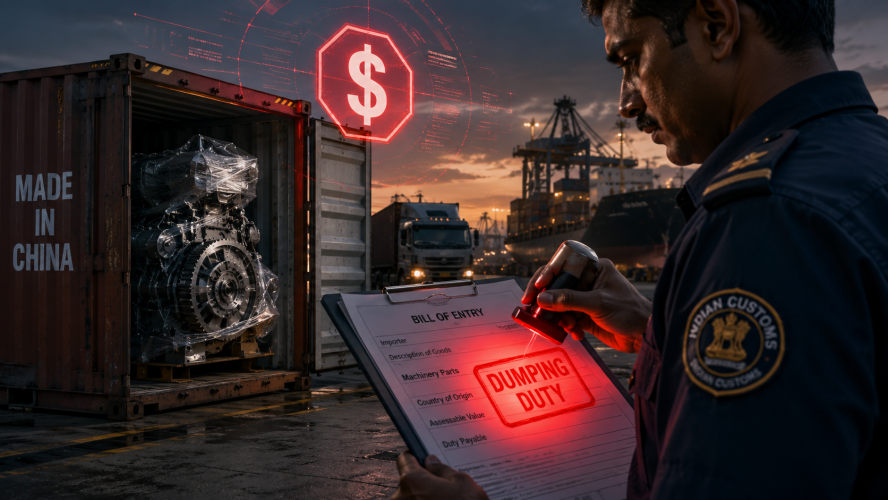
Who is Liable for Sudden Anti-Dumping Duty on Machinery Parts at Indian Ports?
If you run a manufacturing plant, an engineering unit, or a growing industrial enterprise in India, you know that your machinery parts are the literal heart of your business. When an essential component, an automated assembly line asset, or a critical precision tool breaks down or needs scaling, you source it from overseas. You lock in the pricing with a trusted supplier, calculate your standard basic customs duty, pay your 30% advance, and wait for the vessel to land.
Then, your phone rings. It’s your customs broker, and his voice is tense.
Your container of machinery parts has arrived at Nhava Sheva, Mundra, or Chennai port, but it isn’t clearing customs. Overnight, a new notification has rolled out from the Ministry of Finance. Your cargo has been hit with a massive, unexpected Anti-Dumping Duty (ADD) sometimes adding 40% to 100% to the total cost of your invoice.
Suddenly, your profitable business expansion turns into a financial crisis. Your container is stuck, daily port demurrage charges are compounding, and a crucial question flashes through your mind: Who is legally and financially responsible for this sudden bill?
Let’s unpack the harsh realities of the current cross-border trade environment and review the exact roadmap to protect your business from being blindsided at the port entry.
The Reality Check: Who Foot the Bill When ADD Strikes?
Let’s bypass the legal jargon and address the immediate bottom-line answer: The Importer of Record (you, the Indian buyer) is entirely liable for paying any sudden Anti-Dumping Duties at the Indian port.
Many Indian business owners assume that if an anti-dumping notification targets a specific overseas manufacturer or product class, it’s a
dispute between governments, or that the foreign supplier should absorb the cost. This is a highly dangerous misconception.
Indian Customs operates on a strict, immediate legal framework: before a single pallet of commercial cargo can cross the border and clear into your domestic tariff area (DTA), all applicable tariffs, integrated taxes (IGST), and anti-dumping protective duties must be cleared upfront.
If your goods land under standard commercial trade terms such as FOB (Free on Board), CIF (Cost, Insurance, and Freight), or EXW (Ex-Works) the foreign seller’s legal liability ends the moment those goods cross the ship’s rail or leave their factory floor. The financial burden of navigating unexpected custom changes falls completely on your shoulders.
|
🚨 Immediate Commercial Exposure Check
Are your shipping terms exposing you to sudden tax penalties?Don’t let an overnight government notification bleed your profit margins. Message our trade specialists right now with your machinery part specs or HS Code, and let us verify your true customs risk profile. |
The Root Problem: Why Do These Duties Feel So “Sudden”?
To protect domestic industrial ecosystems under the Make in India mandate, the Directorate General of Trade Remedies (DGTR) continuously investigates imports that are suspected of being exported to India at prices below their normal market value.
When these investigations conclude, the Ministry of Finance issues notifications that can go live overnight. What makes machinery parts a prime target for sudden ADD includes:
1. The Dynamic “Catch-All” HS Code Trap
Machinery spare parts, industrial fasteners, bearings, and casting components frequently fall into broad, generic Harmonized System (HS) code classifications. You might assume your specific automated part is exempt, but if customs filters your shipment under a newly restricted broad heading (such as Chapter 73 or 84 items), your cargo is automatically flagged for ADD collection.
2. The Specific Factory Penalty Mismatch
Anti-dumping margins are highly specific. The DGTR often applies lower duty rates to specific, audited overseas factories that cooperative with their investigations, while slapping an aggressive, standard “All Other Exporters” penalty rate (often up to 100%) on any factory not explicitly named in the notification. If your sourcing agent unknowingly routes your order through an unlisted sub-contracted plant, your cargo gets hit with the maximum penalty.
3. The Compounding “Port Demurrage” Penalty
The true threat of a sudden ADD isn’t just the tax rate itself; it’s the element of time. While you spend days arguing with your bank to arrange emergency working capital to clear the sudden duty bill, your shipping line charges you escalating daily container detention and port storage fees. Within a single week, your logistical overhead can easily outcost the value of the machinery parts themselves.
The Solution: Moving from Reactive Panic to Airtight Trade Defense
You cannot control global trade policies or sudden government notifications. However, you can completely insulate your capital by shifting from a reactive strategy to an intentional, pre-shipment protection framework.
Step 1: Push for DDP Contracts (Delivered Duty Paid)
If your machinery components are highly specialized and you want to completely eliminate financial risk, negotiate a DDP (Delivered Duty Paid) contract with your overseas supplier. Under a DDP agreement, the seller assumes 100% of the responsibility, cost, and legal risk of transporting the goods until they arrive directly at your factory gate including paying all sudden customs duties and local port clearance fees. If a sudden anti-dumping duty hits the port, it is legally the supplier’s bill to resolve, not yours.
Step 2: Conduct Pre-Deposit DGTR Ledger Audits
Never wire a 30% or 50% production deposit to an overseas manufacturer based on outdated customs guidance. Before any capital leaves your Indian bank account, map your machinery part’s exact technical specs, raw material composition, and factory origin against the live, active DGTR anti-dumping registries. Determine explicitly whether an active sunset review or a fresh anti-dumping investigation is hovering over that specific product class.
Step 3: Secure an On-Ground Sourcing & Compliance Partner
A traditional freight forwarder simply moves a physical box from Point A to Point B; they do not analyze trade laws or protect your balance sheet. To import industrial assets safely, you need a partner with a deep understanding of customs regulations and real-world infrastructure operating directly where your parts are manufactured and where they land.
| 🛡️ Pre-Shipment Feasibility Audit Ready to map out an airtight, anti-dumping protected import pathway? |
How We Do Import Safeguards Your Industrial Supply Chain
At We Do Import, we don’t believe in logistics guesswork. We bring over 22 years of real-world international trade experience to function as your dedicated end-to-end global sourcing, compliance, and risk mitigation team.
Here is how our framework completely insulates your manufacturing business from unexpected custom liabilities:
-
Pre-Sourcing Compliance Audits: Before you place an order, our expert trade desk conducts a rigorous structural assessment of your machinery components. We cross-verify your target HS codes and check the exact legal factory registration of your overseas supplier to ensure they qualify for the absolute lowest possible duty brackets.
-
Airtight Landed-Cost Transparency: We don’t just quote you a base sea-freight rate. We calculate a comprehensive, transparent Landed Cost Blueprint before your goods leave the factory floor, factoring in active QCO mandates, exact customs classifications, and current trade remedy duties so you know your true margins upfront.
-
On-Ground Technical Verification: Through our deep, cross-border trade networks, we verify that the technical descriptions on your commercial invoices, packing lists, and manufacturing country-of-origin certificates match perfectly. This eliminates the documentation mismatches that trigger manual customs audits and costly port delays.
Don’t let unexpected customs penalties bring your production lines to a sudden halt. Partner with a seasoned industry expert who knows how to predict, manage, and bypass compliance traps completely.
Frequently Asked Questions (FAQ)
To help you secure your trade footprint in an increasingly volatile global landscape, here are explicit, expert answers to the most vital compliance and financial questions being searched by Indian importers right now:
Q1: Who imposes anti-dumping duty in India and how long does it last?
Ans: The Directorate General of Trade Remedies (DGTR), operating under the Ministry of Commerce and Industry, conducts the rigorous trade investigations and recommends the duty. However, the tax is officially imposed and collected by the Department of Revenue under the Ministry of Finance. Once levied, an Anti-Dumping Duty typically remains active for a period of 5 years from the date of its publication, unless extended through a formal “Sunset Review” investigation.
Q2: What is the primary difference between Anti-Dumping Duty and Safeguard Duty?
Ans: While both are trade protective measures, their intent is vastly different. Anti-Dumping Duty targets a specific unfair trade practice it applies when foreign exporters sell goods into India at artificially depressed prices compared to their own domestic market. Safeguard Duty, on the other hand, is a temporary, non-discriminatory tariff applied across an entire product category regardless of origin, used when a sudden, massive surge in import volume threatens to collapse a vulnerable domestic manufacturing sector.
Q3: What documents are required to import machinery and industrial spare parts into India smoothly?
Ans: To clear complex machinery components past customs without triggering audits, your documentation must be flawless. The absolute mandatory paper trail includes:
-
Detailed Commercial Invoice & Packing List (specifying technical grades and raw components)
-
Bill of Lading (BL) or Air Waybill
-
Import Export Code (IEC) Registration
-
Bill of Entry (filed electronically through ICEGATE)
-
Product-Specific Compliance Certificates (such as mandatory BIS or ISI markers under active Quality Control Orders).
Q4: Extended Producer Responsibility (EPR) falls under which act, and does it apply to machinery parts?
Ans: Extended Producer Responsibility (EPR) mandates are governed strictly under the Environment (Protection) Act, 1986, and managed via specific E-Waste, Plastic Waste, and Battery Waste Management Rules. If your imported machinery parts contain electrical sub-assemblies, integrated circuits, digital monitors, or built-in batteries, you are legally classified as a bulk consumer/importer. You must register on the Central Pollution Control Board (CPCB) portal to secure a valid EPR authorization prior to customs clearance.








Leave a Reply