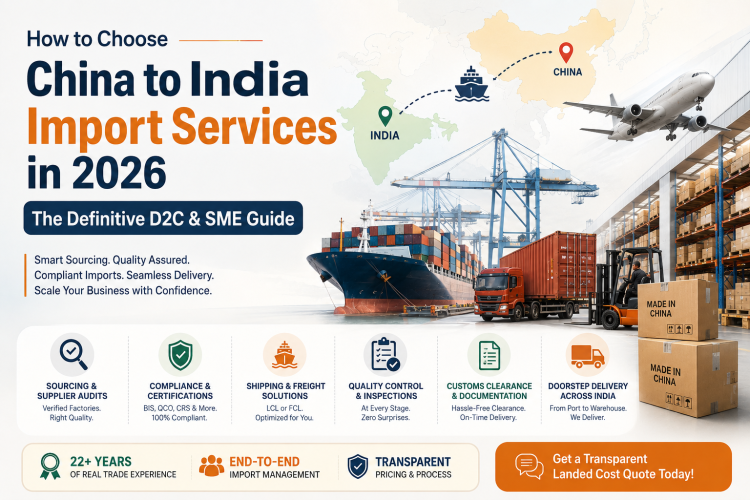
How to Choose China to India Import Services in 2026: The Definitive D2C & SME Guide
The appetite for sourcing from China among Indian Direct-to-Consumer (D2C) brands and small-to-medium enterprises (SMEs) is stronger than ever. Bilateral trade between India and China soared to an all-time high of $155.62 billion, with Chinese exports to India surging by 12.8% to hit $135.87 billion. (Source)
For Indian D2C founders and volume importers, these numbers represent a massive growth opportunity. Sourcing high-margin electronics, lifestyle goods, home decor, and fashion directly from manufacturing hubs like Yiwu, Guangzhou, or Ningbo is the fastest way to scale.
However, importing in 2026 isn’t as simple as clicking “buy” on an online directory. Running headfirst into India’s tightening regulatory environment without an end-to-end strategy is a fast track to severe port demurrage, customs detentions, or ruined product lines.
To achieve successful scaling, it is essential to understand how to assess the comprehensive import services from China to India. This decision-focused guide walks you through every critical bottleneck from factory-floor quality audits to navigating the latest customs policies.
1. Sourcing and Supply Chain Audits: Advancing Beyond Online Directories
The majority of novice importing errors occur well in advance of the cargo arriving at a container. Importers frequently trust a supplier’s verbal or digital confirmation regarding their capability, only to receive mismatched SKUs or defective batches.
When evaluating an import service provider, check if they offer boots-on-the-ground factory verification. Relying entirely on digital communication leaves you vulnerable to trading companies masquerading as primary factories.
Understanding Sourcing Hubs
A professional provider should map your product category to the correct regional manufacturing ecosystem in China:
-
Yiwu: Ideal for fast-moving consumer goods (FMCG), lifestyle products, novelty items, and mixed-SKU, low-Minimum Order Quantity (MOQ) consignments.
-
Guangzhou: The primary hub for mid-to-large consumer goods, apparel, household appliances, and direct factory-level customization.
-
Ningbo and Shenzhen: These are ideally suited for high-volume electronics, components, and heavy freight that necessitate efficient port-side logistics.
An expert management partner like We Do Import ensures that your capital is protected right at the source. Their direct factory-level pre-audits verify active business licenses, production capacity, and historical quality records before you issue an advance wire transfer or Letter of Credit (LC).
Don’t Let Tightening 2026 Regulations Halt Your Inventory
A single mismatched digit or an unverified factory address on your paperwork will trigger heavy automated custom hold-ups at the port. At We Do Import, we proactively build custom compliance roadmaps before your production cycle ever kicks off.
2. The 2026 Compliance Wall: Navigating BIS, QCO, and Customs Requirements
The biggest roadblock for Indian importers this year is compliance. The Directorate General of Foreign Trade (DGFT) and the Bureau of Indian Standards (BIS) have significantly strengthened cross-border enforcement. Treating product certification as an afterthought is no longer viable.
Critical Risk: The list of products requiring mandatory Quality Control Orders (QCOs) expands quarterly. In 2026, everyday commercial furniture, specific lifestyle goods, and consumer appliances face strict mandatory ISI marking constraints.
When choosing an end-to-end import service, ensure they handle the specific regulatory stream required for your catalog:
| Certification Scheme | Target Product Categories | Mandatory Requirements |
| Scheme I (ISI Mark) | Steel, chemicals, machinery, appliances, commercial furniture | Foreign factory audits, intensive pre-shipment product testing. |
| Scheme II (CRS) | Electronics, IT hardware, smart accessories, digital devices | Product sample testing inside NABL-accredited Indian laboratories. |
| Specialist Regulators | Cosmetics, personal care, medical equipment | CDSCO registration, strict chemical formulation clearance. |
The Certificate Mismatch Trap
A common pitfall is using a supplier’s general certificate. A BIS license is strictly tied to a specific factory location, brand, and exact model number. If your supplier shifts your order to a secondary subcontracted facility, or if a model number on the commercial invoice varies by a single digit, Indian Customs’ automated Risk Management System (RMS) will flag and detain the cargo.
Your service provider must run live credential checks via the government’s Manak Online portal. Experienced teams like We Do Import mitigate this risk by executing pre-purchase technical mapping, ensuring every line item on your packing list perfectly aligns with valid Indian standards before shipping.
3. Shipping and Freight Consolidation: LCL vs. FCL Strategies
Maximizing unit economics depends entirely on container utilization. Choosing the wrong freight structure can dilute your margins through unexpected local handling fees.
When evaluating freight providers, analyze their capacity for both major shipping formats:
-
Less than Container Load (LCL): Essential for agile D2C brands running low-MOQ tests on new SKUs. Your provider must operate dedicated consolidation warehouses in China to group your goods with other shipments safely, keeping your per-unit freight cost low.
-
Full Container Load (FCL): Crucial for bulk wholesalers and established brands importing high-volume raw materials or single-category stock. This method offers faster transit times and a lower risk of handling damage.
Your logistics provider should clearly map out the total landed cost structure inclusive of terminal handling charges, documentation fees, and inland transport so you can project your margins accurately before the vessel leaves port.
4. Pre-Shipment Quality Control (QC): Stopping Defects at the Factory Gate
Discovering a 30% defect rate after paying customs duties and hauling containers to an Indian warehouse is a nightmare scenario. At that point, returning defective merchandise to a foreign factory is practically impossible due to reverse-logistics costs and re-export regulations.
A robust import management service eliminates this issue by placing certified inspectors inside the factory during production or packaging.
Key Inspection Touchpoints to Demand:
-
During Production (DUPRO) Audits: Checks material specifications, raw inputs, and initial output consistency early in the manufacturing cycle.
-
Final Random Inspection (FRI): Conducted when at least 80% of the order is packed. Inspectors check dimensions, functional performance, drop-test packaging resilience, and labeling compliance.
-
Container Loading Supervision (CLS): Ensures that boxes are handled correctly, the container is structurally sound, and the actual piece count matches your packing list.
Stop Manufacturing Defect Rates Right At The Factory Gate
Discovering damaged goods at your warehouse in India is a financial disaster. Leveraging 22+ years of localized trade capability, our inspectors systematically audit factories across Yiwu, Guangzhou, and Shenzhen to secure your product standards.
5. Customs Clearance and Last-Mile Delivery: The Final Frontier
The true test of an import service provider lies in their execution at Indian customs ports (such as Nhava Sheva, Chennai, or ICD Sanathnagar/Hyderabad). Minor paperwork errors can lead to expensive storage and demurrage fees.
Your service partner or custom broker must proactively handle:
-
Precise HS Code Classification: Mapping your items to the exact Harmonized System code to determine the correct Basic Customs Duty (BCD), Integrated GST (IGST), and Social Welfare Surcharge (SWS).
-
SWIFT 2.0 Integration: Utilizing the latest customs documentation systems for fast, automated processing.
-
Pre-Arrival Bill of Entry Filing: Submitting documentation before the vessel docks to expedite the transition from port to inland transport.
Once cleared, seamless integration with local transport networks ensures that your cargo moves safely from the port or inland container depot directly to your centralized warehouse or fulfillment centers.
Why Integrated Management Outperforms Fragmented Logistics
Many importers try to piece together their supply chain independently using a freelance sourcing agent in Yiwu, a generic freight forwarder online, and an independent customs broker at the local port. When a delay or compliance dispute inevitably occurs, this fragmented setup often leads to finger-pointing and unresolved issues.
Partnering with an end-to-end service provider offers a clear competitive advantage. By consolidating sourcing, quality control, international logistics, and complex regulatory clearances under a single point of accountability, you protect your capital and streamline your operations.
With over 22 years of real trade experience, We Do Import provides a comprehensive framework designed specifically for Indian D2C brands and bulk buyers. From initial factory audits in China to navigating the latest 2026 BIS regulations and managing final port clearance, their team ensures a transparent, low-risk path to help you successfully scale your import operations.
Ready to Scale Your Import Operations Seamlessly?
Eliminate fragmented channels, endless email delays, and bitter finger-pointing. Experience complete single-point-of-contact accountability—handling every phase from the factory floor to final custom clearing at Nhava Sheva, Chennai, or major ICDs.








Leave a Reply