Why China-India Container Freight Rates Just Doubled
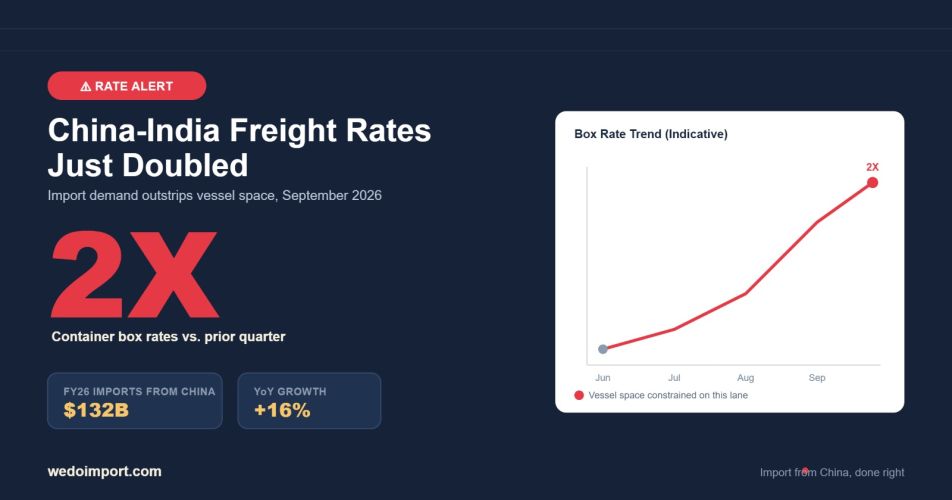
China–India container freight rates have more than doubled since July 2026, as strong import demand competes for available vessel space. For businesses importing from China, the increase is more than a change in shipping prices. It can affect landed cost, inventory planning, booking decisions, and delivery timelines.
If you have a shipment planned in the coming weeks, understanding what’s driving the market and what to check before booking can help you make a more informed decision instead of relying on last quarter’s freight quote.
What’s Actually Happening?
India’s imports from China reached approximately $132 billion in FY2025–26, up 16% year-on-year, making China India’s largest trading partner. Strong demand for Chinese goods, components, and industrial inputs is putting pressure on vessel capacity serving the China–India trade lane.
According to The Loadstar on September 28, 2026, spot rates from Shanghai to JNPA had increased 20% since the end of August, while Shanghai–Chennai rates had risen 25% month-on-month. The publication also reported that China–India spot rates had more than doubled since July, as carriers shifted capacity toward higher-yielding east–west routes.
Seasonal demand ahead of India’s festival period and broader shipping-market uncertainty add to the pressure. The precise impact varies by port pair, carrier, container size, and booking date.
The practical takeaway: A freight quote that was accurate a few months ago may no longer represent the current market. Importers need to reassess both the price and the availability of their intended sailing.
Source: The Loadstar — China–India box rates double as import demand strains vessel space, September 28, 2026.
What Is Driving the Freight-Rate Increase?
Three factors help explain the current pressure on the China–India trade lane.
1. Stronger import demand
India’s growing demand for consumer products, machinery, components, electronics, and industrial inputs supports substantial cargo movement from China. When more businesses are competing for shipping space, available vessel capacity can become harder to secure at previous prices.
2. Vessel capacity allocation
Shipping lines deploy vessel capacity across different routes based on commercial and operational considerations. When carriers allocate more capacity to higher-yielding routes, the remaining space on other services can tighten, even when those routes continue to have strong demand.
3. Seasonal and geopolitical uncertainty
Importers often bring forward orders ahead of major retail and festival periods. At the same time, uncertainty surrounding shipping routes and regional disruptions can influence capacity, sailing schedules, and freight pricing. The effects aren’t identical across all routes, so importers should check the conditions affecting their specific shipment.
The important distinction: Rising rates don’t automatically mean every shipment faces the same increase or that rates will remain elevated for a fixed period. Current quotations and route-specific information are essential.
The Freight Rate Spike Action Checklist
A one-page checklist for planning a shipment during a period of rising freight rates, what to lock in now, what to renegotiate, and the questions to ask your forwarder before you book.
- ✓How to tell if a rate quote is temporary or structural
- ✓Whether to book now or wait, a simple decision framework
- ✓Contract vs. spot rate questions to ask your forwarder
- ✓How rising rates change the FCL vs. LCL breakeven point
What This Means for Your Next Shipment
The freight-rate increase can affect several decisions beyond the shipping line item itself.
1. Your landed-cost calculation may be outdated
If your original estimate used a freight quote from an earlier month, the shipping component may now be materially different. Recalculate the total import cost before confirming the next purchase order.
Consider product cost, freight, insurance, applicable customs duties and taxes, clearance charges, and inland delivery. Don’t assume the change in freight translates into the same percentage change in the total landed cost.
2. Your FCL vs. LCL decision may have changed
A shipment that previously made sense as LCL may need a fresh comparison against FCL when rates move significantly. However, there is no universal CBM threshold that applies to every route and quotation.
Compare the full cost of both options, including consolidation, deconsolidation, destination handling, and any other applicable charges. Transit time and cargo characteristics also matter.
3. Booking availability deserves as much attention as price
When space is tight, a low quotation is not enough on its own. Ask whether the space is confirmed, what sailing is planned, and what happens if the shipment is rolled to a later vessel.
Coordinate cargo readiness with the booking cutoff and factory handover date. Booking earlier may give you more planning time, but it doesn’t guarantee a lower price or a confirmed sailing.
4. Spot and contract rates need to be compared carefully
Spot quotations and contract rates can behave differently when the market moves. Check the pricing basis, validity period, applicable surcharges, and conditions under which the quoted amount can change.
A quotation is only useful for decision-making when you understand exactly what it covers.
The We Do Import 5-Point Freight Decision Check
At We Do Import, we recommend looking at a shipment as a complete decision rather than evaluating ocean freight in isolation. These five checks can help importers structure that review.
1. Rate validity
Is the quotation current? Is it a spot or contract rate? When does it expire, and which charges or conditions could change it?
2. Space and schedule
Is the booking confirmed or still subject to availability? What are the sailing date, cutoff, estimated transit time, and rollover terms?
3. Shipment configuration
Does FCL or LCL fit the actual shipment volume, cargo requirements, and current all-in charges? Have you compared both options where appropriate?
4. Landed-cost impact
What does the revised freight estimate do to the complete import cost, cash requirement, and expected product margin?
5. Delivery and inventory exposure
Does the planned arrival date still work for your sales, production, or replenishment schedule? What is the contingency if the shipment is delayed?
The We Do Import takeaway: Don’t evaluate a freight quote in isolation. Evaluate the shipment decision.
How a Freight Increase Can Change Your Landed Cost
Consider a hypothetical import shipment with the following costs:
| Cost component | Earlier estimate | Revised estimate |
|---|---|---|
| Product and other import costs, excluding freight | ₹5,00,000 | ₹5,00,000 |
| Freight | ₹50,000 | ₹1,00,000 |
| Total | ₹5,50,000 | ₹6,00,000 |
In this illustration, freight doubles from ₹50,000 to ₹1,00,000, but the total increases by approximately 9.1%, not 100%.
This distinction matters because the impact of a freight increase depends on the proportion of total cost represented by freight. A business working with thin product margins or high freight exposure may need to review its pricing, order quantity, or replenishment plan.
Illustrative calculation only. These are not current market rates or an actual We Do Import customer shipment.
Questions to Ask Your Freight Forwarder Before Booking
Before approving your shipment, make sure you have clear answers to these questions:
- Is the quotation based on spot or contract pricing?
- How long is the quotation valid?
- Is vessel space confirmed?
- Which origin and destination charges are included?
- Are there any applicable surcharges or exclusions?
- What are the sailing date, cutoff, and estimated transit time?
- What happens if the cargo is rolled or the schedule changes?
- Does the quotation cover inland delivery, or is that priced separately?
Ask for the final scope and relevant booking terms in writing. This makes it easy to check and compare offers on a like-for-like basis.
Frequently Asked Questions
Why have China–India container freight rates doubled?
According to The Loadstar‘s September 28, 2026 report, strong demand for vessel space from China to India and the allocation of capacity toward higher-yielding routes have contributed to the increase. Seasonal demand and wider shipping-market uncertainty can also influence pricing and availability.
Should I delay my shipment until freight rates come down?
There is no guaranteed answer. Freight rates can change with demand, capacity deployment, and market conditions. Compare the cost of waiting against your cargo readiness, inventory needs, booking options, and the validity of the available quotations. Don’t assume that delaying will automatically produce a lower total cost.
Does the rate increase affect FCL and LCL equally?
Not necessarily. Pricing structures, route availability, consolidation arrangements, and surcharges can differ. Request comparable, current quotations for both options where appropriate and compare the complete cost and delivery implications.
How can I avoid unexpected freight costs?
Ask for an itemized quotation, confirm what is included and excluded, check the rate validity and applicable surcharges, and review the booking and destination charges before committing. Then incorporate the verified figures into your landed-cost estimate.
What should I check before importing from China to India?
Start with the product and shipment details, supplier readiness, cargo volume and weight, required compliance, current freight quotations, vessel space, shipping documents, and the complete landed cost. Customs clearance and inland delivery should be considered separately from port-to-port transit.
Final Takeaway: Plan the Shipment, Not Just the Freight
A higher freight rate can affect more than your shipping budget. It can influence your shipment configuration, delivery schedule, landed cost, and inventory decisions.
The practical response is to refresh your quotations, verify vessel space, compare the actual FCL and LCL options, and review the complete cost before confirming your booking.
Planning a shipment from China to India? Share your cargo volume, origin, destination, and expected booking date with We Do Import. Our team can help you understand the sourcing and import-planning considerations involved.










Leave a Reply