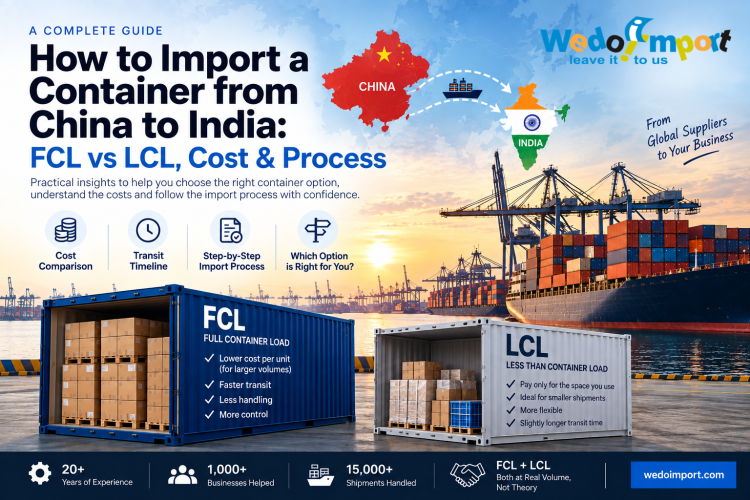
How to Import a Container from China to India: FCL vs LCL, Cost & Process
If you’re importing from China and wondering whether to book a full container or share one, the answer usually comes down to one number: your shipment’s volume in cubic meters (CBM). Below roughly 12-15 CBM, sharing a container (LCL) is typically cheaper. Above that, a full container (FCL) usually becomes both cheaper per unit and faster. Here’s exactly how that decision works, backed by live freight data and patterns from 20+ years of doing this, not a single generic rule of thumb.
20+years importing from China to India
1,000+businesses helped
15,000+real shipments handled
FCL + LCLboth booked at real volume, not theory
Quick Answer: FCL or LCL?
| FCL (Full Container Load) | LCL (Less than Container Load) | |
|---|---|---|
| Best for | Shipments above ~12-15 CBM | Shipments below ~12-15 CBM, samples, smaller orders |
| Cost structure | Flat rate for the whole container, cheaper per unit at volume | Charged per CBM, you only pay for the space you use |
| Typical port-to-port transit | 12-25 days | 15-30+ days (consolidation and deconsolidation add time) |
| 2026 note | Getting priority unloading at several major Indian ports | Rates have grown more volatile due to surcharge increases |
Rates and transit times below are indicative ranges compiled from multiple freight sources and fluctuate by port, carrier, season, and current geopolitical shipping conditions. Always confirm a live quote before finalizing your shipping budget, freight pricing can shift meaningfully within just a few weeks.
Live Trade Lane Data: What’s Actually Moving Right Now
Beyond static freight quotes, tracked shipping data gives a clearer real-time picture: as of late February 2026, the China-to-India lane was moving roughly 135,200 TEU per month, with typical port-to-port transit around 19.2 days, and China accounting for 87% of tracked two-way container volume on this specific lane. Numbers like this shift week to week, but they confirm what we see operationally: this remains one of the highest-volume, most actively tracked shipping corridors in global trade, which is also exactly why rate volatility on it gets noticed and reported quickly.
Source: Cogoport — China to India Trade Lane Intelligence, data refreshed February 2026.
What Container Shipping Actually Costs in 2026
| Mode | Typical Range | What’s Included |
|---|---|---|
| 20ft FCL container | Roughly $1,000-$2,500 | Ocean freight only, port/destination charges and inland delivery add $250-500 more |
| 40ft FCL container | Roughly $1,800-$3,000 | Same as above, scales with container size |
| LCL (per CBM) | Roughly $30-$100/CBM | Base ocean freight, consolidation (China) and deconsolidation (India) fees are separate and can meaningfully affect your final cost |
Source: SeaAirCargoSystems — China to India Freight Rates 2026, DocShipper — Freight China-India 2026, Sino-Shipping — Shipping from China to India, August 2026.
Why the ranges are wide: freight rates on this lane have been genuinely volatile in 2026, driven by geopolitical shipping disruptions (Red Sea and Strait of Hormuz routing changes) and seasonal demand swings. A quote that was accurate in June can be meaningfully out of date by September. Treat any number you see online, including the ranges above, as a starting point for budgeting, not a locked-in price.
✓ Shipping timeline ✓ Freight questions
How to Actually Book and Import a Container: Step by Step
- Calculate your shipment’s CBM and weight. This single number drives almost every decision that follows, container type, cost, and whether FCL or LCL makes sense.
- Get quotes from at least two or three freight forwarders, and confirm exactly what’s included, ocean freight, origin charges, destination handling, and inland delivery are often quoted separately even when a single number is advertised.
- Confirm your HS code and any required compliance certification before booking, not after. If your product needs BIS, WPC, or EPR registration, that needs to be sorted independently of the shipping timeline. See our guides on BIS vs. ISI vs. WPC and EPR registration if you’re unsure what applies.
- Book your container and confirm the sailing schedule. For FCL, this means reserving the full container; for LCL, your cargo is consolidated with other shippers’ goods at an origin warehouse before loading.
- Prepare your documentation: commercial invoice, packing list, Bill of Lading, and Bill of Entry for customs filing on arrival.
- Track the shipment and plan for customs clearance on arrival. Port-to-port transit is only part of the timeline, factor in customs processing and inland delivery to your final destination separately. See our full customs clearance guide for what that stage actually involves.
What 15,000+ Shipments Have Taught Us:
At We Do Import, we’ve booked both FCL and LCL at real commercial volume for over two decades, and the most common costly mistake we see isn’t choosing FCL when LCL would’ve worked, or vice versa, it’s underestimating the “extra” charges beyond the headline freight rate. Origin consolidation fees, destination deconsolidation charges, and inland delivery routinely add hundreds of dollars that a quick online freight quote doesn’t include, and we see this catch out even experienced importers who’ve shipped dozens of times before. Our take: always ask for a complete landed cost estimate before you book, not just the ocean freight number, since that number alone rarely reflects what you’ll actually pay.
FCL vs LCL: A Simple Way to Decide
Choose FCL if: your shipment is above roughly 12-15 CBM, you want faster and more predictable transit, or your cargo is high-value enough that you’d rather not share container space with other shippers’ goods.
Choose LCL if: you’re placing a smaller or trial order, testing a new product line, or your total volume genuinely doesn’t justify a full container’s cost, even accounting for LCL’s per-CBM premium.
The honest middle ground: if your shipment sits close to the 12-15 CBM breakeven point, get quotes for both options before deciding. The right answer depends on current rates on your specific route, which shift often enough that a rule of thumb alone isn’t always reliable.
Our broader take, after 15,000+ shipments: the businesses that get shipping decisions right consistently aren’t the ones with a fixed rule for FCL vs. LCL, they’re the ones who re-check the numbers on every meaningful order instead of assuming last quarter’s answer still holds. Freight is one of the few line items in an import business where yesterday’s right decision can quietly become today’s expensive one, and the businesses that treat it that way are usually the ones with the healthiest margins a year later.
Frequently Asked Questions
How long does it take to import a container from China to India?
Port-to-port transit typically runs 12-25 days depending on the specific route and ports involved, though door-to-door timing (including customs clearance and inland delivery) commonly extends total transit to 20-30+ days. Build in a buffer, especially during monsoon season or peak shipping periods.
Is FCL or LCL cheaper for importing from China to India?
It depends on your shipment volume. Below roughly 12-15 CBM, LCL is typically cheaper since you only pay for the space you use. Above that threshold, FCL usually becomes more cost-effective per unit, since you’re paying a flat rate regardless of how full the container is.
What documents do I need to book a container from China?
At minimum: a commercial invoice, packing list, and booking confirmation with your freight forwarder. For customs clearance on the India side, you’ll also need a Bill of Lading and will file a Bill of Entry, plus any product-specific compliance certificates (BIS, WPC, EPR) your goods require.
Why do container shipping rates from China to India vary so much between sources?
Freight rates on this lane have been genuinely volatile in 2026 due to geopolitical shipping disruptions and seasonal demand changes. A rate that was accurate a few weeks ago can shift meaningfully, always confirm a current quote rather than relying on a published number for budgeting.
Not sure whether FCL or LCL fits your shipment, or want a realistic landed cost estimate before you book? Message us on WhatsApp with your shipment volume and we’ll help you decide.










Leave a Reply