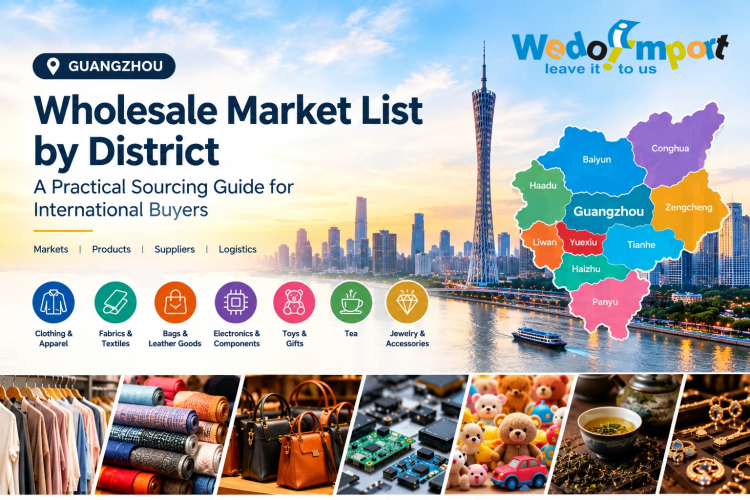
Guangzhou Wholesale Market List District-by-District Guide: Which Area Is Best for Your Product?
Guangzhou Wholesale Market List by District: A Practical Sourcing Guide for International Buyers
If you are planning to source products from Guangzhou, there is one mistake that can waste more time than almost anything else:
Treating Guangzhou as if it has one wholesale market.
It doesn’t.
Guangzhou’s wholesale trade is spread across specialized market clusters and commercial districts. Clothing, fabrics, leather goods, accessories, electronics, jewelry, toys, tea and other product categories tend to concentrate in different parts of the city.
That creates a practical problem for international buyers.
You may know exactly what you want to buy, but still have no idea:
- Which Guangzhou district should you visit?
- Which market is appropriate for your product?
- Should you compare several markets or go directly to suppliers?
- Is a wholesale market better than a factory for your order?
- How do you verify a supplier after finding one?
- What happens after you agree on the product and price?
This guide is designed to address those questions.
At We Do Import | Your Global Sourcing & Trade Partner, we look at Guangzhou sourcing from a wider perspective: product → supplier → order → quality → logistics → destination country.
So instead of simply giving you a list of markets, let’s look at Guangzhou district by district and product by product.
Guangzhou Wholesale Markets at a Glance
Before getting into individual districts, here is the quick version.
| Your Product / Requirement | Area to Explore | Why It Matters |
|---|---|---|
| Fashion & ready-to-wear clothing | Yuexiu / Liwan / Tianhe | Large concentration of apparel wholesalers |
| Fast-fashion clothing | Shisanhang / Shahe | Wide variety and competitive wholesale options |
| Fabrics & textiles | Haizhu / Zhongda | One of Guangzhou’s major textile sourcing clusters |
| Garment accessories & trims | Zhongda / Haizhu | Useful for private-label and garment production |
| Bags & leather goods | Baiyun / Sanyuanli / Guihuagang | Strong concentration of leather and bag wholesalers |
| Jewelry & fashion accessories | Liwan / Yuexiu | Large range of accessories and small goods |
| Toys & gifts | Liwan / Yide Road area | Useful for gift, novelty and small-product sourcing |
| Electronics & components | Tianhe / Gangding and other electronics areas | Electronics-focused commercial clusters |
| Tea | Fangcun | Major tea trading area |
| Budget clothing | Tianhe / Shahe | Large selection aimed at price-sensitive buyers |
Important: These are sourcing clusters, not strict boundaries. Guangzhou’s wholesale ecosystem is large and constantly changing, so the right district depends on your exact product, quantity, target price and sourcing model.
And that brings us to the first important distinction.
1. Yuexiu District: Start Here for Clothing, Fashion and Apparel Sourcing
If your sourcing requirement involves fashion clothing, ready-to-wear apparel, footwear or fashion accessories, Yuexiu is one of the most important areas to understand.
The area around Guangzhou Railway Station and the surrounding commercial streets contains numerous wholesale buildings and markets.
Some well-known names include:
- Baima Clothing Market
- Hongmian International Fashion City
- Liuhua-related wholesale markets
- Zhanxi commercial areas
- Other clothing and accessory wholesalers around the railway-station district
Why buyers come here
The biggest advantage is supplier density.
Instead of dealing with one supplier, you can compare multiple sellers offering similar products, different quality levels and different price points.
That makes Yuexiu particularly useful when you are:
- Comparing product quality
- Looking for different styles
- Testing several suppliers
- Building a new product range
- Looking for ready-stock products
- Trying to understand the market before placing a larger order
The sourcing lesson
Don’t assume the cheapest quote is the best deal.
Two suppliers can show you visually similar products while using different:
- Materials
- Stitching
- Hardware
- Packaging
- Finishing
- Production standards
For international buyers, the landed cost and repeatability of the product matter more than the first price you hear.
|
Apparel & Fashion Sourcing Desk Sourcing Clothing Across Baima, Shisanhang, or Shahe?Navigating hundreds of garment stalls can quickly become exhausting. Send us your target styles, fabric requirements, and order size—our team will connect you directly with audited apparel manufacturers. |
2. Liwan District: Shisanhang, Accessories, Jewelry, Gifts and More
Liwan is another important commercial area for international sourcing.
The Shisanhang area is particularly associated with clothing and fashion wholesale, while other parts of Liwan connect to jewelry, accessories, gifts and small commodities.
Shisanhang: Fast-Fashion Focus
If your business depends on:
- Fast-moving fashion
- Trend-driven apparel
- Women’s clothing
- Smaller fashion collections
- Frequent product rotation
Shisanhang can be worth exploring.
The model here can be very different from sourcing directly from a manufacturer.
You may find suppliers offering:
- Ready-stock products
- Existing designs
- Smaller quantities
- Multiple styles
- Rapidly changing collections
This can be attractive for retailers, online sellers and businesses testing new products.
But there is a catch
A wholesale-market supplier may not necessarily be the manufacturer.
That distinction becomes important when you want:
- Custom designs
- Private labeling
- Custom packaging
- Consistent repeat production
- Specific materials
- Larger recurring orders
Finding a product is just the first step.
Finding out who actually produces it is where sourcing expertise becomes valuable.
3. Haizhu District: Zhongda for Fabrics, Textiles and Garment Accessories
If your requirement is related to fabric, textiles, garment materials or accessories, Haizhu’s Zhongda area deserves special attention.
Zhongda is not simply one building that you walk into and finish your sourcing in an hour.
It is one of the large textile and fabric market cluster.
This distinction matters.
You can spend considerable time comparing:
- Fabrics
- Colors
- Patterns
- Materials
- Trims
- Buttons
- Zippers
- Labels
- Garment accessories
- Related production materials
Who should consider Zhongda?
This area can be particularly useful for:
- Clothing brands
- Fashion designers
- Private-label businesses
- Apparel manufacturers
- D2C brands
- Exporters
- Businesses developing custom garments
The bigger opportunity
If you are developing a private-label clothing line, your sourcing process shouldn’t stop at:
“I found a fabric supplier.”
You also need to consider:
Fabric → trims → garment production → sampling → quality inspection → packaging → shipping
That is where a market visit can evolve into a complete sourcing project.
|
Zhongda Textile Support Need Fabric Swatches from Zhongda Without Flying to China?Send us your target fabric compositions, GSM, and reference images. Our ground team in Haizhu collects swatch cards, negotiates roll rates, and couriers them straight to your office. |
4. Baiyun District: Bags, Leather Goods and Fashion Accessories
Baiyun is particularly relevant if your business involves:
- Handbags
- Backpacks
- Wallets
- Luggage
- Leather goods
- Fashion accessories
- Selected beauty-related products
Areas around Sanyuanli and Guihuagang are well known among buyers looking for bags and leather-related products.
Why this area is useful
One of the major benefits of a specialized wholesale cluster is comparison.
You can compare suppliers based on:
- Material
- Construction
- Hardware
- Stitching
- Finishing
- Packaging
- MOQ
- Branding options
- Price
For a first-time buyer, however, there is another challenge.
Product quality is not always obvious from the showroom
A sample displayed in a market can look excellent.
That doesn’t automatically tell you:
- How the bulk production will look
- Whether the same material will be used
- Whether the supplier can maintain consistency
- Whether the supplier can meet your required quantity
- Whether the supplier actually controls production
This is why sample approval and production quality control should be treated as separate steps.
5. Tianhe District: Shahe for Budget Fashion and Gangding for Electronics
Tianhe offers another important sourcing combination.
Shahe: Price-Sensitive Fashion
The Shahe clothing market area is particularly relevant for buyers searching for:
- Budget clothing
- Fast fashion
- High-volume styles
- Price-sensitive products
- Ready-to-sell apparel
The appeal is straightforward:
Large selection + competitive pricing + high supplier density.
But the same rule applies:
Low purchase price does not automatically mean low landed cost.
Your actual cost can change after considering:
- Packaging
- Domestic transportation
- Freight
- Customs
- Duties/taxes
- Inspection
- Warehousing
- Destination-country compliance
For international buyers, comparing suppliers only on the quoted unit price can produce a misleading margin calculation.
Gangding: Electronics and Technology-Related Sourcing
Gangding is known as an important electronics commercial area in Guangzhou.
For electronics buyers, the sourcing process requires additional caution.
You may need to verify:
- Product specifications
- Components
- Certifications
- Compatibility
- Warranty terms
- Packaging
- Branding
- Testing requirements
- Destination-country regulations
For regulated or technical products, supplier verification and compliance checks become even more important than finding a low price.
|
Electronics & Compliance Advisory Sourcing Electronics? Avoid Customs Seizures & Compliance PitfallsElectronics require rigorous testing, component vetting, and mandatory certifications before they can enter your destination country. Let our compliance team review your product specs first. |
6. Fangcun: Tea and Tea-Related Sourcing
If tea is your product category, Fangcun is one of the Guangzhou areas worth researching.
The area is associated with tea trading and wholesale.
International buyers should look beyond simply asking:
“How much does this tea cost?”
You may also need to understand:
- Tea origin
- Grade
- Harvest information
- Packaging
- Storage
- Private labeling
- Export requirements
- Destination-country food regulations
The same principle applies across Guangzhou:
A wholesale market can help you discover suppliers, but it doesn’t eliminate the need for due diligence.
7. Yide Road Area: Toys, Gifts and Small Commodities
The Yide Road area is associated with wholesale trading in toys, gifts, decorations and various small commodities.
This can be useful for buyers who are:
- Testing products
- Building gift ranges
- Sourcing novelty products
- Looking for small consumer goods
- Developing seasonal collections
However, if your requirement involves custom manufacturing, don’t automatically assume the market supplier is your final supplier.
Use the market to understand:
What’s available → What’s selling → What price range exists → Who can supply it → Who actually manufactures it
That last question can completely change your sourcing strategy.
8. Don’t Choose a Guangzhou District Only by Product
This is one of the most important points for international buyers.
Suppose you want to source backpacks.
You find a suitable supplier in a wholesale market.
The obvious conclusion is:
“I’ve found my supplier.”
But that’s not necessarily true.
You first need to understand your order.
If you need 50 pieces
A market wholesaler with ready stock may be more practical.
If you need 500 pieces
You may need to compare wholesale suppliers with manufacturers.
If you need 5,000 pieces
Direct factory sourcing may become considerably more important.
If you need your own logo and packaging
You need to investigate customization and private-label capability.
If you need the same product every month
Production consistency and supplier capacity become critical.
This is why the correct sourcing question isn’t simply:
“Which Guangzhou market sells my product?”
It is:
“Which sourcing route makes sense for my product, quantity, quality requirement and long-term business model?”
That is a much better question.
|
Free Field Resource Walking the Guangzhou Markets Soon?Get our pocket-sized Guangzhou Sourcing Field Pass & Evaluation Matrix delivered straight to your WhatsApp. Includes district transit cheat sheets, stall-screening scripts, and 3-vendor scorecards. |
9. Guangzhou Wholesale Market vs Factory: Which One Should You Choose?
Here’s a simple way to think about it.
| Requirement | Wholesale Market | Direct Factory |
|---|---|---|
| Small quantity | ✅ Often easier | ⚠️ May be difficult |
| Ready-stock products | ✅ Strong advantage | ⚠️ Depends |
| Many styles | ✅ Excellent | ❌ Usually limited |
| Product comparison | ✅ Excellent | ⚠️ One supplier at a time |
| Custom product | ⚠️ Limited | ✅ Better |
| Private labeling | ⚠️ Supplier dependent | ✅ Usually better |
| Large repeat orders | ⚠️ Depends | ✅ Often better |
| Production control | ⚠️ Need verification | ✅ Potentially better |
| Lowest possible factory price | ❌ Not always | ✅ Potential advantage |
But there is no universal answer.
An experienced sourcing process often uses both.
A market can help you understand products and suppliers.
Factory sourcing can then help you develop the right product for larger or recurring orders.
10. The Biggest Mistake International Buyers Make in Guangzhou
Many first-time buyers focus heavily on the market visit.
They plan:
Day 1 → Visit market → Find product → Negotiate price → Place order
That sounds simple.
Real sourcing rarely works that way.
A stronger process looks more like:
Product requirement
↓
Market / supplier discovery
↓
Supplier screening
↓
Sample evaluation
↓
Price + MOQ negotiation
↓
Supplier verification
↓
Production
↓
Quality inspection
↓
Consolidation / warehousing
↓
International shipping
↓
Customs & destination delivery
The market is only one part of that chain.
And this is where many sourcing problems begin.
11. Before You Contact a Guangzhou Supplier, Prepare These 7 Things
You don’t need to know everything before starting.
But having these basics ready can dramatically improve your supplier conversations.
1. Product specification
What exactly are you looking for?
Include:
- Dimensions
- Material
- Color
- Design
- Features
- Packaging
- Reference images
2. Target quantity
Don’t simply say:
“I need a good price.”
Tell suppliers your expected quantity.
3. Target quality
Define what “good quality” means for your business.
4. Customization requirements
Do you need:
- Logo?
- Packaging?
- Label?
- Color customization?
- Product modification?
5. Target destination
A supplier quote means little until you know where the goods are going.
Shipping to the US, UK, Europe, Middle East, Africa or another market can produce very different landed costs and compliance requirements.
6. Target timeline
Tell suppliers when you need the goods.
7. Your actual business model
Are you:
- Testing a new product?
- Running an e-commerce store?
- Building a D2C brand?
- Supplying retail stores?
- Importing regularly?
- Developing private-label products?
The answer can change the best sourcing route.
12. Don’t Compare Suppliers on Unit Price Alone
This is one of the most expensive sourcing mistakes.
Imagine Supplier A quotes:
$5.00
Supplier B quotes:
$5.40
At first glance, Supplier A wins.
But what happens if Supplier A has:
- Higher defect rates
- Poorer packaging
- Higher MOQ
- Longer production time
- More expensive domestic transportation
- Less reliable communication
Supplier B may actually be cheaper after the complete sourcing process.
That’s why experienced buyers think in terms of:
Landed Cost
Product Cost + Packaging + Local Logistics + Freight + Duties/Taxes + Inspection + Other Import Costs
The supplier’s initial quote is only one component.
|
Cost Audit Desk Calculate Your Real Landed Cost Before You Wire Any DepositDon’t base business margins on Ex-Works stall quotes alone. Send us your target product, estimated volume, and destination, and our trade desk will calculate duty tiers, consolidation freight, and inspection costs. |
13. Supplier Verification: The Step You Shouldn’t Skip
A polished showroom does not automatically mean you are dealing with a reliable manufacturer.
Before placing a significant order, consider checking:
- Business registration
- Actual company identity
- Factory capability
- Product specialization
- Export experience
- Production capacity
- Quality systems
- Certifications where relevant
- Bank/payment details
- References or trading history
- Sample consistency
And if the order value is significant, consider independent quality inspection before shipment.
The goal isn’t to make sourcing complicated.
The goal is to prevent an expensive mistake.
|
Supplier Due Diligence Found a Supplier at the Market, But Not Sure Who Actually Owns the Factory?Send a photo of the vendor’s stall card or business license directly to our desk on WhatsApp. Our ground team cross-checks registered records and factory history before you commit funds. |
14. What Should You Do After Finding a Supplier in Guangzhou?
This is where many first-time importers get stuck.
You’ve found the supplier.
You’ve negotiated the price.
You’ve received a sample.
Now what?
A professional sourcing workflow should answer:
Who verifies the supplier?
Who confirms the specifications?
Who follows production?
Who checks quality?
Where are the goods consolidated?
How will they be shipped?
What import requirements apply in the destination country?
Who handles problems if something goes wrong?
These questions become especially important when sourcing internationally.
15. A Better Way to Plan Your Guangzhou Sourcing Trip
Instead of randomly visiting markets, build your trip around your sourcing objective.
Step 1 — Define your product
Be specific.
Step 2 — Identify the relevant district
Use the product-to-district mapping in this guide.
Step 3 — Shortlist suppliers
Don’t commit to the first supplier you meet.
Step 4 — Compare samples and specifications
Look beyond appearance.
Step 5 — Verify the supplier
Confirm who you are actually buying from.
Step 6 — Decide whether market or factory sourcing is better
Your MOQ and business model matter.
Step 7 — Calculate landed cost
Don’t build your business margin from FOB or supplier price alone.
Step 8 — Establish quality control
Agree on what will be inspected before production and shipment.
Step 9 — Plan logistics
Consolidation and international freight can materially affect your final cost.
Step 10 — Think beyond the first shipment
A good supplier should ideally support your next order, not just your first order.
16. Quick Guangzhou District Cheat Sheet
If you only want to remember one section from this guide, remember this:
Looking for clothing?
Start with Yuexiu, Liwan/Shisanhang or Tianhe/Shahe depending on your price and product positioning.
Looking for fabrics?
Explore Haizhu/Zhongda.
Looking for bags and leather goods?
Explore Baiyun/Sanyuanli/Guihuagang.
Looking for jewelry and accessories?
Explore Liwan and relevant Yuexiu commercial areas.
Looking for electronics?
Explore Tianhe/Gangding and specialized electronics markets.
Looking for tea?
Explore Fangcun.
Looking for toys, gifts and small commodities?
Explore Yide Road and surrounding wholesale areas.
But remember:
The best district is not necessarily the district with the cheapest supplier.
It is the district—and ultimately the sourcing route—that best fits your product, MOQ, quality expectations, customization needs and long-term business model.
17. The International Buyer Checklist
Before placing your first Guangzhou sourcing order, ask yourself:
☐ Have I clearly defined the product?
☐ Do I know my target quantity?
☐ Have I compared multiple suppliers?
☐ Have I confirmed whether the supplier is a manufacturer or trading company?
☐ Have I approved a sample?
☐ Have I documented product specifications?
☐ Have I negotiated MOQ and payment terms?
☐ Have I verified the supplier?
☐ Have I calculated landed cost?
☐ Have I checked destination-country compliance requirements?
☐ Do I have a quality inspection plan?
☐ Do I know how the goods will be consolidated and shipped?
☐ Do I have a plan if the shipment doesn’t meet specifications?
If several boxes are still unchecked, you may not be ready to place the order yet—and that’s okay.
Good sourcing is about reducing uncertainty before money and inventory are committed.
18. Want to Source From Guangzhou but Don’t Know Where to Start?
This is where the difference between finding a supplier and building a reliable supply chain becomes important.
You don’t need to arrive in Guangzhou already knowing:
- Which market to visit
- Which supplier to choose
- What MOQ to negotiate
- How to verify the supplier
- How to inspect the order
- How to consolidate shipments
- How to arrange international logistics
You can start with the product.
At We Do Import | Your Global Sourcing & Trade Partner, we help businesses approach China sourcing as a complete process from identifying reliable suppliers to coordinating the steps required to move products toward their destination market.
Whether you’re a startup testing its first product, an established e-commerce brand expanding its product line, a retailer looking for new suppliers, or an international business building a recurring supply chain, the right sourcing strategy starts with understanding your requirements.
|
We Do Import • Global Sourcing & Trade Partner Turn Your Guangzhou Sourcing Into a Complete, Hassle-Free Supply ChainFrom multi-stall cargo consolidation and factory vetting to AQL quality checks, export customs, and door-to-door delivery—connect directly with our operations desk. Connect on WhatsApp with a Sourcing Specialist → ✓ Multi-Stall Cargo Consolidation | ✓ Factory Verification | ✓ Pre-Shipment QC | ✓ Destination Delivery |
Frequently Asked Questions
What is the best wholesale market in Guangzhou?
There is no single best wholesale market for every buyer. Guangzhou’s wholesale ecosystem is organized around specialized commercial areas, so the best market depends on your product category, quantity, quality requirements and sourcing model.
Which Guangzhou district is best for clothing?
Yuexiu, Liwan/Shisanhang and Tianhe/Shahe are important clothing sourcing areas, but the best option depends on whether you need higher-end fashion, fast fashion, budget clothing, ready stock or customized production.
Where can I source fabric in Guangzhou?
Haizhu’s Zhongda area is one of the major fabric and textile sourcing clusters in Guangzhou and is particularly relevant for apparel and private-label businesses.
Where can I source bags and leather goods?
Baiyun, Sanyuanli and Guihuagang are important areas to investigate for bags, leather goods and related products.
Is Guangzhou better than buying from Alibaba?
Not necessarily. Guangzhou markets provide a physical sourcing environment where buyers can compare products and suppliers directly. Online platforms can provide broader supplier discovery. The right approach depends on your product, MOQ, customization requirements and sourcing strategy.
Can I source directly from a Guangzhou factory?
Yes, but finding a factory is different from finding a market supplier. If you need custom manufacturing, private labeling or recurring large-volume production, factory sourcing may be more appropriate.
Do I need to visit Guangzhou personally to source products?
Not always. International buyers can work with sourcing partners who can identify suppliers, coordinate samples, manage production follow-up and arrange quality inspection and logistics support.
What should I check before ordering from a Guangzhou supplier?
At minimum, verify the supplier’s identity and capabilities, confirm specifications and samples, understand MOQ and payment terms, calculate your landed cost and establish an appropriate quality-control process.
Final Takeaway
Guangzhou is not one wholesale market.
It is a network of specialized sourcing districts, and choosing the right area can make your sourcing process faster and more productive.
But the bigger lesson is this:
Finding a product is not the same as building a reliable supply chain.
The real sourcing journey continues from:
Market → Supplier → Sample → Production → Quality Control → Consolidation → Shipping → Destination
That’s why experienced international buyers don’t ask only:
“Where can I buy this product?”
They ask:
“Who can supply this product consistently, at the required quality and cost, and help me build a reliable supply chain?”
That is the difference between simply buying from China and building a sustainable sourcing operation.
We Do Import | Your Global Sourcing & Trade Partner
If you know what you want to source but aren’t sure where to begin, tell us your product, quantity and destination country.
Your next supplier could be in Guangzhou. The right sourcing strategy is what gets you there.




Leave a Reply