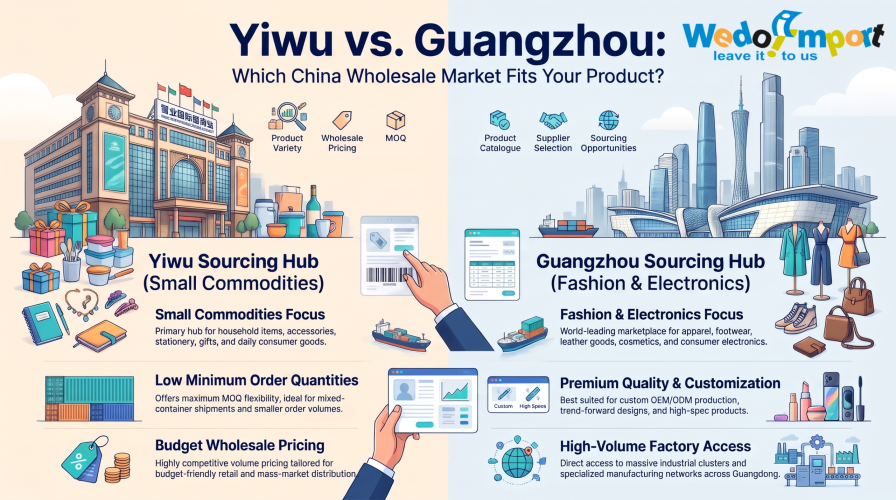
Yiwu vs. Guangzhou: Which China Wholesale Market Fits Your Product?
Choosing between Yiwu and Guangzhou can significantly affect your product selection, supplier options, sourcing costs and purchasing experience. Both are major wholesale destinations in China, but they serve different sourcing needs.
Yiwu is particularly well known for small commodities, accessories, household products, gifts, stationery, toys and everyday consumer goods. Guangzhou, on the other hand, has specialised wholesale districts for clothing, fabrics, footwear, leather goods, cosmetics, electronics and several other product categories.
So, which one should you visit? And more importantly, which market is better suited to your business?
The answer depends on what you want to import, how much you intend to purchase, whether you need custom manufacturing and how you plan to manage quality and logistics.
In this guide, we compare Yiwu and Guangzhou across 10 important factors, including product categories, wholesale market locations, supplier types, MOQ, pricing, sourcing opportunities and common mistakes to avoid.
Let’s break it down.
1. Yiwu vs. Guangzhou: What Is the Actual Difference?
Before comparing individual products and markets, it is important to understand how these two sourcing destinations operate.
What makes Yiwu a popular wholesale destination?
Yiwu, located in Zhejiang Province, is internationally recognised for its large small-commodity wholesale ecosystem.
Its main attraction is the Yiwu International Trade Market, also known as Yiwu International Trade City.
According to a March 2026 report published by the Zhejiang provincial government, the market hosts nearly 80,000 booths and offers more than 2.1 million types of goods, serving buyers from 233 countries and regions.
The market is particularly useful for buyers looking to explore multiple product categories in one destination.
Common categories include:
- Artificial flowers and decorative products
- Jewellery, accessories and fashion ornaments
- Toys and gift items
- Stationery and office supplies
- Household and kitchen products
- Bags, luggage and travel accessories
- Hardware, tools and everyday utility products
- Festival and seasonal decorations
Yiwu is especially attractive to wholesalers, retailers, distributors, e-commerce sellers and businesses looking to source a broad selection of consumer goods.
What makes Guangzhou a popular wholesale destination?
Guangzhou, the capital of Guangdong Province, has a distinct wholesale structure.
Rather than depending on one central marketplace, it has multiple specialised wholesale districts, each focusing on particular product categories.
For example:
- Shisanhang and Baima for clothing
- Zhongda for fabrics and garment accessories
- Sanyuanli for leather goods and bags
- Zhanxi for footwear and clothing
- Xidi Second Road for electronics
- Yide Road for toys, stationery and general merchandise
The Liwan District government has published a guide to 17 specialised wholesale markets in its district alone, illustrating how diverse Guangzhou’s wholesale ecosystem is.
Guangzhou is therefore useful for buyers who already have a clearer idea of their product category and want to explore specialised market clusters.
Yiwu vs. Guangzhou: Quick comparison
| Comparison factor | Yiwu | Guangzhou |
|---|---|---|
| Main strength | Small commodities and general merchandise | Specialised product categories |
| Market structure | Large, organised wholesale market ecosystem | Multiple specialised market districts |
| Product variety | Very broad across everyday consumer goods | Strong category-specific clusters |
| Clothing | Available, with dedicated markets | Major strength |
| Accessories and gifts | Major strength | Available |
| Fabrics and garment materials | Available | Major strength |
| Electronics | Available, category-dependent | Dedicated electronics markets |
| Leather goods and bags | Available | Strong specialised clusters |
| Best suited for | Mixed-category sourcing | Category-focused sourcing |
| Sourcing approach | Explore multiple product categories | Visit relevant specialised districts |
Important: Neither city is automatically cheaper or better. Actual pricing depends on specifications, order quantity, supplier type, product quality, customisation and negotiation.
Not Sure Which China Market Is Right for Your Product?
Share your product requirements with us and get guidance on identifying suitable suppliers in China.
2. Which Products Should You Source from Yiwu?
Yiwu is particularly suitable when your business needs a wide assortment of small and medium-sized consumer products.
Here are eight product categories worth exploring.
1. Home and kitchen accessories
<em>Examples:</em> Storage organisers, kitchen tools, cleaning accessories, bathroom organisers and household utility products.
Yiwu is worth exploring if you operate a homeware store, general merchandise business or online retail brand.
You can compare different designs, materials, colours and product variations across multiple suppliers.
What to check: Material quality, product dimensions, packaging, durability and consistency between samples and bulk orders.
2. Artificial jewellery and fashion accessories
<em>Examples:</em> Earrings, necklaces, bracelets, hair accessories, fashion ornaments and decorative accessories.
Yiwu offers a broad selection of fashion accessories suitable for wholesalers, boutique owners, resellers and online sellers.
However, the lowest-priced option may not always be the best purchase.
What to check: Plating quality, material composition, colour consistency, finishing and skin-contact material requirements in your destination market.
3. Toys and gift products
<em>Examples:</em> Educational toys, plush toys, novelty gifts, promotional merchandise and seasonal gift items.
This category is useful for businesses that need multiple designs or frequently changing product collections.
What to check: Age grading, material safety, small-parts hazards, labelling and applicable toy safety requirements.
4. Stationery and office supplies
<em>Examples:</em> Notebooks, pens, desk organisers, school accessories, art supplies and office utility products.
Businesses selling school supplies, corporate gifts and office products can explore a variety of styles and price points.
What to check: Printing quality, writing performance, packaging, dimensions and branding requirements.
5. Festival and seasonal decorations
<em>Examples:</em> Decorative lights, artificial flowers, festive ornaments, party supplies and celebration accessories.
This is particularly relevant for businesses that operate around seasonal demand.
What to check: Production lead times, seasonal availability, electrical safety where applicable and the supplier’s ability to fulfil orders before your selling season.
6. Bags and travel accessories
<em>Examples:</em> Backpacks, handbags, wallets, travel organisers and utility bags.
These products can suit retailers, distributors and private-label businesses.
What to check: Stitching, zippers, lining, material thickness, load capacity and hardware quality.
7. Hardware and household utility products
<em>Examples:</em> Hand tools, locks, fasteners, small hardware accessories and household utility items.
Yiwu can be useful for businesses sourcing general-purpose hardware and related products.
What to check: Material specifications, load ratings, dimensions, safety requirements and functional testing.
8. Promotional and customised merchandise
<em>Examples:</em> Corporate gifts, promotional products, branded accessories and event merchandise.
This category can be interesting for businesses that purchase products for marketing campaigns, corporate events or resale.
What to check: Logo printing, colour matching, packaging, artwork approval, minimum order quantities and production timelines.
Yiwu sourcing takeaway: If your business needs multiple product categories, a wide selection of designs or everyday consumer goods, Yiwu is a strong starting point.
3. Which Products Should You Source from Guangzhou?
Guangzhou is particularly useful when your sourcing requirements are more category-specific.
Instead of visiting every wholesale market, identify the relevant district first.
Here are eight important product categories and the markets worth exploring.
1. Clothing and fashion apparel
<em>Markets to explore:</em> Baima, Shisanhang, Shahe and Zhanxi.
Guangzhou has several established clothing wholesale districts.
Different markets serve different segments, including women’s fashion, men’s clothing, children’s wear, casual apparel and trend-driven collections.
For example:
- Baima is associated with clothing wholesale and more design-oriented apparel.
- Shisanhang is known for women’s and children’s clothing.
- Shahe is a major clothing wholesale area with a strong fast-fashion focus.
- Zhanxi has clothing and fashion-related wholesale businesses.
What to check: Fabric composition, stitching, size consistency, colour variation, labelling and seasonal production capacity.
2. Fabrics and garment accessories
<em>Market to explore:</em> Zhongda Fabric Market.
If you manufacture garments or operate a clothing brand, Guangzhou’s Zhongda fabric market is worth considering.
You can explore:
- Knitted and woven fabrics
- Different fabric compositions
- Garment trims
- Textile accessories
- Buttons and decorative materials
- Materials for fashion production
What to check: GSM, composition, shrinkage, colourfastness, roll consistency and availability of repeat orders.
3. Footwear
<em>Markets to explore:</em> Zhanxi and surrounding footwear wholesale areas.
Guangzhou has specialised footwear wholesale clusters where buyers can explore different styles and product segments.
Potential categories include casual footwear, fashion shoes, sandals, sports-style footwear and other retail shoe collections.
What to check: Sole material, stitching, sizing standards, comfort, bonding strength and product durability.
4. Leather goods and bags
<em>Markets to explore:</em> Sanyuanli Leather Goods Area and Shiling leather goods cluster.
These areas are relevant for businesses sourcing:
- Handbags
- Backpacks
- Wallets
- Travel bags
- Luggage
- Fashion accessories
Shiling, in Huadu District, is particularly associated with leather goods and bag manufacturing.
What to check: Material composition, stitching, lining, zippers, hardware, finishing and actual manufacturing capability.
5. Cosmetics and beauty accessories
<em>Markets to explore:</em> Sanyuanli cosmetics trade area and Meibocheng Beauty Market.
Businesses exploring beauty and personal-care products can investigate Guangzhou’s specialised wholesale areas.
Potential products include beauty accessories, hairdressing supplies, salon accessories and cosmetic-related merchandise.
What to check: Ingredient documentation for cosmetic products, labelling, shelf life, packaging integrity and destination-market regulatory requirements.
Remember that a wholesale listing does not automatically establish that a product is compliant for import or sale in your country.
6. Electronics and digital accessories
<em>Market to explore:</em> Xidi Second Road electronics wholesale area.
Guangzhou’s Xidi Second Road is associated with several electronics and digital-product wholesale centres.
Potential categories include:
- Mobile accessories
- Charging accessories
- Digital gadgets
- Electronic components and accessories
- Small consumer electronics
What to check: Technical specifications, compatibility, battery documentation, warranty arrangements, applicable certifications and product testing.
7. Children’s clothing and accessories
<em>Markets to explore:</em> Zhongshan 8th Road wholesale cluster.
Guangzhou’s children’s clothing wholesale area includes specialised buildings and markets for infant and children’s apparel, shoes and accessories.
This can be relevant for children’s fashion retailers and distributors.
What to check: Fabric composition, sizing, stitching, colourfastness, age-related safety requirements and labelling.
8. Toys, stationery and general merchandise
<em>Market to explore:</em> Yide Road and Yiyuan Stationery & Art Supplies Trade Center.
Businesses sourcing stationery, art supplies, toys, gifts and general merchandise can also explore Guangzhou’s specialised markets.
What to check: Product safety, material specifications, packaging, labelling and applicable compliance requirements.
Guangzhou sourcing takeaway: If you already know your product category and need specialised suppliers, fabrics, apparel, leather goods, footwear or electronics, Guangzhou deserves serious consideration.
4. Yiwu vs. Guangzhou: Which Market Offers Better Wholesale Prices?
This is one of the most common questions importers ask.
Is Yiwu cheaper than Guangzhou?
Or can Guangzhou suppliers offer better pricing for bulk orders?
There is no universal answer.
A product available for a lower price in one market may have a different material, specification, packaging or quality level from a similar-looking product elsewhere.
Consider these three situations.
Situation 1: You want to purchase 500 different small products
Suppose you operate a general merchandise store and want to purchase:
- 50 kitchen accessories
- 50 stationery products
- 50 household organisers
- 50 fashion accessories
- 50 gift products
- Other assorted items
Yiwu may be more convenient because of its broad small-commodity market ecosystem.
However, individual suppliers may have different MOQ requirements, so a mixed shopping list does not automatically mean you can purchase every product in small quantities.
Situation 2: You want to import 5,000 pieces of one clothing design
In this situation, Guangzhou may be a more relevant starting point because of its specialised clothing wholesale districts.
You can explore fabric choices, garment construction, different designs and suppliers with relevant apparel capabilities.
But if you need a completely customised design, private labelling or repeat production, you should identify whether the market seller is the actual manufacturer or a trading company.
Situation 3: You want to develop a private-label product
Your priority is no longer just finding the lowest wholesale price.
You need to evaluate:
- Product design and specifications
- Branding and packaging
- Customisation capability
- Production capacity
- MOQ
- Sample approval
- Quality consistency
- Production timelines
For this type of sourcing, either destination can be a starting point. You may eventually need to work directly with a suitable manufacturer rather than purchase from a market stall.
The better way to compare prices: Ask at least three relevant suppliers for quotations based on identical specifications, quantities, packaging and delivery terms.
Compare the final landed cost, not just the unit price.
5. MOQ and Small-Quantity Buying: Is Yiwu or Guangzhou Better?
Minimum Order Quantity is an important consideration, particularly for first-time importers and small businesses.
MOQ denotes the smallest order quantity a supplier is willing to accept.
It can vary based on:
- Product category
- Manufacturing process
- Stock availability
- Packaging requirements
- Customisation
- Production economics
- Supplier policies
Why Yiwu can be attractive for smaller buyers
Yiwu’s wholesale ecosystem is oriented towards a wide range of small commodities.
This makes it attractive for buyers who want to explore different products, compare designs and purchase selected stock items.
However, do not assume every supplier accepts very small quantities.
Some products may be available off the shelf, while customised products may require considerably larger orders.
Why Guangzhou can be useful for category-focused buyers
Guangzhou offers access to specialised wholesale markets, where suppliers may have ready-stock products as well as options for larger or customised orders.
For apparel, for example, the MOQ may differ depending on whether you purchase available stock, select multiple sizes or request custom production.
What questions should you ask suppliers before placing an order?
Ask these questions:
- What is your MOQ for ready-stock products?
- What is your MOQ for customised products?
- Can I combine different colours or designs?
- Can I purchase a sample before bulk ordering?
- Does the quoted price change with quantity?
- Can you provide packaging and branding options?
- Can you support repeat orders?
- Are you a manufacturer or a trading company?
These questions help you understand whether the supplier is suitable for your actual buying requirements.
6. Yiwu vs. Guangzhou: Which Is Better for Private Label and Custom Manufacturing?
There is an important distinction between buying wholesale products and sourcing products for your own brand.
A wholesale market can help you discover products, compare suppliers and understand available designs.
But it does not automatically mean that every seller can manufacture your customised product.
Choose Yiwu as a starting point when:
- You want to explore existing product designs.
- You need multiple small-commodity categories.
- You want to compare ready-stock merchandise.
- You are testing products before expanding your range.
- You need customised packaging for selected products, subject to supplier capability.
Choose Guangzhou as a starting point when:
- You need apparel or fashion-related products.
- You want to explore fabric and garment accessories.
- You need leather goods or footwear.
- You are looking for specialised product suppliers.
- You want to investigate manufacturers behind market sellers.
What if you need a completely customised product?
For example, imagine you want to launch your own branded kitchen organiser.
You may find several similar products in Yiwu or Guangzhou.
However, before placing a large order, you should confirm:
- Whether the supplier manufactures the product.
- Whether the design can be modified.
- Whether the material can be changed.
- Whether your logo can be added.
- Whether packaging can be customised.
- Whether the supplier can maintain the same specifications in future orders.
You should also clarify design ownership, intellectual property rights and permitted use of any existing product design.
Remember: A supplier displaying a product in a wholesale market is not necessarily the factory that manufactures it.
Before You Pay a Chinese Supplier, Verify Them!
A good-looking product and an attractive quotation don’t guarantee a reliable supplier. Learn what to check before making your payment.
7. Can You Visit Yiwu and Guangzhou on the Same China Sourcing Trip?
Yes, you can plan a trip covering both destinations, but it is important to organise the itinerary around your product categories and supplier meetings.
Yiwu is located in Zhejiang Province, whereas Guangzhou is situated in Guangdong Province.
They are separate sourcing destinations, so travelling between them requires additional time and planning.
A practical approach is to avoid visiting both cities simply because they are famous wholesale destinations.
Instead, shortlist the products you want to purchase first.
Example: A five-day sourcing plan
| Day | Suggested activity |
|---|---|
| Day 1 | Visit selected Yiwu wholesale market sections |
| Day 2 | Explore shortlisted suppliers and compare products |
| Day 3 | Visit suppliers, discuss samples and negotiate |
| Day 4 | Travel to Guangzhou and visit the relevant wholesale district |
| Day 5 | Meet shortlisted suppliers and finalise sourcing discussions |
This is an illustrative itinerary, not a fixed travel schedule. Actual travel time, market opening days, appointments and supplier availability should be confirmed before departure.
What if you are sourcing multiple product categories?
For example:
- Household products from Yiwu
- Clothing from Guangzhou
- Fabrics from Guangzhou
- Accessories from Yiwu
You may benefit from a planned multi-city sourcing trip.
However, remember that sourcing from multiple suppliers creates additional coordination requirements.
You need to manage separate quotations, samples, order timelines, quality requirements, packaging and shipment consolidation.
8. What Are the Biggest Risks When Buying from Yiwu and Guangzhou?
Visiting a wholesale market and finding an attractive product does not mean the supplier is automatically reliable.
The biggest mistakes often happen after the buyer has shortlisted a product and is ready to make payment.
Here are seven risks to consider.
1. Assuming the market seller is manufacturer
A market stall may be operated by a trading company, distributor, wholesaler or factory sales representative.
Ask for the supplier’s legal business details and manufacturing information.
If factory production is important to your order, verify the actual production facility and its capabilities.
2. Comparing products only by appearance
Two products may look identical but have different materials, components, dimensions and quality.
Request detailed specifications rather than relying only on photographs.
3. Paying before verifying the supplier
Do not transfer a large advance payment without understanding who you are paying.
Verify the supplier’s business identity, bank beneficiary details, contractual terms and order information.
4. Skipping sample approval
A product displayed in a market may not represent the exact product that will be supplied in bulk.
Obtain a sample and approve its specifications before confirming mass production.
5. Ignoring product compliance
Different products have different regulatory requirements in their destination markets.
For example, electrical products, toys, cosmetics, batteries and children’s products may have specific testing, certification, labelling or documentation requirements.
Do not assume that a supplier’s statement that a product is certified is sufficient. Verify the relevant documents and their applicability to the exact product and destination country.
6. Not checking the final landed cost
The product quotation is only one part of your import cost.
Your total cost may include:
- Product purchase price
- Domestic transportation in China
- Sample and inspection expenses
- Packaging and labelling
- Consolidation and warehousing
- International freight
- Insurance
- Customs duties and applicable taxes
- Customs clearance and destination handling
- Final delivery
A lower supplier quotation does not necessarily mean a lower landed cost.
7. Not planning shipment consolidation
If you purchase from multiple suppliers, you need to coordinate product collection, quantity verification, packaging, documentation and shipment arrangements.
Without proper planning, delays and additional handling expenses can affect your import schedule.
The important lesson: The wholesale market helps you discover products. Supplier verification, quality checks, compliance and shipment planning help you make a better purchasing decision.
9. How to Choose Between Yiwu and Guangzhou: A Practical Decision Framework
Instead of choosing a destination based only on popularity, evaluate your sourcing requirements.
Use this simple decision framework.
| Your sourcing requirement | Suggested starting point |
|---|---|
| Multiple small consumer product categories | Yiwu |
| Artificial jewellery and accessories | Yiwu |
| Household and kitchen products | Yiwu |
| Toys, stationery and gifts | Yiwu |
| Fashion apparel and clothing | Guangzhou |
| Fabrics and garment materials | Guangzhou |
| Leather goods and bags | Guangzhou |
| Footwear | Guangzhou |
| Electronics and digital accessories | Guangzhou |
| Mixed-category sourcing across different product groups | Both, depending on product requirements |
| Custom manufacturing and private label | Identify suitable manufacturers in either destination |
Ask yourself these five questions before choosing
1. What exactly do I want to import?
Start with a product list, not a city name.
2. Am I buying ready-made products or looking for manufacturing?
These are two different sourcing requirements.
3. What is my expected order quantity?
Your quantity affects supplier selection, MOQ, pricing and production options.
4. Do I need customisation?
If you need your own branding, packaging or product specifications, verify the supplier’s capabilities.
5. What is my target landed cost?
Calculate the complete cost of importing before deciding whether a supplier’s quotation is commercially viable.
The answers will help you identify the most relevant market and avoid spending time visiting locations that do not match your requirements.
10. How We Do Import Helps Businesses Source from China
Finding a wholesale market is relatively easy. Identifying the right supplier, evaluating product suitability and coordinating the import process require more attention.
This is where having a sourcing and trade partner can make the process easier to manage.
At We Do Import, we help businesses identify reliable suppliers in China and coordinate their sourcing requirements.
Our approach focuses on helping importers make informed decisions at different stages of the sourcing process.
This can include:
- Understanding your product and sourcing requirements.
- Identifying suitable suppliers in China.
- Evaluating supplier information and product options.
- Coordinating sample discussions and approvals.
- Following up on production requirements.
- Coordinating quality inspection arrangements.
- Supporting consolidation and shipment coordination.
- Helping you plan the import process from supplier to delivery.
We work with businesses that are exploring new product categories, developing private-label products, expanding existing product ranges or purchasing from China for the first time.
With 22+ years of real trade experience and experience helping 500+ brands and customers, our focus is on helping businesses approach sourcing with better information and clearer decisions.
Explore our six-step sourcing and import service process to understand how the process works.
Planning to source from Yiwu or Guangzhou?
Share your product requirements, target quantity and destination country with our team.
Discuss Your China Sourcing Requirements on WhatsApp →
Website: https://www.wedoimport.com/
Final Verdict: Should You Choose Yiwu or Guangzhou?
There is no single winner in the Yiwu vs. Guangzhou comparison.
Both destinations offer valuable sourcing opportunities, but the right choice depends on your product category and purchasing requirements.
Choose Yiwu if:
- You want to source a variety of small commodities.
- You need household products, accessories, toys, gifts or stationery.
- You would like to compare several categories of consumer products.
- You are exploring ready-stock products for wholesale or retail.
Choose Guangzhou if:
- Your focus is clothing, footwear or fabrics.
- You need leather goods, bags or fashion-related products.
- You are exploring specialised electronics or beauty wholesale markets.
- You want to investigate category-specific suppliers.
Consider both if:
You are sourcing multiple product categories and your buying requirements justify visiting both destinations.
Ultimately, successful importing is not about finding the biggest market or the lowest quotation. It is about finding the right supplier, confirming product quality, understanding the actual costs and ensuring that the order can be delivered according to your requirements.
A good sourcing decision begins before you visit China.
It begins with knowing exactly what you want to buy, how much you want to purchase and what your business needs from the supplier.
Ready to Source Products from China?
From identifying suitable suppliers to coordinating sourcing and shipment requirements, We Do Import helps businesses navigate the China sourcing process.
22+ Years of Trade Experience | 500+ Brands and Customers Helped
LET’S DISCUSS YOUR IMPORT REQUIREMENTS →
Website: www.wedoimport.com
Frequently Asked Questions
1. Is Yiwu cheaper than Guangzhou for wholesale products?
Not necessarily. Yiwu is known for small commodities and a wide range of wholesale products, while Guangzhou has specialised markets for several product categories. Actual prices depend on product specifications, quality, order quantity, supplier type and negotiation.
2. Which is better for importing products in small quantities: Yiwu or Guangzhou?
Yiwu can be a useful starting point for buyers exploring smaller quantities of assorted consumer goods. However, MOQ varies by supplier and product. Guangzhou also has suppliers offering ready-stock products, depending on the category.
3. Which city is better for clothing wholesale in China?
Guangzhou is generally a stronger starting point for clothing wholesale because it has specialised clothing districts such as Baima, Shisanhang and Shahe, along with other apparel-related markets.
4. Can I source products directly from factories in Yiwu and Guangzhou?
Yes, you can identify manufacturers and factory-linked suppliers through both sourcing ecosystems. However, not every wholesale market seller is a manufacturer. Verify the actual supplier and production facility before placing a large order.
5. Which is better for private-label products: Yiwu or Guangzhou?
Both can be useful depending on the product. Guangzhou is particularly relevant for apparel, fabrics, footwear and leather-related products, while Yiwu offers broad small-commodity options. Your final decision should depend on manufacturing capability, customisation, MOQ and product specifications.
6. Can I visit Yiwu and Guangzhou during one China sourcing trip?
Yes. You can plan a multi-city sourcing trip, provided you allow sufficient time for travel, market visits and supplier meetings. Shortlist your products and suppliers before travelling.
7. How do I verify a Chinese wholesale supplier before making payment?
Check the supplier’s registered business information, verify the payment beneficiary, request product samples, confirm specifications and review the purchase agreement. For larger orders, consider appropriate supplier verification and independent quality inspection arrangements.
8. What is the difference between a wholesale market supplier and a manufacturer?
A wholesale market supplier may be a manufacturer, trading company, distributor or wholesaler. A manufacturer operates or controls production, while a trading company may source products from multiple factories. Verify the supplier’s actual role before making purchasing decisions.
9. Do I need a sourcing agent to buy from Yiwu or Guangzhou?
Not every buyer needs a sourcing agent. However, businesses unfamiliar with Chinese suppliers, product verification, language coordination, quality requirements and shipment arrangements may benefit from sourcing support.
10. What should I prepare before visiting a wholesale market in China?
Prepare a product shortlist, target quantities, specifications, expected price range, packaging requirements and destination-market compliance requirements. Also prepare questions about MOQ, samples, customisation, payment terms and delivery timelines.
About the Author
Maulik Shah – Founder, We Do Import
Maulik Shah has 22+ years of real trade experience, helping businesses navigate supplier sourcing, import planning and shipment coordination. His experience includes working with businesses to identify suppliers in China and coordinate sourcing requirements from supplier selection through delivery.
Learn more about We Do Import.

Leave a Reply