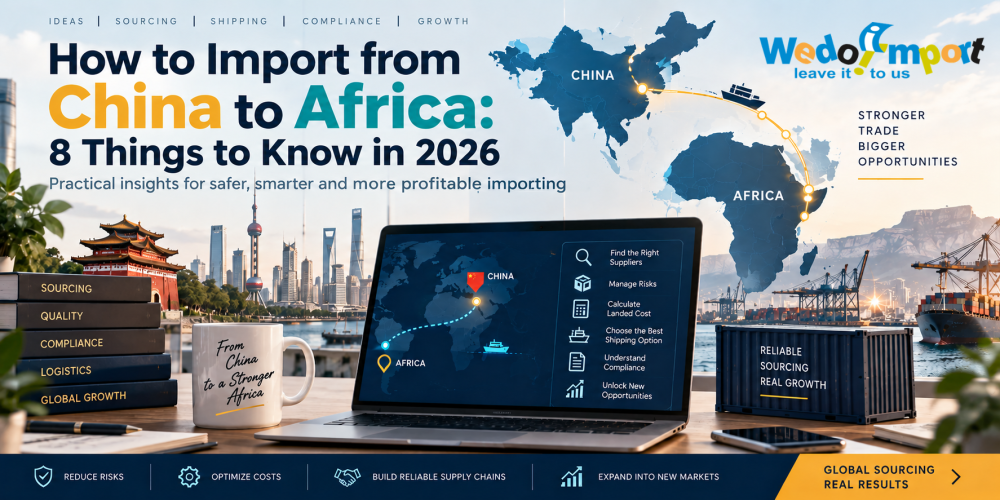
How to Import from China to Africa: 8 Things to Know in 2026
If you’re trying to figure out how to import from China into an African market right now, here’s the challenge: China-Africa trade is already enormous, but practical guidance for individual importers is still fragmented.
Most “import from China” guides are written primarily for Indian, American or European buyers. Yet China-Africa trade continues to expand rapidly. From January to July 2026, China-Africa trade reached approximately US$239.6 billion, up 23.5% year-on-year, while China’s exports to Africa increased by approximately 25%.
But growing trade doesn’t make importing automatically easy.
You still need to find the right supplier, verify who you’re dealing with, understand your destination country’s requirements, structure payments properly, inspect the goods, choose the right shipping method and calculate what the product will actually cost when it reaches your market.
This guide explains the 8 things businesses should understand before importing from China into an African market, using current trade developments alongside what more than 20 years of China sourcing experience has taught us.
How Do You Import From China to Africa?
Importing from China into an African market generally involves choosing your product, identifying and verifying a Chinese supplier, checking the destination country’s import and product-compliance requirements, calculating landed cost, agreeing payment terms and Incoterms, approving samples, inspecting production, arranging international freight, completing customs clearance and delivering the shipment locally.
The important part: there is no single “Africa import process.” Duties, taxes, standards, documentation and customs procedures depend on the destination country and the product being imported.
2026 trade data: China Ministry of Commerce / China Customs. China’s zero-tariff framework applies to qualifying African goods entering China; it does not mean Chinese goods automatically enter African markets duty-free.
China-Africa Trade Is Growing Rapidly
China-Africa trade isn’t new. China has been Africa’s largest trading partner for years. What is notable in 2026 is the pace at which the relationship continues to expand.
Official Chinese customs data shows that from January to July 2026, China-Africa trade reached approximately US$239.58 billion, an increase of 23.5% year-on-year.
China’s exports to Africa reached approximately US$152.67 billion during the same period, growing around 25% year-on-year.
For businesses importing from China, this matters because growing trade tends to support deeper supplier relationships, established product flows and increasingly important logistics corridors between Chinese manufacturing centres and African markets.
Source:
Ministry of Commerce of the People’s Republic of China
China’s New Zero-Tariff Policy Matters – But Understand What It Actually Means
From May 1, 2026, China expanded zero-tariff treatment to cover all 53 African countries with which it has diplomatic relations.
It is an important development in China-Africa trade, but there’s one distinction importers shouldn’t miss.
China’s zero-tariff framework primarily applies to qualifying African products entering China. It does not mean products exported from China can automatically enter South Africa, Kenya, Nigeria, Ghana, Egypt or another African market duty-free.
If you’re importing Chinese products into Africa, you still need to check the destination country’s customs tariff, taxes, product regulations and documentation requirements.
What the policy does demonstrate is the growing institutional and commercial importance of the China-Africa trade relationship.
Sources:
Ministry of Finance of China | Government of China
Chinese Products Already Serve Established Demand Across African Markets
African markets already import large volumes of manufactured goods from China. Machinery, intermediate goods and consumer products are important parts of the trade relationship.
In the first quarter of 2026 alone, China’s exports of intermediate goods to Africa grew 23.3%, while exports of capital goods grew 43.5% and consumer goods increased by 25%.
For an importer, that means you’re not necessarily trying to create an entirely new supply chain. In many product categories, established supplier ecosystems and trade routes already exist.
However, existing demand does not automatically mean every product will be commercially viable in every African country.
Source:
State Council Information Office — Q1 2026 China-Africa Trade
The Real Problem Isn’t Finding a Supplier – It’s Knowing Who to Trust
This is one of the most common concerns we see in China sourcing regardless of the destination country.
Alibaba, 1688, trade fairs and online directories can give you access to thousands of potential suppliers. The difficult part is determining whether you’re dealing with an actual manufacturer, a capable trading company, an inexperienced intermediary or a supplier whose capabilities don’t match what they’re claiming.
Depending on the size and complexity of the order, supplier verification may also include a factory audit, sample evaluation, video inspection or independent production-capability assessment.
Never rely only on supplier photos, marketplace badges or sales claims when a significant amount of money is involved.
Payment Terms and Documentation Are Two Major Risk Points
Even when a supplier is legitimate, unclear payment terms and incomplete documentation can create serious problems.
A buyer may send a large deposit without clearly defined production milestones, approve a product without confirming the final specification, or discover after shipment that an important customs or product document is missing.
These problems aren’t always caused by fraud. They can simply come from poor coordination or inexperience on either side of the transaction.
The principle is simple: resolve documentation requirements before shipment — not when the container is already approaching the destination port.
Africa Is Not One Customs Market
A shipment from China to South Africa should not automatically be treated the same as a shipment to Kenya, Nigeria, Ghana, Egypt, Morocco or another African destination.
Depending on the country and product, you may need to investigate:
Always verify the current requirements for your specific destination country and product before placing the production order.
6. Growing Trade Doesn’t Remove the Need for a Good Sourcing System
We’ve watched China sourcing evolve for more than two decades. Markets change, freight rates change, trade relationships deepen and new opportunities appear — but the fundamentals of a successful import don’t change nearly as much.
The businesses that tend to build more reliable supply chains are the ones that develop a repeatable process for supplier verification, samples, specifications, payment control, quality inspection, compliance checks and landed-cost calculation.
China-Africa trade is already well established. The opportunity now isn’t simply about being “early.” It’s about building better sourcing systems while trade between the two regions continues to expand.
Shipping From China to Africa Needs to Be Planned Around the Actual Shipment
There is no single feasible shipping method for every importer.
The right option depends on your cargo volume, weight, product value, urgency, supplier location in China and final destination in Africa.
Don’t select a freight method based only on the headline shipping rate. Origin charges, consolidation, destination handling, customs clearance and local delivery can materially change the final economics.
A $10 Product in China Isn’t a $10 Product in Your Market
Your buying decision should be based on the landed cost per unit, not just the supplier’s quotation.
A supplier with the lowest FOB or EXW price isn’t necessarily the supplier that gives you the best final margin.
What 20+ Years of China Sourcing Has Taught Us
8. Better-Prepared Importers May Have the Strongest Advantage
China-Africa trade is already substantial, so this isn’t about trying to enter an untouched market.
The opportunity we see is different.
Businesses that establish verified supplier relationships, repeatable quality-control processes, destination-country compliance workflows and accurate landed-cost models may be better positioned as trade continues to grow.
The advantage isn’t simply moving first. It’s learning how to source correctly before increasing order volumes.
How We Do Import Can Support Your China Sourcing
We Do Import helps businesses manage the China side of the sourcing and import process, from finding and evaluating suppliers through production and shipment coordination.
Destination-country customs, tax and regulatory requirements vary by country and product and should be confirmed for the specific African market before ordering.
The Round-Off
✓ China-Africa trade grew 23.5% YoY during January-July 2026.
✓ China’s exports to Africa increased around 25% during the same period.
✓ China’s zero-tariff framework covers 53 African diplomatic partners — but primarily concerns qualifying African exports entering China.
✓ Chinese products already serve established demand across intermediate, capital and consumer goods categories.
⚠ Supplier verification should happen before payment, not after a problem appears.
⚠ Each African country has its own import requirements, so compliance must be checked by destination.
💡 The strongest advantage may come from building a reliable sourcing system, not simply trying to enter the market first.
If you’re unclear on where to start, the first step doesn’t need to be placing an order.
Start by understanding your product, identifying the right supplier, checking the requirements in your destination market and calculating whether the product still makes commercial sense after freight, duty, taxes and other import costs are included.
Frequently Asked Questions
How to import from China to South Africa?
The general process involves identifying and verifying a Chinese supplier, confirming product specifications, checking South African import and product requirements, calculating landed cost, agreeing payment and shipping terms, inspecting the goods, arranging freight and completing customs clearance. The exact duties, taxes and regulatory requirements depend on the product being imported.
How to start importing from China without getting scammed?
Verify the supplier’s business registration and production capability independently, confirm that the receiving bank account matches the business you’re dealing with, approve samples and specifications, use clearly agreed payment milestones and consider a factory audit or pre-shipment inspection for significant orders. Don’t rely only on marketplace listings, photographs or supplier claims.
Can I import from China without using an agent?
Yes. Businesses can source and import directly. However, you’ll need to manage supplier verification, negotiation, specifications, payment risk, quality control, shipping coordination and destination-country requirements yourself. Some businesses use sourcing or import specialists when they don’t have the resources or experience to manage those steps internally.
How do I import from China and sell in my own country?
Start by checking whether there is sufficient local demand and margin for the product. Then identify a supplier, calculate the complete landed cost, check customs duties and product-specific requirements in your country, arrange samples and quality control, ship the goods and complete customs clearance. Your selling price should be based on the landed cost rather than only the supplier’s product price.
Which is the cheapest way to ship goods from China to Africa?
There isn’t one cheapest option for every shipment. Air freight may make sense for smaller urgent cargo, LCL sea freight for smaller commercial shipments and FCL for larger volumes. The correct comparison should include origin charges, freight, destination handling, customs clearance and local delivery rather than comparing only the headline freight rate.
Do Chinese products enter African countries duty-free?
Not automatically. China’s 2026 zero-tariff framework primarily applies to qualifying African goods entering China. Goods imported from China into an African country remain subject to the destination country’s applicable tariffs, taxes, customs procedures and product regulations.
Start With 5 Details
Send us your requirement and we’ll help you understand what needs to be checked on the China sourcing side before you move forward.
Product
Quantity
Destination Country
Destination City / Port
Supplier Found? Yes / No





Leave a Reply