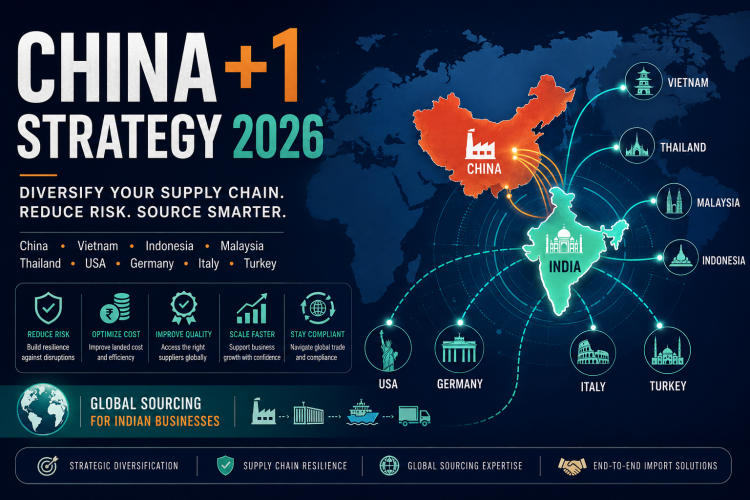
China+1 Strategy 2026 for Indian Importers: The Smart Guide to Supply Chain Diversification
China+1 isn’t about leaving China. It’s about making sure your business isn’t completely relying on one country, one supplier or one supply chain.
For Indian importers, that distinction matters.
China remains one of the world’s biggest manufacturing ecosystems. It offers enormous supplier depth, competitive pricing, mature infrastructure and access to components and supporting industries that are difficult to replicate elsewhere.
But depending entirely on one sourcing country can create its own risks.
Changes in anti-dumping duties, export restrictions, freight disruptions, supplier capacity, currency movements, compliance requirements or geopolitical conditions can affect your landed cost and supply continuity.
That doesn’t automatically mean you should move production to Vietnam, Indonesia or another country.
It means you should know what your exposure actually is.
A practical China+1 strategy starts with a different question:
Which parts of my supply chain should remain in China, which parts should be diversified, and which alternative sourcing country actually makes commercial sense for my product?
For some businesses, the answer may be Vietnam.
For others, it could be Indonesia, Malaysia or Thailand.
For certain products, sourcing from the USA, Germany, Italy or Turkey may make more sense because of product quality, technology, specialization or supplier capability.
And in many cases, the smartest answer may simply be better supplier diversification within China.
This guide explains how to make that decision.
What Does China+1 Actually Mean?
China+1 is a supply-chain strategy where a business continues sourcing from China while developing at least one additional sourcing or manufacturing base.
It is not necessarily:
China → Vietnam
It can be:
China + Vietnam
China + Indonesia
China + Thailand
China + Malaysia
or, depending on the product:
China + Germany
China + Italy
China + Turkey
China + USA
The objective isn’t to replace China.
The objective is to reduce unnecessary concentration risk while improving your options for cost, quality, capacity, compliance and supply continuity.
China+1 does not mean China-1
This is one of the most important things to understand before making a sourcing decision.
You don’t have to move your entire supply chain.
You can start with:
One product → one alternative supplier → one trial order → one additional sourcing country.
If the alternative performs well, you can gradually increase the percentage of sourcing from that location.
If it doesn’t, you haven’t disrupted your entire supply chain.
Why Indian Importers Are Looking at China+1 in 2026
The China+1 conversation is becoming more relevant because businesses are no longer evaluating suppliers purely on factory price.
Today, an importer has to consider the total cost and total risk of getting the product into India.
That includes:
- Product cost
- Freight
- Customs duties
- Anti-dumping or trade-remedy exposure
- Compliance and certification
- Customs clearance
- Quality-control costs
- Lead time
- Supplier reliability
- Country-of-origin requirements
- Working capital
- Reordering flexibility
- Supply disruption risk
A supplier offering a lower FOB price isn’t necessarily the cheaper supplier.
Likewise, a country offering lower labour costs isn’t automatically the better sourcing destination.
The real question is:
Which sourcing option gives you the best combination of landed cost, quality, compliance, reliability and scalability?
That is the basis on which a China+1 decision should be made.
Should You Actually Diversify Away From China?
Not necessarily.
This is where many China+1 articles become misleading.
Diversification creates additional supplier relationships, quality-control requirements, logistics arrangements, compliance considerations and management complexity.
If your China supplier is reliable, your margins are healthy and your product category has no significant concentration risk, moving production simply because “everyone is doing China+1” may actually make your business less efficient.
You may not need China+1 yet if:
- Your China suppliers are reliable and consistently meet specifications.
- Your category has no significant anti-dumping or trade-remedy exposure.
- Your margins remain healthy after all landed costs.
- Your supplier has sufficient production capacity.
- Your business doesn’t depend on a single factory.
- Your product has no realistic alternative manufacturing base that improves the economics.
- Your current supply chain can handle your expected growth.
You should seriously evaluate China+1 if:
- You depend heavily on one Chinese supplier.
- Your category faces changing trade-remedy exposure.
- Your margins are becoming increasingly sensitive to duty or freight changes.
- Your supplier regularly struggles with capacity.
- Your business cannot tolerate a prolonged supply disruption.
- Your customers require greater supply continuity.
- A viable second sourcing country exists for your specific product.
- You are scaling enough to justify maintaining multiple sourcing relationships.
The objective isn’t diversification for the sake of diversification.
It’s diversification where the business case actually exists.
The First Step: Don’t Diversify the Country. Diversify the Risk.
Before looking for a factory in Vietnam or Indonesia, look at your existing China supply chain.
Ask:
How dependent are you on one supplier?
If 80–100% of a critical product comes from one factory, your first risk may not be China itself.
It may simply be supplier concentration.
In that situation, having two qualified suppliers in different Chinese manufacturing regions could reduce your risk without introducing the additional complexity of another country.
How dependent are you on one product?
If one SKU generates most of your revenue, that product deserves greater supply-chain protection than a low-volume SKU.
How exposed are you to regulatory changes?
Check your product’s:
- HS code
- Customs duty
- Anti-dumping status
- BIS/ISI/WPC requirements, where applicable
- Other product-specific regulations
- Country-of-origin requirements
How much does disruption actually cost you?
A second sourcing base only makes sense if the cost of diversification is justified by the risk you’re reducing.
The Cost Question: Compare Landed Cost, Not Factory Price
This is probably the most important financial principle in China+1 sourcing.
Don’t compare:
China factory price vs. Vietnam factory price
Compare:
China landed cost vs. alternative-country landed cost
Your calculation should consider:
| Cost Component | China | Alternative Country |
|---|---|---|
| Product cost | ✓ | ✓ |
| Export charges | ✓ | ✓ |
| International freight | ✓ | ✓ |
| Customs duty | ✓ | ✓ |
| Trade-remedy exposure | ✓ | ✓ |
| Compliance/certification | ✓ | ✓ |
| Customs clearance | ✓ | ✓ |
| Inland transportation | ✓ | ✓ |
| Quality inspection | ✓ | ✓ |
| Financing/working capital | ✓ | ✓ |
| Expected wastage/rejection | ✓ | ✓ |
| Lead-time impact | ✓ | ✓ |
This is why a product that looks cheaper at the factory level can become more expensive after it reaches India.
Example
Imagine:
Supplier A — China
Factory price: ₹500
Freight and logistics: ₹60
Duty/taxes/clearance: ₹120
Compliance/QC: ₹20
Approximate landed cost: ₹700
Now imagine:
Supplier B — Vietnam
Factory price: ₹540
Freight and logistics: ₹70
Duty/taxes/clearance: ₹70
Compliance/QC: ₹25
Approximate landed cost: ₹705
Vietnam may look cheaper from a labour-cost or tariff perspective, but the final economics may be almost identical.
That’s why HS-code-level landed-cost analysis should happen before changing your sourcing country.
Country Selection: Where Should Your “+1” Actually Be?
There is no universally best China+1 country.
The right country depends on your product.
Vietnam
Vietnam can be attractive for categories such as:
- Garments
- Footwear
- Furniture
- Electronics assembly
- Selected consumer products
Its growing manufacturing ecosystem and integration into global supply chains make it an important alternative for certain categories.
But Vietnam shouldn’t automatically be treated as a alternative for China.
For products heavily dependent on Chinese components or complex upstream manufacturing, moving final assembly to Vietnam may not eliminate China dependency.
Best question to ask:
Can Vietnam manufacture my complete product competitively, or would I simply be moving the final assembly while continuing to depend on China for components?
Indonesia
Indonesia can be relevant for categories including:
- Furniture
- Wood-based products
- Footwear
- Certain consumer goods
- Natural-resource-linked products
For businesses where raw-material availability is an important part of the sourcing decision, Indonesia can be worth evaluating.
Malaysia
Malaysia can be relevant for:
- Electronics
- Electrical products
- Industrial components
- Medical and technical products
- Higher-value manufacturing categories
The decision here should focus less on cheap labour and more on supplier capability, technology, quality and product specialization.
Thailand
Thailand can be particularly relevant for:
- Automotive components
- Machinery-related products
- Electronics
- Industrial manufacturing
- Selected consumer products
For businesses requiring an established industrial ecosystem rather than simply the lowest manufacturing cost, Thailand can be worth considering.
USA
The USA isn’t necessarily a low-cost manufacturing alternative to China.
That’s not the point.
For certain products, American sourcing may make sense because of:
- Specialized technology
- Product quality
- Proprietary manufacturing
- Industrial expertise
- Brand positioning
- Specialized components
China+1 doesn’t always mean lower cost.
Sometimes it means better capability or lower strategic risk.
Germany
Germany can be relevant when the priority is:
- Engineering
- Industrial technology
- Precision manufacturing
- Machinery
- Specialized components
- High-quality technical products
If the product requires advanced engineering rather than mass-market production, the right sourcing decision may favour capability over unit-price savings.
Italy
Italy can be particularly relevant for specialized categories where:
- Design matters
- Product craftsmanship matters
- Brand positioning matters
- Manufacturing expertise is important
- Premium quality justifies a higher sourcing cost
For these categories, comparing Italy with China purely on factory price would miss the commercial objective.
Turkey
Turkey can be strategically relevant for categories such as:
- Textiles
- Apparel
- Home furnishings
- Selected industrial and consumer products
Its geographic position can also make it interesting for businesses looking to diversify their supply network.
The Most Important Question: Which Country Fits Your Product?
Instead of asking:
“Which country is cheaper than China?”
Ask:
“Which country possesses a structural advantage for the manufacturing of this particular product?”
A simplified starting framework:
| Product Requirement | Potential Sourcing Base |
|---|---|
| High-volume electronics/components | China |
| Electronics assembly | China / Vietnam / Malaysia |
| Garments | Vietnam / Turkey / other suitable textile bases |
| Furniture | China / Vietnam / Indonesia |
| Automotive components | China / Thailand |
| Precision engineering | China / Germany |
| Premium design-led products | Italy / Germany |
| Selected consumer products | China / Vietnam / Thailand / Indonesia |
| Specialized industrial products | Germany / USA / China |
| Textiles/home furnishings | China / Vietnam / Turkey |
This is only a starting point.
Your exact product, specifications, HS code, volume, target price and compliance requirements determine the final answer.
One of the Biggest China+1 Risks: “Country of Origin” Isn’t Just a Label
This is particularly important for Indian importers.
A product being shipped from Vietnam does not automatically mean that it qualifies as Vietnamese-origin merchandise for every trade or preferential-duty purpose.
If components are imported from China and the product undergoes limited processing elsewhere, you need to understand the applicable Rules of Origin and value-addition requirements.
This matters because an importer cannot simply assume:
China → Vietnam → India = Vietnam-origin product
Country of origin can affect:
- Preferential tariff eligibility
- Customs assessment
- Trade-remedy exposure
- Documentation
- Compliance
- Customs scrutiny
Before committing to a new sourcing country, verify:
Where are the raw materials coming from?
Where are the components manufactured?
What processing happens in the second country?
What percentage of value is added there?
Can the supplier substantiate the declared origin?
This is where supplier verification becomes more important than simply finding a cheaper quotation.
Don’t Forget Anti-Dumping Duties
A sourcing decision can look attractive until trade-remedy exposure changes the calculation.
Before moving a product to another country, check the relevant HS code for:
- Existing anti-dumping duties
- Countervailing measures
- Safeguard measures
- Product-specific notifications
- Changes in customs treatment
A lower factory price doesn’t protect your margin if an additional duty materially changes your landed cost.
This is why trade compliance needs to be part of sourcing strategy, not an afterthought once the shipment reaches India.
China+1 and Product Compliance
Changing the manufacturing country doesn’t automatically eliminate Indian compliance requirements.
Depending on the product, you may still need to evaluate requirements involving:
- BIS
- ISI
- WPC/ETA
- Legal Metrology
- FSSAI
- CDSCO
- Product-specific standards
- Labelling requirements
- Packaging requirements
The specific requirement depends on the product.
For example, moving an electronic product from China to Vietnam doesn’t mean Indian certification requirements disappear.
The principle is simple:
Change the sourcing country for your imports → reassess the compliance pathway.
Don’t assume that a new supplier automatically means a compliant shipment.
What Should You Actually Move?
You don’t have to move your entire product catalogue.
Start with the products where diversification can create the biggest strategic benefit.
Prioritize SKUs that have:
High revenue contribution
High supply risk
Viable alternative suppliers
Acceptable alternative-country landed cost
Those products deserve attention first.
A simple portfolio approach can look like this:
Tier 1 — Keep in China
Products where China has a significant cost, quality or ecosystem advantage.
Tier 2 — Dual-source
Products where maintaining China while developing another supplier reduces risk.
Tier 3 — Evaluate alternative country
Products where another country provides a meaningful cost, quality, regulatory or strategic advantage.
Tier 4 — Consider moving
Products where China concentration creates substantial risk and another sourcing base can meet the commercial requirements.
This is a much more practical approach than trying to relocate your entire supply chain.
China+1 Doesn’t Have to Start With 30% of Your Production
Don’t make the first trial bigger than necessary.
A sensible diversification process is:
Identify one vulnerable product
↓
Find qualified suppliers
↓
Verify the factory
↓
Compare landed cost
↓
Check compliance
↓
Run a sample/trial order
↓
Inspect production
↓
Evaluate quality and delivery
↓
Scale only if the numbers work
This allows you to learn about a new sourcing country without putting the entire business at risk.
A Practical China+1 Decision Framework for Indian Importers
Before changing your sourcing strategy, work through these seven questions.
1. What is your actual China exposure?
Calculate how much of your revenue-generating inventory depends on China and how much depends on a single supplier.
2. What is your actual risk?
Verify your HS code, duty rates, potential anti-dumping liabilities, compliance obligations, reliance on suppliers, and delivery timelines.
3. Can the risk be reduced inside China?
If another qualified Chinese supplier can solve the problem, you may not need a second country yet.
4. Which countries can realistically manufacture your product?
Don’t select Vietnam or Indonesia first and then try to force your product into that ecosystem.
Start with the product.
5. What is the complete landed cost?
Compare the full India landed cost—not just the factory quotation.
6. Can the alternative supplier meet your quality requirements?
Check:
- Factory capability
- Production capacity
- Certifications
- Quality systems
- Raw-material sources
- Previous export experience
- Production timelines
- Inspection results
7. Can the alternative country scale with you?
A supplier that can produce 2,000 units may not be the right supplier when you need 50,000.
Your China+1 strategy should support your next stage of growth, not just your first trial order.
How We Do Import Helps You Build a China+1 Strategy
The hardest part of China+1 isn’t finding another country.
It’s deciding whether you need another country, which one makes sense, and how to execute the change without creating a new set of problems.
That’s where We Do Import can help.
We support businesses with sourcing and importing across:
China
Vietnam
Indonesia
Malaysia
Thailand
USA
Germany
Italy
Turkey
That means you don’t have to approach China+1 as a theoretical exercise.
You can evaluate sourcing options across multiple manufacturing and supply markets based on your actual product requirements.
1. We start with your product, not a predetermined country
You tell us:
- What you’re importing
- Your expected quantity
- Target price
- Quality requirements
- Current supplier
- Current sourcing country
- Your business objective
Then the sourcing strategy can be evaluated around the product.
2. We compare suppliers and sourcing countries
Instead of simply giving you another supplier quotation, the objective is to understand:
Who can make it?
Where can it be made competitively?
What will the landed cost look like?
What compliance will apply?
Can the supplier scale with you?
3. We verify suppliers before you commit
A lower quotation isn’t useful if the supplier cannot consistently meet your specifications.
Supplier verification and factory assessment help you evaluate:
- Manufacturing capability
- Factory legitimacy
- Production capacity
- Quality systems
- Export experience
- Product specialization
- Documentation
4. We build quality control into the sourcing process
Quality shouldn’t be checked only after the shipment arrives in India.
Depending on the product and requirement, quality control can include:
- Production inspection
- Final random inspection
- Pre-shipment inspection
- Container loading supervision
- Product specification verification
The objective is simple:
Find the problem before the shipment becomes expensive to fix.
5. We evaluate Indian compliance before shipment
Before committing to an order, the applicable compliance requirements should be understood.
Depending on the product, that may include:
BIS / ISI / WPC / Legal Metrology / FSSAI / CDSCO / other product-specific requirements.
6. We help connect sourcing with logistics and customs
Changing the supplier is only one part of the process.
The product must still be transported from the factory to India and successfully pass through customs.
That means sourcing, inspection, documentation, freight and customs should work as one connected process rather than separate pieces managed by different parties.
Why This Matters for Your Business
You don’t need another supplier list.
You need a sourcing strategy that answers:
Where should I buy this product?
Who should I buy it from?
What will it actually cost after reaching India?
What compliance applies?
What happens if my primary supplier cannot deliver?
Should I stay with China, diversify within China, or develop a second sourcing country?
Those are the questions that determine whether China+1 actually improves your business.
China+1 Is a Strategy, Not a Trend
There is no universal rule saying:
“Move away from China.”
There is also no rule saying:
“Stay 100% dependent on China.”
The right strategy depends on your:
- Product
- Volume
- Margin
- Supplier concentration
- Compliance exposure
- Customer expectations
- Growth plans
- Risk tolerance
- Target landed cost
For one business, the smartest move may be China + Vietnam.
For another, it may be China + Indonesia.
For another, China + Germany.
And for another, the smartest strategy may simply be two qualified suppliers in China.
The objective isn’t to follow the China+1 trend.
The objective is to build a supply chain that gives your business better control over cost, quality, compliance and continuity.
Frequently Asked Questions
Should every Indian importer diversify away from China?
No. China remains highly competitive across many product categories. Diversification should be based on actual supplier concentration, trade exposure, landed cost, product requirements and the availability of a commercially viable alternative.
Does China+1 mean moving my entire production out of China?
No. China+1 is generally about maintaining China as an important sourcing base while developing an additional sourcing option. You can start with one product, one supplier or a small percentage of your sourcing.
Is Vietnam always the best China+1 country?
No. Vietnam is an important alternative for several manufacturing categories, but the right sourcing country depends on your product. Indonesia, Malaysia, Thailand, USA, Germany, Italy and Turkey can also make sense for specific categories.
Should I diversify suppliers within China before moving to another country?
Often, yes. If your primary problem is dependence on one factory rather than China itself, adding another qualified Chinese supplier may reduce your risk without introducing another country’s sourcing, compliance and logistics complexity.
How do I compare China and another country properly?
Compare the total landed cost into India, not simply factory prices. Include product cost, freight, customs duties, trade-remedy exposure, compliance, inspection, clearance and domestic logistics.
Can I get preferential duty when importing from another country?
Potentially, depending on the applicable trade agreement, product classification, origin requirements and eligibility. Preferential treatment should never be assumed solely because goods are shipped from a particular country.
How do I know whether a supplier from Vietnam or another country is genuine?
Supplier verification should include factory assessment, manufacturing capability, documentation, ownership/background checks, production capacity, export history and verification of the actual manufacturing and country-of-origin position where relevant.
What is the safest way to start China+1?
Start small. Identify a product where diversification has a clear business case, verify an alternative supplier, calculate the complete landed cost, confirm compliance, run a trial order and evaluate the result before scaling.
The Bottom Line
China+1 isn’t about choosing China or another country.
It’s about having the ability to choose.
If China remains the best option for a particular product, you should know why you’re staying.
If Vietnam offers a better opportunity, you should be able to test it.
If Indonesia, Malaysia or Thailand provides the right manufacturing ecosystem, you should be able to evaluate it.
And if your product requires specialized manufacturing from Germany, Italy, Turkey or the USA, the sourcing strategy should reflect that rather than forcing everything into a China-only model.
The strongest supply chain isn’t necessarily the one with the most countries.
It’s the one where you understand:
where your products come from, why they’re sourced there, what they really cost, what risks exist, and what your alternative is if something changes.
That’s the real purpose of China+1.
And that’s where an experienced sourcing and import partner can make the difference.
We Do Import helps Indian businesses source and import from China, Vietnam, Indonesia, Malaysia, Thailand, USA, Germany, Italy and Turkey—with supplier sourcing, verification, quality control, compliance, logistics and customs support built around the specific requirements of the product.
Not sure whether your business actually needs a China+1 strategy?
Share your product, current sourcing country and approximate order volume with us. We can help you evaluate whether staying with China, diversifying within China, or developing an alternative sourcing country makes commercial sense for your business.




Leave a Reply