Why Business Heads Are Rethinking How They Import from China
Most problems in China sourcing don’t show up as a bad shipment. They show up as a margin that quietly shrank, a senior manager’s calendar that’s somehow full of customs calls instead of strategy, or a Monday morning where three different vendors are each blaming the other for a shipment that’s still sitting at port. If you’re a business head, none of these individually looks like a crisis but together, they’re the actual cost of importing from China without the right structure behind it, and it’s a cost that rarely shows up on a P&L line labeled “sourcing risk.”
Here’s what that cost actually looks like, and what changes when you fix the structure instead of the symptom.
The Real Pain Points Business Heads Face – Not the Operational Ones
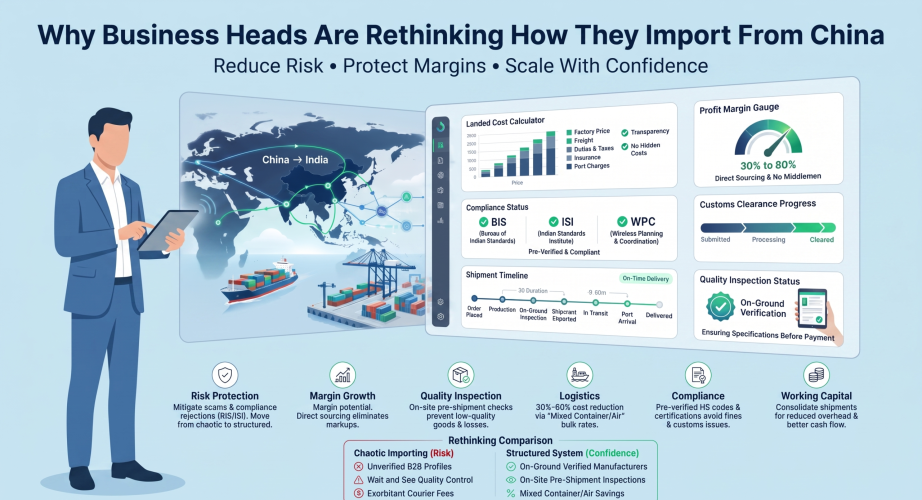
Margin erosion you can’t fully explain. Landed cost isn’t just product price plus freight it’s Basic Customs Duty, IGST, potential anti-dumping duty, compliance costs, and clearance fees, all stacking in ways that are hard to fully see until the bill arrives. A margin that looked healthy at the quotation stage can quietly disappear by the time goods clear customs, and by then it’s too late to renegotiate.
Senior time going to firefighting instead of decisions. When sourcing, compliance, freight, and customs clearance sit with three or four disconnected vendors, something going wrong means a business head or senior manager personally coordinating between parties who each only see their own piece of the problem. That’s expensive time, and it’s time that should be going to strategy, not vendor triage.
Compliance liability that sits on you personally, not on a vendor. If a shipment is flagged due to the absence of BIS, ISI, or WPC certification, or for not declaring exposure to anti-dumping duties, the result may be a held shipment, a financial penalty, and a strained customer relationship lands on your business, not on whichever vendor missed the requirement. Most sourcing agents and freight forwarders don’t carry that risk with you; you do.
A scaling bottleneck nobody plans for. Doubling your import volume rarely means your oversight burden scales proportionally it usually scales faster, because more shipments mean more chances for a certification gap, a documentation mismatch, or a quality slip to surface. Growth that isn’t matched by process discipline turns into growth that quietly increases your risk exposure.
Brand and quality risk that’s invisible until a customer complains. A defect that reaches your customer isn’t just a returned product it’s a brand reputation cost that’s much harder to recover than the shipment cost itself. By the time quality issues surface at the customer end, the window to catch them cheaply at the factory, before the container is sealed has already closed.
⚠️ Think your import process is working just fine?
Most costly import problems don’t appear until after you’ve paid your supplier. Send us your product or HS code on WhatsApp, and we’ll help you identify potential compliance, sourcing, customs, or cost risks before they become expensive mistakes.
Working capital tied up in shipments you don’t have visibility into. Cash sitting in a shipment stuck at customs for a documentation issue isn’t earning you anything it’s capital you can’t deploy elsewhere in the business, for reasons that were often avoidable.
20+ Years, 1,000+ Businesses, 15,000+ Shipments: What That Actually Means for You
We Do Import was founded in 2006, which means the patterns above aren’t new to us we’ve seen versions of every one of them play out across more than 1,000 businesses and 15,000+ shipments. That’s not a claim about being big; it’s a claim about pattern recognition. A certification gap that looks unique to your product has usually shown up before, in a different product, for a different client, and the fix was already known before your shipment ever left the factory.
That’s the actual value of experience at this scale: fewer first-time mistakes, because most of the mistakes aren’t first-time for us.
How We Do Import Solves Each of These
For margin erosion: we build a full landed cost estimate BCD, IGST, anti-dumping exposure, compliance costs, and clearance fees before you commit to a supplier price, so your margin is based on what you’ll actually pay, not what you hope you’ll pay.
For senior time lost to firefighting: we run sourcing, compliance, inspection, and customs clearance as one accountable process, so when something needs attention, there’s one point of contact not three vendors you’re personally coordinating between.
For compliance liability sitting on you: we check BIS/ISI/WPC requirements and DGTR/CBIC anti-dumping status against your specific HS code before you place an order, so the certification gap gets caught at the sourcing stage, not discovered as your liability at the port.
For the scaling bottleneck: because we’re managing the process rather than you managing multiple vendors, your oversight burden doesn’t scale linearly with your import volume the way it would if you were coordinating everything yourself.
For brand and quality risk: our three-stage inspection process during production (DUPRO), final random inspection (FRI), and container loading supervision (CLS) catches defects before they’re sealed into a container, not after they’ve reached your customer.
For working capital tied up in stuck shipments: pre-arrival Bill of Entry filing and correct HS code classification upfront are specifically what prevent the documentation-driven customs holds that tie up your cash unnecessarily.
What Working With Us Actually Looks Like
This isn’t a black box. A typical engagement starts with an honest conversation about your product, your current process (or lack of one), and where the real risk sits not a sales pitch, a straight assessment. From there, we build the specific compliance roadmap, sourcing plan, and cost estimate for your product category before you commit to anything. You keep visibility throughout; you’re just not the one personally holding the pieces together anymore.
Ready to make your import process more predictable?
We’ll review your current sourcing approach and highlight opportunities to reduce risk, improve visibility, and avoid costly compliance or customs issues before they affect your business.
Frequently Asked Questions
We already import directly is this still relevant to us?
Yes, often more so. Many of the businesses we work with already have a working import process; what they’re usually missing is the compliance and inspection layer that catches problems before they become expensive, not a wholesale replacement of what they’re already doing well.
How quickly can we start if we’re already mid-negotiation with a supplier?
We can typically step in at any stage reviewing an existing supplier relationship, checking compliance on a product already in production, or building the process from scratch for a first order. The earlier we’re involved, the more we can prevent rather than fix.
What’s the realistic ROI of working with an import partner instead of managing it ourselves?
It’s rarely a single number, because the value shows up as avoided cost a certification gap caught before a shipment is seized, an anti-dumping duty identified before it erases your margin, a defect caught before it reaches a customer. Over 1,000 businesses and 15,000+ shipments, the pattern is consistent: the cost of prevention is almost always smaller than the cost of the problem it prevents.
Do you work across all product categories, or do you specialize?
Our core strength is the process sourcing, compliance, inspection, and customs clearance which applies across categories, though the specific certification and inspection requirements naturally differ by product type (electronics vs. furniture vs. medical devices, for example).
If you’re a business head weighing whether your current China sourcing process actually has the right structure behind it, message us on WhatsApp for a straight conversation – not a sales pitch – about where the real risk in your current setup sits.







Leave a Reply