Customs Clearance in India: A Complete Guide (From 15,000+ Real Shipments)
If you’ve ever watched a shipment sit at port for days with no clear reason, you already know the problem with most customs clearance guides online they explain the process like a textbook, not like something that actually happens to real cargo with real deadlines attached. This guide is built the other way around: from patterns we’ve actually seen across 15,000+ shipments, plus the latest government data on how the system performs in practice.
What Is Customs Clearance in India?
Customs clearance is the legal process a shipment goes through before it’s allowed to enter (or leave) India where customs authorities verify what’s being imported, check it against your declared documents, assess the applicable duty, and release it once everything checks out. Nothing physically moves out of a port or airport without this sign-off, regardless of how simple or routine your shipment is.
How Long Does Customs Clearance Actually Take in India?
Here’s the honest answer: it depends heavily on your cargo type and entry point, and the government’s own data backs that up clearly.
Real 2025 Government Data (Not Estimates)
According to CBIC’s National Time Release Study (NTRS) 2025 released by the Finance Ministry at the CBIC Conclave average release times for imports improved measurably between 2023 and 2025: seaports got roughly 6 hours faster, Air Cargo Complexes (ACCs) roughly 5 hours faster, and Integrated Check Posts roughly 18 hours faster. Inland Container Depots (ICDs), on the other hand, actually got about 12 hours slower over the same period a detail most generic guides won’t tell you, because it complicates the “everything’s improving” narrative.
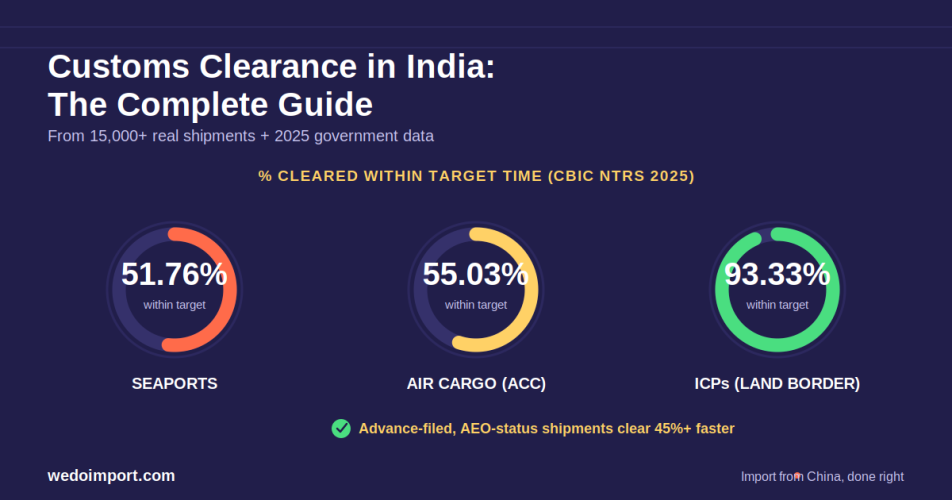
Against the government’s own targets, 93.33% of ICP cargo cleared within 48 hours, 55.03% of ACC (air cargo) cleared within 24 hours, and 51.76% of seaport cargo cleared within the target window meaning even with real improvement, roughly half of seaport shipments still miss the target timeline.
Source: PIB CBIC Releases National Time Release Study (NTRS) 2024, TaxGuru National Time Release Study 2025: Key Highlights.
What Actually Speeds This Up
One number in the government data is worth remembering: shipments that combine advance filing + facilitated processing + AEO (Authorized Economic Operator) status clear 45–46% faster than the average for their port category. That’s not a marginal improvement it’s close to half the wait, and it’s entirely within your control, not luck.
Once duty is actually paid, the final release itself is fast CBIC’s Pre-payment Compliance Verification data shows automated release happening within about 3 minutes of payment. The real bottleneck almost never lives in the payment step. It lives earlier in documentation, classification, and whether your shipment got flagged for physical examination.
Where This Is Headed
CBIC has proposed a new integrated digital customs system aimed at cutting clearance time from the current 3–4 day norm down to a 1–48 hour range, using AI-assisted risk management on a single unified platform. It’s still pending final approval as of this writing, but it signals where the system is heading faster, more automated, and less dependent on manual intervention.
Documents Required for Customs Clearance in India
Missing or mismatched documents are the single most common reason a shipment gets held not fraud, not bad luck, just paperwork that doesn’t line up.
Mandatory Documents (Every Shipment Needs These)
- Import Export Code (IEC) issued by DGFT, required to legally import at all
- Commercial Invoice from your supplier, matching your actual purchase price
- Packing List itemized contents, matching what’s actually in the shipment
- Bill of Lading (sea) or Air Waybill (air) your identity of shipment
- Bill of Entry the formal customs declaration, typically filed by your Customs House Agent (CHA)
- GST registration details for IGST payment and input tax credit purposes
Category-Specific Documents (Only If Your Product Requires Them)
- BIS/ISI certificate for products under India’s mandatory certification list
- WPC/ETA certificate for any wireless or radio-frequency emitting device
- EPR certificate for plastic packaging, e-waste, or battery-related imports
- Certificate of Origin sometimes required to confirm where goods were actually manufactured, particularly relevant if anti-dumping duty applies
📋 One missing document can delay your shipment for days.
Before your shipment leaves the supplier, let us review your documentation and certification requirements. A quick WhatsApp review today can save you days of delays and unexpected costs at Indian customs.
If you’re not sure which of these apply to your product, our BIS vs. ISI vs. WPC breakdown walks through exactly how to check.
Step-by-Step: How Customs Clearance Actually Works
Step 1: Your shipment arrives, and a Bill of Entry gets filed. Your CHA files this electronically through ICEGATE India’s customs filing system declaring what’s in the shipment, its value, and its HS code classification.
Step 2: The Risk Management System (RMS) decides what happens next. This is an automated system that scores each shipment based on risk factors your import history, the product category, and the declared value, among other things. Low-risk shipments often get facilitated (cleared with minimal manual review); higher-risk ones get flagged for closer attention.
Step 3: If flagged, your shipment goes through document or physical examination. At this stage, a customs officer verifies your documentation against the merchandise, and in certain instances, conducts a physical examination of the cargo. This step is the single biggest source of delay in the entire process and it’s also the step most within your control to avoid, through accurate, consistent documentation upfront.
Step 4: Duty gets assessed and you pay. Basic Customs Duty, IGST, and any applicable anti-dumping duty are calculated based on your declared value and HS code. Once you pay, release is typically fast often within minutes, per the government’s own data above.
Step 5: “Out of Charge” your shipment is officially released. This is the final sign-off that allows the goods to actually leave the port or airport.
For the full picture of what happens before this stage sourcing, compliance, and shipping see our step-by-step guide to importing from China to India.
Customs Clearance Charges in India: What You’ll Actually Pay
Customs clearance itself isn’t free, separate from the duty you owe on the goods. Typical costs include CHA/customs broker fees (flat fee or a small percentage of shipment value), port or airport handling charges, and if your shipment gets held for examination potential demurrage or storage charges for the extra days it sits. For the full breakdown of duty, IGST, and total landed cost, see our complete cost breakdown guide.
Why Shipments Actually Get Held at Customs (Patterns From 15,000+ Real Shipments)
Textbook guides will tell you “ensure accurate documentation.” Here’s what that actually looks like in practice, based on what we see repeatedly:
The declared value doesn’t match the actual invoice. Even small, unintentional discrepancies between what’s declared and what the commercial invoice shows can trigger a reassessment and reassessment means delay, every time.
The HS code doesn’t match how customs sees the product. This is rarely deliberate misclassification it’s usually a genuine judgment call on an ambiguous product that customs interprets differently than the importer did. The fix isn’t “be more careful,” it’s getting the classification checked by someone who’s seen how that specific product category tends to get treated.
A required certificate exists, but wasn’t ready at the time of filing. BIS, WPC, or EPR certification that’s “in progress” doesn’t help you at the port customs needs it in hand, not in process.
The packing list and the physical shipment don’t line up exactly. Even a small quantity mismatch between what’s declared and what’s actually in the container is enough to trigger closer scrutiny.
Will your shipment clear customs smoothly?
Send us your product details, invoice, or HS code on WhatsApp. We’ll help you identify possible documentation gaps, certification requirements, customs duties, and clearance risks before your cargo reaches India.
How to Avoid Customs Delays: What Actually Works
- File in advance, not at arrival. The government’s own data shows advance-filed shipments clear significantly faster this alone is one of the highest-leverage things you control directly.
- Get your HS code checked before you place the order, not after the goods are already produced and shipped.
- Have every category-specific certificate in hand before filing not applied for, not “expected soon.”
- Cross-check your commercial invoice, packing list, and Bill of Lading against each other before your CHA ever files three documents that don’t perfectly agree is one of the most common, most avoidable triggers for a hold.
- Work toward AEO status if you’re importing at real volume. It’s a bigger upfront lift, but the 45%+ speed improvement the government data shows is a real, compounding advantage over time.
How We Do Import Helps You Navigate This
Not knowing whether your documentation will actually hold up until customs flags it. We cross-check your commercial invoice, packing list, and Bill of Entry against each other before filing catching the mismatches that trigger holds, before they become your problem at the port.
HS code classification that’s a judgment call, not a clear answer. Because we’re handling classification across many shipments and product categories, we’re not guessing on ambiguous products we’re applying what we’ve already seen customs accept or reject for similar goods.
A certificate that’s “in progress” when the shipment arrives. We build the compliance timeline backward from your expected shipping date, so BIS, WPC, or EPR certification is actually in hand before filing not racing to catch up once your goods are already at port.
It’s easier to fix paperwork before your shipment sails than after it reaches customs.
Planning your next import? Share your product details with us on WhatsApp, and we’ll help you review documentation, HS code classification, customs duties, and compliance requirements before your shipment reaches Indian customs.
Frequently Asked Questions
How long does customs clearance take in India in 2026?
Per CBIC’s 2025 National Time Release Study, roughly half of seaport shipments clear within the government’s target window, while air cargo (ACCs) and Integrated Check Posts perform notably better 55% and 93% within target respectively. Advance-filed, AEO-status shipments clear 45%+ faster than the average.
What is the Risk Management System (RMS) in Indian customs?
RMS is the automated system that scores each shipment’s risk level based on factors like import history and product category, determining whether it gets facilitated with minimal review or flagged for closer document or physical examination.
Can I clear customs myself without a Customs House Agent (CHA)?
Technically in some cases, but in practice almost all commercial importers use a CHA, since Bill of Entry filing through ICEGATE and navigating RMS flags requires specialized, current knowledge of the system that’s genuinely difficult to manage without dedicated experience.
What happens if my shipment gets held at customs?
It typically means your shipment was flagged by RMS for document or physical examination the specific reason (value mismatch, HS code question, missing certificate) determines the fix, and the shipment stays held until that specific issue is resolved and re-verified.
<
p dir=”ltr” data-sourcepos=”129:1-130:270;12256-12579″>
Want your documentation checked before your next shipment reaches Indian customs not after? Message us on WhatsApp and we’ll review it before it becomes a delay.










Leave a Reply