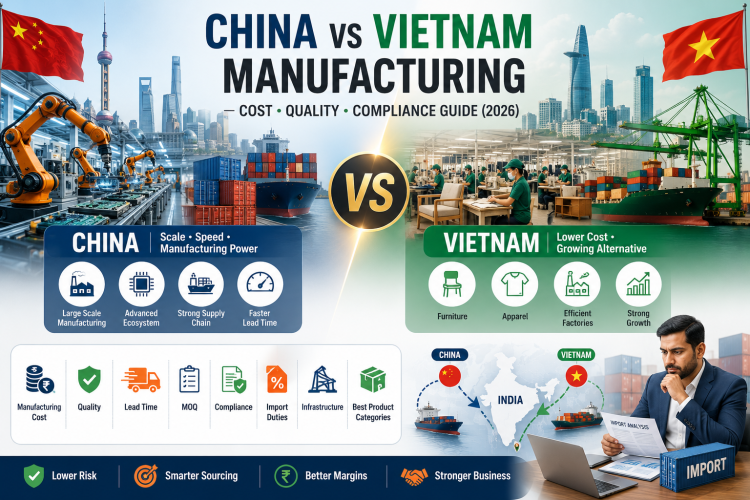
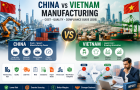
China vs. Vietnam Manufacturing in 2026: A Comprehensive Cost, Quality, and Compliance Guide for Importers
The Decision That’s Reshaping Global Supply Chains
Here’s a question that comes up in almost every conversation I have with Indian businesses: “Should I move my sourcing from China to Vietnam?”
The short answer is not a simple yes or no. The real answer depends on your product, your volume, your timeline, and what you’re actually trying to achieve.
I’ve been helping Indian businesses source from China for over 22 years. I’ve seen the entire evolution from the early days when China was the undisputed default, to today where Vietnam is a genuine contender for many product categories.
Let’s cut through the noise and look at the actual data.
Snapshot: China vs. Vietnam in 2026
| Factor | China | Vietnam |
|---|---|---|
| Average Factory Labor | $5–8/hr | $2.5–4/hr [1] |
| Typical MOQ | 500–1,000+ units | 300–1,000 units |
| Production Lead Time | 20–45 days | 30–60 days |
| Manufacturing GDP Rank | #1 globally | Top 20, rising fast |
| Workforce Size | ~800 million | ~55 million |
| Best-Fit Products | Machinery, Electronics, mass production | Footwear, furniture, garments, electronics assembly |
| Infrastructure Maturity | World-class | Rapidly improving; some constraints |
Cost: What You Actually Pay Per Unit Landed
Most comparisons stop at labor costs. That’s a mistake.
The main question is Total Landed Cost (TLC) unit cost plus freight plus tariffs plus compliance plus risk premium.
Labor and Unit Cost
Vietnam’s labor cost advantage is significant. As of 2026, Vietnamese factory wages are roughly 40–60% lesser than China [1]. The regional minimum wage in Vietnam ranges from VND 3.7 million to VND 5.31 million per month (roughly A$220–330), while China’s manufacturing hubs like Guangdong sit around RMB 2,300–2,520/month (A$490–540) [1].
However, it is important to note that lower wages do not necessarily equate to reduced per-unit costs.
Chinese factories offer higher productivity, more automation, and greater efficiency [1]. For complex products requiring precision engineering, the cost per unit in China can actually be competitive with Vietnam despite higher wages.
Tariff Exposure: The Game-Changer
This is where the math shifts dramatically.
Section 301 tariffs make Chinese goods 25% or more expensive at the customs line for wide range of categories. Some categories carry 50% cumulative tariffs [1]. Vietnam faces standard MFN duty rates materially lower for almost every HTS category [1].
Take a product with a $5.00 factory unit cost from both countries:
| Scenario | China | Vietnam |
|---|---|---|
| Factory Unit Cost | $5.00 | $5.50 |
| Tariff | 25% Section 301 ($1.25) [1] | 5% MFN ($0.28) |
| Ocean Freight | ~$0.80/unit | ~$0.90/unit |
| Landed Cost | ~$7.05 | ~$6.68 |
The tariff calculation frequently outweighs the labor cost differential [1].
The Vietnam “Backdoor” Alert for Indian Importers
A critical warning for Indian businesses: some suppliers may offer “Vietnam” sourcing that isn’t truly Vietnamese.
“Vietnam has observed large-scale Chinese investment, and many of the manufacturing units there are fully or partially Chinese-owned. Due to a free trade agreement (between India and the ASEAN bloc), there is no import duty on goods coming from Vietnam, making it an easy backdoor for Chinese products to enter India” [2].
The Indian steel ministry has flagged this exact issue. Most cast iron and stainless-steel imports coming from Vietnam are essentially of Chinese origin [2]. This isn’t just about steel it’s a pattern across multiple product categories.
If your Indian business is sourcing from Vietnam, you need to verify actual Vietnamese content and value addition, not just the country of origin stamp.
🌏 China or Vietnam? The answer depends on your product.
Every product has a different sourcing strategy. Share your product details on WhatsApp, and we’ll help you compare manufacturing costs, compliance requirements, shipping, and overall feasibility before you place an order.
For Indian Importers: The Duty and Compliance Landscape
India’s Tariff Structure: Product-Specific, Not Country-Generic
Indian importers cannot rely on “Vietnam is cheaper than China” as a rule. The actual duty depends on:
-
The exact HS code of your product
-
The country of origin (with proper Certificate of Origin)
-
The applicable trade agreement
-
Whether trade-remedy duties apply
China-origin goods sit on a different preference map. India and China exchange tariff concessions under the Asia Pacific Trade Agreement (APTA), but APTA is a PTA (Preferential Trade Agreement), not a broad FTA. It works through a positive list of agreed tariff lines, not a blanket preference [3].
Vietnam-origin goods are covered by the India–ASEAN Trade in Goods Agreement (AITIGA). This can reduce or eliminate Basic Customs Duty but not on every product line. The agreement works through multiple tracks (Normal Track, Sensitive Track, Highly Sensitive List, and Exclusion List) [3].
A good illustration: for HS 73064000 as of 2026, the ASEAN-India preferential tariff for Vietnam-origin shipment is 0%, while the MFN tariff on the same line is 15% [3].
Anti-Dumping Duty Reality
Even with preferential tariffs, trade-remedy duties can change the picture entirely.
Recent example: Textured tempered coated and uncoated glass from China and Vietnam now faces provisional anti-dumping duty of USD 565–677 per metric ton [3].
This matters because: anti-dumping and safeguard duties are included in the value base used for IGST and compensation-cess calculations [3].
The ASEAN-India FTA Scrutiny
India is actively reviewing its free trade agreements, including AITIGA, to prevent circumvention and curb the surge in non-essential imports [3]. Over 1,000 copper importers in India have reportedly been issued show-cause notices from customs authorities for misusing FTA duty exemptions by routing Chinese goods through countries like Vietnam [4]. This trend of supply chain circumvention has prompted Indian authorities to tighten scrutiny on imports from ASEAN nations to ensure compliance with Rules of Origin [4].
Quality and Capability: The Full Picture
China: The Unmatched Ecosystem
China’s manufacturing advantages remain formidable in 2026 [1]:
-
Scale and diversity are unmatched. Whatever product you need, there are dozens or hundreds of factories making it. This competition gives you leverage.
-
The supply chain ecosystem is deeply integrated. Raw materials, components, packaging, and finishing services are often available within a few kilometers of the assembly factory. This reduces costs and lead times.
-
Infrastructure is world-class. China ranks 19th globally on the World Bank’s Logistics Performance Index, compared to Vietnam’s 43rd [1].
-
Speed to market is a genuine advantage. Production cycles from confirmed order to shipment-ready goods are 20–45 days. For reorders, this can drop to 15–25 days [1].
-
“System-level certainty” as one executive noted, “China is not only about labor cost. It is about the system” [5]. When an unexpected problem arises, the ecosystem can solve it overnight in a way other countries simply can’t replicate [5].
Vietnam: The Rising Contender
Vietnam has positioned itself as the leading alternative, but it’s still developing [6]:
Strengths:
-
Flexibility Supported by modern production systems, manufacturers have reduced response time for major customers from ~10 days to just 24 hours [6]
-
Young workforce with strong ability to absorb advanced manufacturing technologies [6]
-
Deep international integration through FTAs like EVFTA and CPTPP [6]
Weaknesses:
-
Technological capability – Most support industry companies are SMEs that struggle to finance advanced machinery [6]
-
Limited financial capacity – Thin capital makes it difficult to expand production facilities [6]
-
Poor industrial links – Cooperation between domestic companies and between local suppliers and FDI manufacturers remains limited [6]
Infrastructure Constraints:
-
Vietnam’s manufacturing ecosystem is growing, but the country’s size is too small to replace China [7]
-
“The manufacturing best ecosystem” comes from China Vietnam still needs Chinese technology, equipment, and expertise [7]
-
Ports, roads, and domestic logistics are improving but not yet at China’s level [1]
Which Country for Which Product? A Decision Framework
| If Your Product Is… | Best Fit | Second Choice | Why |
|---|---|---|---|
| Consumer electronics, semiconductors | China | Vietnam (assembly) | Component ecosystem depth unmatched [1] |
| Garments and basic apparel | Vietnam | India | Labor cost + CPTPP/EVFTA access [6] |
| Footwear and leather goods | Vietnam | India | Established supplier base |
| Furniture (wood, upholstered) | Vietnam | India | Vietnam dominates ocean-shipped furniture |
| Home textiles, rugs, bedding | India | Vietnam | India’s cotton + textile cluster strength |
| Automotive parts, machinery | China | India | China’s scale; India’s engineering base |
| Toys and children’s products | China | India | China for scale [1] |
🇨🇳 or 🇻🇳 Which country is actually better for YOUR product?
The answer isn’t always China. It isn’t always Vietnam either. Send us your product details on WhatsApp, and we’ll help you compare manufacturing costs, duties, compliance requirements, lead times, and sourcing risks before you commit.
The Smart Importer’s Strategy: Dual Sourcing
The businesses I work with aren’t choosing between China and Vietnam. They’re using both strategically.
Here’s why:
-
Risk diversification – After the pandemic disruptions, relying entirely on one country creates unacceptable risk [1]
-
Product-specific optimization – Different products belong in different countries
-
Tariff arbitrage – Using ASEAN routes for products where it makes sense
The key is to know which products and which volumes belong where.
Your Decision Checklist
Before you decide China vs. Vietnam:
-
✅ Run the Total Landed Cost calculation for your specific HS code
-
✅ Check the preferential tariff route (APTA for China, AITIGA for Vietnam) [3]
-
✅ Verify actual country of origin ensure Vietnamese goods are genuinely Vietnamese [2]
-
✅ Check anti-dumping duty status for your product category [3]
-
✅ Assess quality requirements can Vietnam meet your specifications?
-
✅ Evaluate MOQ are you buying enough volume to justify either option?
-
✅ Consider lead time can you absorb longer production cycles?
How We Do Import Helps You Navigate This
With 22+ years of experience and 500+ businesses served, we at We Do Import help Indian importers make the right sourcing decision:
-
Factory verification in both China and Vietnam we physically inspect facilities
-
Multi-stage quality control using ISO 2859-1 standards
-
End-to-end compliance management BIS, WPC, LMPC, anti-dumping
-
Tariff and duty optimization we help you run the landed cost calculation
-
Door-to-door logistics and customs clearance
Our goal isn’t just to help you import it’s to help you make the right sourcing decision for your specific business.
One sourcing decision can affect your profits for years.
Before you shift manufacturing or place your next order, get a second opinion from our sourcing specialists. We’ll help you understand costs, supplier risks, certifications, and the best manufacturing base for your product.
Sources
[3] “Import Customs Duties from China and Vietnam.” We Do Import.
[4] “Over 1,000 copper importers get customs show-cause notices.” Moneycontrol.
[6] “Vietnam manufacturing: Three strengths, three weaknesses.” Vietnam Economic Times.




Leave a Reply