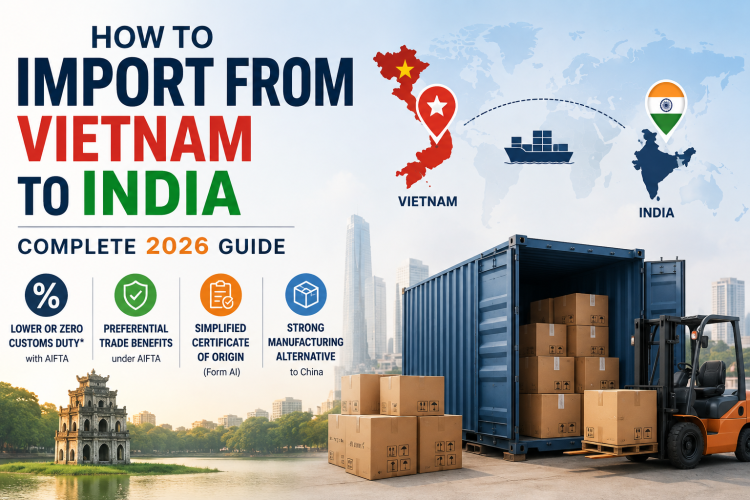
How to Import from Vietnam to India: Complete 2026 Guide
Some qualifying products imported from Vietnam to India can receive significantly reduced and in certain tariff lines, zero Basic Customs Duty under the ASEAN-India Free Trade Agreement (AIFTA), compared with the standard MFN rate that would otherwise apply. This is one of the biggest reasons Vietnam has become a go-to “China+1” sourcing destination for Indian businesses. But there’s a catch: preferential duty isn’t based simply on where your shipment leaves from. Your product must qualify under the applicable tariff line and Rules of Origin.
Here’s exactly how the Vietnam-to-India import process works, what saves you money, and where the real risk sits.
Quick Answer: Why Import from Vietnam?
Vietnam offers Indian importers two things at once: a genuine manufacturing alternative to China (strong in electronics assembly, textiles, footwear, furniture, and plastics) and a trade agreement that can provide reduced or zero customs duty on qualifying product categories. Together, that combination is why Vietnam has grown from a niche sourcing option into a mainstream one for Indian businesses over the past few years.
How the ASEAN-India Free Trade Agreement (AIFTA) Actually Works
AIFTA is a trade agreement between India and the ASEAN bloc (which includes Vietnam, along with Indonesia, Malaysia, Thailand, and other Southeast Asian countries). It progressively eliminated or reduced tariffs across thousands of product lines between the two regions.
In plain terms: if your product qualifies under AIFTA, you may pay a reduced or zero preferential Basic Customs Duty instead of the standard MFN (Most Favoured Nation) rate that applies otherwise. The actual saving depends on your product’s HS code, applicable preferential tariff rate, and whether the goods meet AIFTA Rules of Origin.
| Standard MFN Rate | AIFTA Preferential Rate | |
|---|---|---|
| Typical Basic Customs Duty | Varies by product | Reduced or 0% on qualifying tariff lines |
| What determines your rate | Your product’s HS code | Your product’s HS code AND proof it genuinely originates in Vietnam |
Source: Department of Commerce, Government of India ASEAN-India Free Trade Agreement and Rules of Origin.
The word “genuinely” in that table is doing a lot of work, and it’s the whole reason the next section exists.
The Rules of Origin Trap (Read This Before You Order)
Here’s the part most guides skip: AIFTA preferential duty only applies to goods that actually meet the applicable Rules of Origin (ROO) requirements, not just goods that shipped from a Vietnamese port.
This distinction matters because Indian customs can scrutinize preferential-duty claims where goods routed through an ASEAN country do not satisfy the applicable Rules of Origin. If the origin claim cannot be substantiated, the importer can face reassessment of the preferential duty benefit and related consequences.
Why this happens innocently, too. A product genuinely assembled in Vietnam can still fail Rules of Origin tests if it does not meet the applicable origin criteria. “Assembled in Vietnam” and “originates in Vietnam” are not automatically the same thing under trade law.
What you actually need: a valid AIFTA Certificate of Origin (Form AI) or other applicable proof of origin accepted under the agreement, and ideally your own understanding of how your product meets the applicable Vietnam-origin criteria, not just where it was boxed and shipped from.
Certificate of Origin: What Changed in 2026
Vietnam continued updating how Certificate of Origin (C/O) procedures are administered in 2026. The Ministry of Industry and Trade reported further decentralisation and simplification of C/O administration, including changes under Circular No. 26/2026/TT-BCT that took effect from August 1, 2026. For an India-bound shipment claiming AIFTA preferential treatment, the key point for the importer remains the same: the supplier must be able to provide the correct AIFTA proof of origin for the specific goods and the origin claim must satisfy the applicable Rules of Origin.
Before you place an order, confirm with your supplier:
- Can they provide a valid AIFTA Certificate of Origin (Form AI) or other applicable proof of origin for this specific shipment?
- Can they explain how the product meets the applicable Vietnam-origin criteria, not just its shipping origin?
- Which authorized issuing process or applicable origin-certification procedure will they use for the shipment?
What to Actually Source from Vietnam
Vietnam has built genuine manufacturing strength in specific categories, this isn’t a “Vietnam does everything China does” story, it’s a “Vietnam does these things well” story:
- Electronics assembly: Vietnam has become a major hub for electronics and consumer tech assembly, though component-level manufacturing can still depend on imported inputs
- Textiles and apparel: one of Vietnam’s strongest, most established export categories
- Footwear: a long-standing Vietnamese manufacturing strength
- Furniture: growing steadily as a sourcing category, particularly for export-oriented manufacturers
- Plastics and industrial hardware: an increasingly capable category, though supplier vetting matters more here than in more mature categories
Worth knowing before you commit fully: Vietnam’s manufacturing base is deeply integrated with regional supply chains, including inputs from China. This doesn’t make Vietnam the wrong choice, but it does mean “Vietnam” isn’t automatically a clean break from Chinese-origin supply chains. For AIFTA claims, what matters is whether the specific product meets the applicable Rules of Origin.
How to Actually Import from Vietnam to India: The Process
- Confirm your product’s HS code and whether it qualifies for AIFTA preferential treatment. Not every product category receives a zero rate, check the applicable preferential rate before you assume the benefit.
- Vet your supplier’s ability to provide the correct AIFTA Certificate of Origin (Form AI) or other applicable proof of origin, not just a shipping document.
- Get your IEC (Import Export Code) and GST registration in order, the same baseline requirements as importing from any country.
- Check whether your product needs BIS, WPC, or other India-specific certification, this applies regardless of where you’re importing from. See our BIS vs. ISI vs. WPC breakdown if you’re unsure which applies.
- File your Bill of Entry with the applicable proof of origin attached, claiming the AIFTA preferential rate explicitly, it isn’t applied automatically.
- Keep your documentation, invoices, origin-supporting records, the Certificate of Origin itself, well after the shipment clears. Customs can verify origin claims after the fact.
Vietnam vs. China: A Quick Comparison for Indian Importers
| Vietnam | China | |
|---|---|---|
| Duty treatment | AIFTA may provide reduced or 0% preferential rates if the tariff line qualifies and Rules of Origin are met | Standard applicable tariff treatment, plus anti-dumping duty exposure on some categories |
| Manufacturing depth | Strong in specific categories (textiles, footwear, electronics assembly) | Broadest component ecosystem and manufacturing depth overall |
| Typical MOQs | Often higher than China for smaller/newer suppliers | More flexible, especially in Yiwu/Guangzhou-style wholesale markets |
| Best fit | Businesses in Vietnam’s strength categories where sourcing economics and preferential tariff eligibility make sense | Businesses needing broad product range, complex components, or the lowest MOQs |
This isn’t an either-or decision for most businesses. See our China+1 sourcing guide for how to think about splitting sourcing between the two rather than choosing one exclusively.
✓ AIFTA Eligibility ✓ Landed-Cost Factors
How We Do Import Can Help You Navigate This
A supplier promises preferential duty but can’t actually back it up.
We verify the applicable Certificate of Origin documentation and Rules of Origin position before you commit to a supplier, not after your shipment is already at Indian customs.
Not knowing whether your specific product qualifies for AIFTA treatment at all.
We check your HS code against current AIFTA coverage and applicable rates before you finalize sourcing, so your cost assumptions are based on your real, confirmed rate, not an assumed best case.
Managing compliance across a new country when you’re used to China.
BIS, WPC, and various certification requirements in India are applicable depending on the product, irrespective of the country of origin. We develop an identical compliance roadmap for sourcing from Vietnam as we do for sourcing from China.
Frequently Asked Questions
Do all products from Vietnam get 0% import duty into India?
No. Only products covered by the applicable AIFTA preferential tariff schedule and that genuinely meet the Rules of Origin criteria, backed by the correct proof of origin, receive the applicable reduced or zero preferential rate. Products that don’t qualify are subject to the otherwise applicable customs rate.
What happens if I claim AIFTA benefits on goods that don’t actually qualify?
Customs can verify and reassess the preferential-duty claim, and if the origin claim doesn’t hold up, the importer can become liable for the duty benefit that was incorrectly claimed along with other applicable consequences.
Can Vietnam be a good alternative to China for sourcing?
For specific categories, textiles, footwear, furniture, and certain electronics assembly, yes. For broad product range, complex components, or the lowest MOQs, China generally still has the deeper ecosystem. Many businesses use both rather than choosing one exclusively.
What documents do I need to claim AIFTA preferential duty rates?
The correct AIFTA proof of origin, typically a Certificate of Origin (Form AI), your standard import documents (commercial invoice, packing list, Bill of Lading, Bill of Entry), and supporting origin documentation where required. Keep the relevant records after the shipment clears because customs can request verification of the preferential origin claim.





Leave a Reply