China +1 Sourcing: Should Your D2C Brand Diversify Beyond China in 2026?
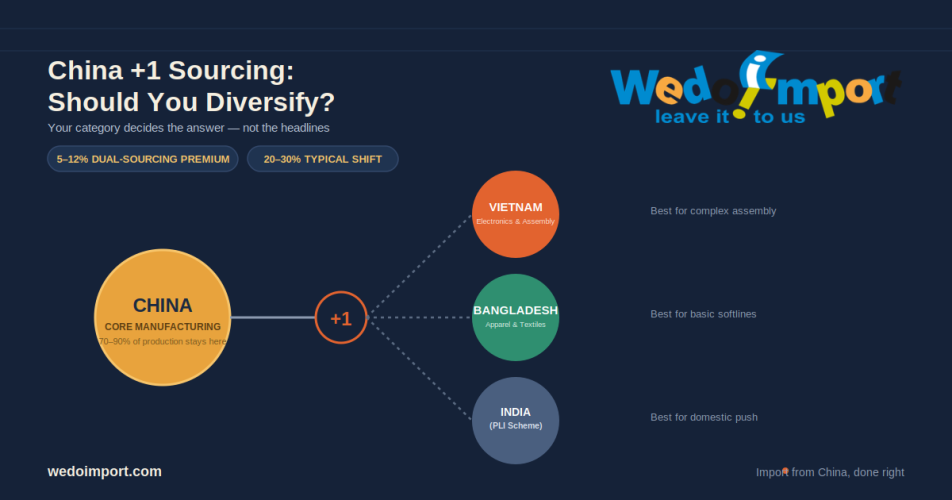
Diversifying away from China isn’t a yes-or-no decision it’s a category-by-category one, and the data backs that up. Dual-sourcing typically costs 5–12% more than staying single-source in China, and most brands that do diversify only shift 20–30% of production to a second base, not their whole supply chain. The core issue is not whether to depart from China, but rather determining which components of your product line present a level of risk that justifies the associated premium.
Most China+1 content answers this from a US-tariff angle Vietnam and Mexico as ways to dodge American import duties. That’s one valid version of the question, but it’s not the only one. Depending on where you’re importing into, the pressures that actually justify diversifying look different: US brands are weighing tariffs, while other markets are weighing their own mix of anti-dumping duties, raw material dependencies, or domestic manufacturing incentives. Here’s a straight, data-backed way to work out where your brand actually stands with a closer look at the factors that matter specifically for anyone importing into India, since that’s where a lot of the existing advice thins out.
Quick Answer: What China+1 Actually Means for Your Brand
The specific “+1” depends entirely on your category and your market. A US brand chasing tariff relief typically looks at Vietnam or Mexico. A brand importing into India is weighing a different set of pressures anti-dumping duties, rare earth dependency, and a genuine domestic manufacturing alternative through the PLI scheme. In both cases, the underlying decision is the same:
- Identify which parts of your product line carry real, specific risk
- Decide whether that risk justifies the typical 5–12% cost premium of dual-sourcing
- If it does, match the second country to the category rather than diversifying wholesale.
Before you diversify, let’s see if it actually makes financial sense.
China+1 isn’t the right strategy for every product. Share your product details or HS code with us on WhatsApp, and we’ll help you understand whether staying with China, diversifying suppliers, or moving part of your sourcing elsewhere is the smarter business decision.
Why This Conversation Is Happening Now
China’s rare earth export restrictions are creating real, measurable delays. Indian manufacturers dependent on Chinese rare earth materials have reported procurement delays of 40–45 days and new mandatory DGFT authentication requirements that didn’t exist before a direct, India-specific supply chain risk that has nothing to do with US tariff policy. This sits alongside an already-growing list of active anti-dumping duties on Chinese products that can independently erase a category’s margin overnight.
Global diversification data shows this isn’t a fringe strategy anymore. Dual-sourcing (splitting production between China and a second country) typically costs 5–12% more than staying single-source in China a real premium that has to be weighed against actual disruption risk, not adopted reflexively. Brands that have diversified are generally shifting 20–30% of production to a second base, not abandoning China wholesale.
India’s own PLI scheme has moved from policy announcement to measurable results. As of 2026, PLI-covered sectors have recorded average annual export growth of roughly 10.6% since FY21, with electronics and mobile manufacturing as the standout India is now the world’s second-largest smartphone producer, and telecom has shown genuine import substitution. This matters directly for D2C brands: it means domestic manufacturing capability in electronics-adjacent categories is measurably stronger than it was three years ago, not just a government talking point.
Source: RealShePower – PLI Scheme Impact 2026, PIB – PLI Scheme Overview.
The Real Trade-Offs: China vs. Diversifying
| Factor | Staying 100% China | Diversifying (China+1) |
|---|---|---|
| Cost | Lowest baseline cost, most mature supply chain | Typically 5–12% more expensive to run dual-sourcing |
| Risk exposure | Concentrated a single disruption (export restriction, anti-dumping duty change, logistics crisis) affects 100% of your supply | Spread a disruption in one base doesn’t halt everything |
| Complexity | One set of supplier relationships, one compliance framework to manage | Multiple supplier relationships, potentially multiple compliance frameworks |
| Best fit | Smaller D2C brands with limited operational bandwidth, or categories with no viable alternative base | Brands with enough scale to absorb the cost premium and manage added complexity |
Source: Fanxstar Supply Chain Diversification Guide, citing US ITC data, Cosmo Sourcing China Plus One Ultimate Guide.
The honest takeaway: diversification isn’t free, and it isn’t automatically the right call for every brand. If you’re a smaller D2C brand with one or two hero products and limited operational bandwidth, the 5–12% cost premium and added supplier-management complexity may genuinely outweigh the risk you’re hedging against. This is a scale-and-category decision, not a blanket “diversify or fall behind” rule despite how most content on this topic frames it.
🌏 Should you diversify or is China still the right choice?
Every product category is different. Tell us what you’re importing, and we’ll help you understand whether staying with China, adopting a China+1 strategy, or exploring domestic manufacturing makes the most business sense for your specific product.
How to Decide: A Simple Framework
Step 1: Check your category’s actual exposure. Does your product touch rare earth materials, or sit in a category with active or pending anti-dumping duty from China? If not, your risk may be lower than the general “China+1” narrative suggests. Check our full 2026 anti-dumping duty list for your specific HS code.
Step 2: Start with supplier diversification inside China, not country diversification. Multiple factories across different Chinese regions already reduces single-point-of-failure risk, without the 5–12% cost premium or added compliance complexity of a second country. If cost modeling is where you’re stuck, our full landed cost breakdown walks through exactly what changes when you add a second sourcing base.
Step 3: If you do need a second base, match the country to the category, not the other way around. Electronics and complex assembly generally have stronger alternatives in Vietnam; simpler textile and apparel categories have viable alternatives in Bangladesh; but neither replaces China’s component ecosystem overnight most successful transitions keep core manufacturing in China and move only final assembly or simpler product lines elsewhere.
Step 4: Factor in India’s own PLI-supported sectors as a genuine option, particularly for electronics-adjacent categories, where domestic capability has measurably improved rather than being purely aspirational. Whichever base you choose, the certification requirements don’t disappear see our BIS vs. ISI vs. WPC breakdown for what still applies regardless of where a product is made.
How We Do Import Helps You Navigate This
Not knowing your actual risk exposure before deciding to diversify. We check your specific product’s HS code against current DGTR/CBIC anti-dumping status and known rare-earth dependency, so your diversification decision is based on your real exposure, not a general headline.
Diversifying too early, adding cost and complexity you don’t need yet. We help clients diversify suppliers within China first multiple vetted factories, reducing single-point failure before recommending the added cost and complexity of a second country, which isn’t the right first move for every brand. This is the same “one accountable process” approach we use for every China sourcing engagement, not a separate service.
Managing compliance across multiple sourcing countries becomes its own burden. If a second base does make sense for your category, we build the compliance roadmap for each sourcing country separately, so BIS/ISI/WPC requirements are managed consistently regardless of where a given product line is actually made. And if you’re managing supplier relationships across two countries without a dedicated partner, our guide on vetting China import agents applies just as much to any second-country agent you’re evaluating.
Is your product actually at risk or are you worrying unnecessarily?
Share your product name or HS code on WhatsApp. We’ll help you assess exposure to anti-dumping duties, rare-earth dependencies, compliance requirements, and whether a China+1 strategy is genuinely worth considering.
Frequently Asked Questions
Should every D2C brand diversify away from China in 2026?
No. Diversification typically costs 5–12% more to run and adds real supplier-management complexity for smaller brands without meaningful exposure to anti-dumping duty or rare-earth-dependent categories, staying with a well-managed China sourcing relationship is often still the more efficient choice.
What’s the difference between China+1 for a US brand and an Indian D2C brand?
US brands are largely diversifying to dodge tariffs and gain USMCA/trade-agreement advantages, favoring Vietnam and Mexico. Indian D2C brands face different pressures rare earth export restrictions, India-specific anti-dumping duties, and currency exposure and have a genuine domestic manufacturing option through India’s PLI scheme that US brands don’t have in the same way.
Is Vietnam or Bangladesh a good “plus one” for an Indian D2C brand?
It depends entirely on category Vietnam has stronger capability for electronics and complex assembly, while Bangladesh is generally better suited to textiles and basic apparel. Neither fully replaces China’s component ecosystem, so most brands that diversify keep core manufacturing in China and shift only specific product lines.
How much of my production should I actually move if I do diversify?
Most brands that diversify successfully shift roughly 20–30% of production to a second base rather than a wholesale move treating it as a hedge against disruption, not a replacement strategy.
Not sure whether your product category has real diversification risk, or whether staying with China is still the smarter move for your brand’s scale? Message us on WhatsApp we’ll give you a straight read on your actual exposure before you make any changes.




Leave a Reply