The 4-Hour Guangzhou Wholesale Market Challenge: What to Check Before You Pay
A practical guide to checking supplier credentials, evaluating product samples, comparing commercial terms and reducing payment risks before placing an order in China.
Walking into a Guangzhou wholesale market can feel like entering an entirely different world of business. Rows of suppliers, hundreds of product variations, busy sales counters and seemingly endless purchasing options make it possible to discover products quickly.
But finding an attractive product at a competitive price is only the beginning.
Who actually owns the business behind the stall? Does the seller manufacture the product or source it from another factory? Will the bulk production match the sample? Are the quoted prices inclusive of packaging and customisation? Does the bank account receiving your payment belong to the company named on your invoice?
These are questions that matter much more than the price written on a supplier’s calculator.
For international buyers, particularly first-time importers, the challenge is not simply finding products in Guangzhou. It is establishing whether the supplier, product, commercial terms and payment arrangements are suitable before committing money.
A promising showroom sample does not automatically represent the quality of a bulk order. A business licence does not independently prove manufacturing capability. And a low unit price does not necessarily translate into a profitable landed cost.
This is why a structured supplier evaluation process is important.
In this guide, we break the initial supplier-screening process into four practical hours. It covers the checks buyers can start at a Guangzhou wholesale market, the information they should request from suppliers, and the additional verification that may need to happen after leaving the market.
The objective is simple: compare suppliers on evidence, not just sales promises.
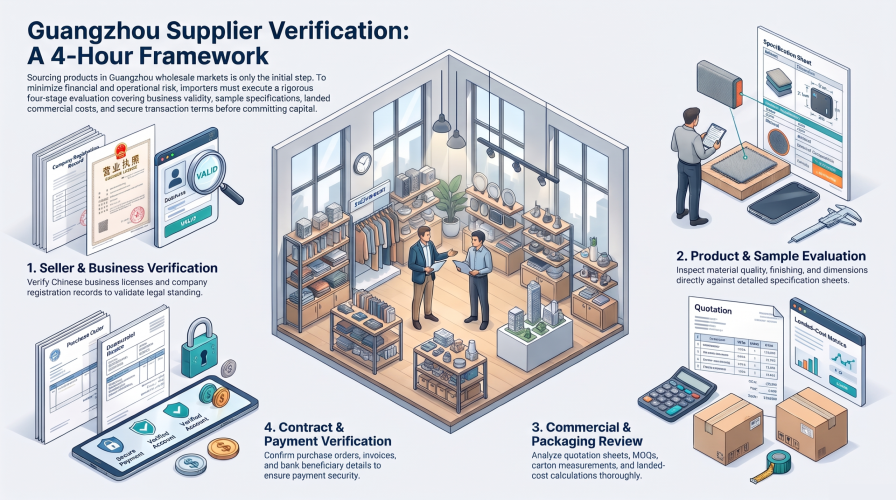
The 4-Hour Guangzhou Supplier Verification Framework
Before discussing prices or paying an advance, use this four-part framework to organise your supplier evaluation.
| Time | Verification stage | What you need to establish |
|---|---|---|
| Hour 1 | Seller and business verification | Who are you dealing with? Manufacturer, trading company or market reseller? |
| Hour 2 | Product and sample evaluation | Does the sample meet your actual product requirements? |
| Hour 3 | Commercial and packaging review | Are the price, MOQ, MPQ, specifications and delivery terms clear? |
| Hour 4 | Contract and payment preparation | Are the contracting entity, payment beneficiary and transaction documents consistent? |
Important: Four hours is a practical initial screening window, not a substitute for a complete factory audit, independent legal verification, laboratory testing or pre-shipment inspection. Some checks will require additional time, documentation and independent service providers.
Hour 1: Verify the Seller Behind the Wholesale Stall
One of the first mistakes buyers make is assuming that every wholesale stall represents a manufacturing facility.
In reality, you may encounter several types of businesses:
- Manufacturer (Gōngchǎng – 工厂): A business operating production facilities or manufacturing processes.
- Trading company (Màoyì Gōngsī – 贸易公司): A business that sources products from manufacturers and sells them to buyers.
- Wholesale distributor: A business purchasing products in bulk and reselling them.
- Market reseller or agent: A seller who may represent another supplier or coordinate orders without manufacturing the products themselves.
Working with a trading company is not automatically a bad decision. A capable trading company may offer product variety, communication support, consolidated purchasing and access to several factories.
The important thing is to understand who is responsible for your order and whether the supplier’s actual capabilities match what they are promising.
Step 1: Request the company’s business licence
Ask the supplier to share its Chinese business licence (Yíngyè Zhízhào – 营业执照).
You should collect:
- Registered Chinese company name.
- Unified Social Credit Code.
- Legal representative’s name.
- Registered business address.
- Business scope.
- Registration or establishment date.
Do not rely solely on a photograph of the licence displayed at a stall. Request a clear digital copy and compare its details with the information provided on the quotation and pro forma invoice.
Step 2: Verify the company through China’s official registry
China’s National Enterprise Credit Information Publicity System (GSXT) is an important starting point for checking registered business information.
Official website: https://www.gsxt.gov.cn/
The system provides access to company registration information, including company names, Unified Social Credit Codes, registered addresses, business scope and other enterprise information. The Shanghai Municipal Government also explains that the national enterprise registration database makes this information publicly accessible through GSXT. Source: Shanghai Municipal Government.
Check the following:
- Does the Unified Social Credit Code match the licence?
- Does the registered company name match the supplier’s documents?
- Is the business registration status active?
- Does the registered address appear consistent with the supplier’s explanation?
- Does the business scope reasonably cover the activities being represented?
- Are there publicly disclosed abnormal-operation or serious-violation records that require further investigation?
The Unified Social Credit Code is particularly useful because it serves as a unique identifier for registered business entities.
A useful distinction: Business scope is an indicator, not conclusive proof of manufacturing capability. A company listing manufacturing activities may still outsource production, while a trading company may be an entirely legitimate supplier.
The Chinese Market Entity Registration Regulations establish the registration framework for businesses and require market entities to be registered before operating under that status, subject to applicable exceptions. Source: State Council of China.
Step 3: Establish whether the supplier actually controls production
If a seller claims to own a factory, ask for evidence that supports that claim.
Useful questions include:
- Where is the manufacturing facility located?
- Which processes are performed in-house?
- Which components or processes are outsourced?
- Can the company provide recent production-floor photographs or videos?
- Can you arrange a scheduled factory visit?
- Who is responsible for quality control during production?
- Can the supplier identify the actual manufacturing entity on the purchase documents?
A live video call can be useful as an initial screening method. Ask to see relevant production areas, machinery, raw materials and finished-goods storage where appropriate.
However, a video call is not proof of factory ownership. The supplier could be showing another company’s premises or an outsourced production facility.
For higher-value orders, arrange an independent factory verification or on-site assessment.
Questions to ask before moving forward
| Question | Why it matters |
|---|---|
| Are you the manufacturer or a trading company? | Establishes the supplier’s business role. |
| Which company will sign the purchase contract? | Identifies the contracting entity. |
| Where will the products actually be manufactured? | Helps establish production responsibility. |
| Can you provide the factory’s registered details? | Allows further verification where relevant. |
| Who handles quality checks? | Establishes the quality-control arrangement. |
| Can we arrange a factory visit or independent verification? | Helps validate manufacturing claims. |
Hour 1 outcome: You should understand who you are negotiating with, what role the company plays and what further verification is required before placing an order.
Not Sure If Your Chinese Supplier Is Reliable?
Before making an advance payment, get the right sourcing guidance and make a more informed decision.
Hour 2: Evaluate the Product Sample Beyond Its Appearance
A product that looks impressive on a wholesale display may not necessarily represent the specifications or consistency of the bulk production.
This is why product evaluation should go beyond visual appearance.
For example, two bags may look almost identical but differ in zipper quality, lining thickness, stitching strength and material composition. Similarly, two electronic accessories may have the same external appearance but use different internal components.
The buyer’s responsibility is to define what constitutes an acceptable product before approving production.
Step 1: Prepare a product specification sheet
Before evaluating samples, establish the basic requirements.
Depending on the product, document:
- Product dimensions and tolerances.
- Material type and grade.
- Weight.
- Colour and finish.
- Component specifications.
- Functional requirements.
- Branding and printing requirements.
- Packaging requirements.
- Applicable safety and regulatory requirements.
For example, if you are sourcing a travel bag, the specification sheet might include fabric type, lining material, zipper specification, stitching requirements, handle strength, dimensions and acceptable weight range.
This provides a measurable reference rather than relying on descriptions such as premium quality or export quality.
Step 2: Conduct product-specific sample checks
Not every product should be tested using the same procedure.
The following table illustrates checks that may be appropriate depending on the product.
| Product category | What to evaluate |
|---|---|
| Apparel and textiles | Fabric composition, GSM where relevant, stitching, seams, sizing and colour consistency |
| Leather goods and bags | Material consistency, zipper operation, stitching, lining, hardware and edge finishing |
| Household products | Dimensions, material thickness, finish, functionality and durability requirements |
| Consumer electronics | Electrical specifications, charging performance, component details, safety and applicable certifications |
| Plastic products | Dimensions, wall thickness, material identification, finish and functional performance |
| Footwear | Sizing, sole attachment, stitching, material, flexibility and comfort requirements |
For electrical products, battery-powered goods, chemicals or products with safety implications, do not improvise potentially hazardous tests at a market stall. Use appropriate test equipment, qualified personnel and accredited laboratories where required.
Step 3: Measure and document important specifications
Depending on the product, you may need:
- Digital calipers for dimensions.
- A weighing scale for product weight.
- A measuring tape for fabric or garment dimensions.
- A colour reference or Pantone specification where applicable.
- Functional testing equipment suitable for the product.
Record the actual measurements and compare them with the agreed specifications.
A difference in weight, thickness or material can affect product performance, shipping economics and the buyer’s ability to maintain consistent quality.
Step 4: Approve and retain a reference sample
Once a sample meets your requirements, establish it as the approved reference sample.
A good sample approval process should include:
- A unique sample reference number.
- Product photographs from multiple angles.
- Recorded measurements and material details.
- Approved colour and finish references.
- Any agreed functional test results.
- Written supplier confirmation.
- A retained physical sample where practical.
Both parties should acknowledge the approved reference sample and retain matching records.
This is important because the sample, written specification and final production must be evaluated against the same agreed requirements.
China’s Product Quality Law addresses the responsibilities of producers and sellers, including product conformity with applicable requirements and the quality conditions communicated through product descriptions and physical samples. Source: China’s National Medical Products Administration / official law publication.
Hour 2 outcome: You should have a documented product specification and an agreed sample reference, not merely a verbal assurance that the product is good quality.
Looking for the Right Supplier in China?
Finding suppliers is easy. Finding the right ones takes research, comparison and proper evaluation.
Hour 3: Compare MOQ, MPQ, Pricing and Packaging Requirements
A supplier offering a lower unit price does not necessarily offer the better commercial deal.
Your actual purchase cost depends on order quantity, packaging, customisation, shipping dimensions, production arrangements and other charges.
This is why buyers should compare the complete quotation rather than focusing only on the unit price.
Step 1: Understand MOQ and MPQ
Two terms that buyers frequently encounter are MOQ and MPQ.
MOQ – Minimum Order Quantity
The minimum quantity a supplier is willing to accept for an order or production run.
MPQ – Minimum Pack Quantity
A supplier-defined minimum quantity per pack, bundle or packaging unit. Its meaning and application can vary between suppliers, so confirm exactly how it is being used in the quotation.
Consider this illustrative example:
- Supplier MOQ: 500 units.
- Supplier MPQ: 40 units per carton.
If the supplier requires orders to be placed in complete cartons, quantities may need to follow multiples of 40.
For example:
| Order quantity | Meets 500-unit MOQ? | Complete 40-unit cartons? |
|---|---|---|
| 480 | No | Yes |
| 520 | Yes | Yes |
| 560 | Yes | Yes |
| 600 | Yes | Yes |
In this example, 520 units would satisfy both requirements.
Always confirm whether the MOQ applies to a single product, a particular colour, a design, a combined order or the total production run.
Step 2: Compare quotations using identical specifications
When comparing suppliers, request quotations using the same product requirements.
Your comparison should include:
- Unit price.
- Order quantity.
- MOQ and MPQ.
- Material and component specifications.
- Packaging cost.
- Branding or customisation charges.
- Sample charges.
- Tooling or mould charges, if applicable.
- Production lead time.
- Payment terms.
- Delivery terms.
A supplier quoting a lower price may be using a different material, packaging arrangement or product specification.
For a fair comparison, establish that the quotations describe equivalent products.
Step 3: Check packaging dimensions and carton configuration
Packaging is not just a presentation detail. It affects product protection, handling, warehouse space and transportation costs.
Request the following details:
| Packaging information | What to confirm |
|---|---|
| Carton dimensions | Length × width × height |
| Units per carton | Exact quantity packed in each carton |
| Net weight | Weight of products without packaging |
| Gross weight | Weight including packaging |
| Packaging material | Carton strength and internal protection |
| Carton configuration | Number of cartons for the full order |
| Shipping marks | Carton identification and handling information |
| Special handling | Fragile, moisture-sensitive or orientation requirements |
Do not assume that every shipment should use the same carton weight or board thickness. Packaging should be selected according to the product, transport conditions, handling requirements and applicable standards.
Where retail barcodes or logistics identifiers are required, confirm the correct standards and allocation responsibilities. GS1 explains that barcodes can encode product, shipment and location identifiers, helping supply-chain participants identify and track goods. Source: GS1.
Step 4: Understand the complete landed cost
The supplier’s unit price is only one part of your purchasing cost.
A useful landed-cost calculation is:
Total landed cost = Product cost + Origin charges + International freight + Insurance + Customs duties and taxes + Destination charges + Other applicable costs.
For a unit-level estimate:
Landed cost per unit = Total estimated landed cost ÷ Total sellable units received.
Depending on the shipment, additional costs may include:
- Inland transportation in China.
- Consolidation and warehouse handling.
- Export documentation.
- Freight forwarding.
- Cargo insurance.
- Customs brokerage.
- Import duties and taxes.
- Port and terminal charges.
- Local transportation.
- Inspection and testing.
- Bank and foreign-exchange charges.
For example, a supplier quoting USD 4 per unit may appear more attractive than one quoting USD 4.30. But if the first supplier uses larger cartons, has higher packaging costs or requires a more expensive shipping arrangement, the overall landed cost may be higher.
Step 5: Clarify delivery responsibilities using Incoterms
When negotiating international shipments, clarify the agreed Incoterms rule and its named place or port.
The International Chamber of Commerce (ICC) publishes Incoterms rules to define important responsibilities, costs and risk allocation between buyers and sellers. Incoterms 2020 is the current edition identified by the ICC. Source: ICC.
For example, FOB, CIF, FCA and DAP do not mean the same thing. Buyers should understand which party is responsible for arranging transportation, insurance where applicable, export and import formalities, and where delivery risk transfers.
One important point: Incoterms do not replace a purchase contract. They do not independently establish product specifications, payment terms, ownership transfer or remedies for defective goods. Those matters need to be addressed separately in the sale agreement. Source: ICC Digital Library.
Hour 3 outcome: You should have a comparable quotation, a clear understanding of packaging and order quantities, and a preliminary landed-cost estimate.
Hour 4: Confirm Contracts, Payment Details and Transaction Documents
This is where supplier evaluation becomes a commercial commitment.
A buyer may have identified a suitable product, approved a sample and negotiated an attractive price. However, the transaction should not move forward until the contracting entity, payment instructions and order documentation have been checked.
Step 1: Request a pro forma invoice
A pro forma invoice should clearly identify the seller and describe the proposed transaction.
Check that it includes:
- Full registered company name.
- Registered or business address.
- Buyer and seller details.
- Product description and specifications.
- Quantity and unit price.
- Total order value and currency.
- Packaging details.
- Production lead time.
- Payment schedule.
- Delivery terms and named place.
- Any additional charges.
- Invoice date and reference number.
The product description should be specific enough to identify what you are buying.
Avoid vague descriptions such as accessories, bags or electronic products when a detailed product specification is available.
Step 2: Match the contracting entity with the payment beneficiary
One of the most important payment checks is establishing who will receive your money.
Compare:
- The company named on the business licence.
- The company named on the pro forma invoice.
- The company signing the purchase contract.
- The beneficiary named in the bank payment instructions.
Ideally, these should refer to the same legal entity.
If a supplier requests payment to a different company or individual, pause and ask for a clear written explanation and supporting documentation. Third-party payment arrangements should be independently verified and reviewed before funds are released.
Do not rely solely on a WeChat message or an informal explanation for a change in bank details.
Confirm bank instructions through an independently verified communication channel, especially when a supplier sends revised payment information.
Step 3: Agree on payment milestones
There is no universal payment structure suitable for every Chinese supplier or product category.
A 30% deposit and 70% balance arrangement is one possible commercial structure, but the appropriate terms depend on the supplier, order value, product, relationship and negotiating position.
Instead of accepting a standard arrangement without discussion, establish:
- What triggers the initial deposit?
- When does production officially begin?
- Will sample approval be documented?
- What production updates will be provided?
- When will inspection take place?
- What happens if the goods fail the agreed inspection?
- When is the remaining balance payable?
- How will delays, defects or order changes be handled?
For larger or higher-risk orders, consider more protective payment mechanisms where commercially and legally appropriate.
Step 4: Put product quality and delivery requirements in writing
A purchase order or sales contract should refer to the approved product specifications and sample.
It should also explain:
- Product dimensions and tolerances.
- Materials and components.
- Colour and finish.
- Branding and packaging.
- Agreed quantity.
- Production timeline.
- Inspection arrangements.
- Acceptance criteria.
- Defect-handling procedures.
- Replacement, rework or refund arrangements.
- Dispute-resolution provisions.
This is important because a sample approval without a detailed specification can leave room for disagreement about what was actually promised.
Step 5: Agree on a quality inspection milestone
Where appropriate, arrange an independent pre-shipment inspection before releasing the final balance.
The inspection should be based on agreed specifications and a written inspection plan.
This may include:
- Product appearance and workmanship.
- Quantity verification.
- Dimensions and measurements.
- Functional testing.
- Packaging and carton checks.
- Labelling and marking.
- Required documentation.
- Product-specific safety or compliance checks.
Understanding AQL and ISO 2859-1
AQL stands for Acceptance Quality Limit. It is used in statistical acceptance sampling plans, not as a simple guarantee that a shipment will contain a particular percentage of defects or that every item is defect-free.
Importantly, ISO published the third edition of ISO 2859-1 in January 2026. The standard covers single, double and multiple sampling plans for inspection by attributes, indexed by AQL. It also includes rules relating to normal, tightened, reduced and skip-lot inspection. Source: ISO 2859-1:2026.
Before commissioning an inspection, agree on:
- The inspection standard and edition.
- The inspection level.
- The lot size.
- The sample size.
- Critical, major and minor defect classifications, where applicable.
- Acceptance and rejection numbers.
- Functional tests.
- Packaging and labelling checks.
- The process for handling a failed inspection.
AQL 2.5, for example, should not be treated as a universal quality guarantee. The applicable sampling plan and acceptance criteria must be selected and agreed upon for the particular order.
Hour 4 outcome: You should have a documented commercial agreement, verified payment instructions and a clear plan for inspection and final payment.
5. Five Supplier Red Flags That Deserve Further Investigation
Not every supplier concern means that the business is fraudulent. However, certain behaviours should prompt additional verification before you proceed.
| Warning sign | Why it matters | What to do |
|---|---|---|
| Refusal to provide business details | You cannot establish the contracting entity | Request verifiable registration information |
| Payment requested to an unrelated personal account | The payment beneficiary may not be accountable under the purchase contract | Pause and independently verify the arrangement |
| Unclear factory or production claims | You may not know who is actually responsible for manufacturing | Request production evidence and independent verification |
| Resistance to documented specifications or inspection | There may be disagreement about quality expectations | Establish written specifications and inspection terms |
| Repeated pressure to pay immediately | You may not have enough time to complete due diligence | Avoid making rushed payment decisions |
Other warning signs include unexplained changes in bank details, quotations that omit important costs, unrealistic production promises and inconsistent company information.
A practical rule: Do not make a purchasing decision based on a single warning sign. Assess the complete picture, request evidence and escalate the checks according to the value and risk of the order.
THE IMPORTER’S FIELD GUIDE
Visiting Guangzhou to Source Products? Take This Checklist With You!
Make your Guangzhou sourcing visit more productive. Get our practical field checklist to explore wholesale markets, evaluate suppliers, assess product samples, compare quotations and identify red flags before placing an order.
Get Your FREE Checklist on WhatsApp →
Free resource · Practical Guangzhou sourcing guide · Delivered on WhatsApp
SUPPLIER VERIFICATION
Verify Suppliers
Evaluate Products
Compare Costs
Prepare to Order
6. The Importer’s Supplier Verification Scorecard
Comparing suppliers becomes easier when you use the same evaluation criteria for every business.
Use the following scorecard to compare three potential suppliers.
| Evaluation criteria | Supplier A | Supplier B | Supplier C |
|---|---|---|---|
| Company identity verified | /10 | /10 | /10 |
| Business role clearly established | /10 | /10 | /10 |
| Manufacturing capability assessed | /10 | /10 | /10 |
| Product sample meets requirements | /10 | /10 | /10 |
| Product specifications documented | /10 | /10 | /10 |
| Price and commercial terms clear | /10 | /10 | /10 |
| MOQ and MPQ suitable | /10 | /10 | /10 |
| Packaging and shipment requirements clear | /10 | /10 | /10 |
| Payment details verified | /10 | /10 | /10 |
| Inspection and defect-handling terms agreed | /10 | /10 | /10 |
| Total | /100 | /100 | /100 |
This scorecard is a buyer’s decision-making tool, not a formal certification or guarantee of supplier reliability.
A supplier scoring well on price but poorly on business verification, product specifications or payment transparency should not automatically be selected.
For high-value orders, give more importance to the criteria that represent the greatest commercial and product risk.
7. What Happens After the Guangzhou Market Visit?
Completing an initial supplier assessment does not mean the sourcing process is finished.
In fact, some of the most important checks happen after you leave the wholesale market.
A typical sourcing process may continue through these stages:
1. Supplier verification
Confirm the legal entity, business role, manufacturing arrangements and relevant company information.
2. Sample confirmation
Obtain and approve the sample against documented specifications.
3. Commercial confirmation
Finalise the purchase order, pricing, quantity, payment milestones, packaging and delivery terms.
4. Production follow-up
Coordinate with the supplier to monitor production progress, changes and agreed timelines.
5. Quality inspection arrangements
Arrange appropriate product and shipment checks before dispatch, based on the order requirements.
6. Consolidation and shipment coordination
Confirm the quantity received, carton details, shipping documents, freight arrangements and destination requirements.
7. Import and delivery planning
Account for applicable customs requirements, duties, taxes and destination logistics.
This process matters because a successful market visit is only the first step towards receiving the right products at the right destination.
8. How We Do Import Helps Businesses Source from China
Finding a wholesale supplier in Guangzhou is one part of importing. Identifying the right supplier, understanding the product, documenting the commercial terms and coordinating the shipment require a more structured approach.
At We Do Import, we help businesses identify reliable suppliers in China and coordinate their sourcing requirements.
Our support can include:
Supplier Identification
Finding potential Chinese suppliers based on your product requirements, target pricing, order quantity and sourcing preferences.
Supplier Selection Support
Helping assess available supplier information, product suitability, commercial terms and sourcing options before you proceed.
Sample Coordination
Coordinating sample requests and confirmation so that product expectations are documented before bulk production.
Production Follow-up
Coordinating supplier communication and progress updates during the production process.
Quality Inspection Arrangements
Helping arrange appropriate inspection services based on the product, agreed specifications and shipment requirements.
Consolidation and Shipment Coordination
Supporting the coordination of products from suppliers, consolidation arrangements and international shipping requirements.
With 22+ years of real trade experience and 500+ brands and customers helped, We Do Import aims to make sourcing from China more structured and transparent.
Whether you are a first-time importer, a growing retailer, a D2C brand or an established business looking for additional suppliers, a well-planned sourcing process can help you make more informed purchasing decisions.
From Supplier Search to Shipment Coordination
Need help finding reliable suppliers in China? We Do Import helps businesses with supplier sourcing, sample confirmation, production follow-up, quality inspection coordination and shipment support.
Talk to Our Sourcing Team on WhatsApp →
We Do Import | 22+ Years of Trade Experience
Frequently Asked Questions
1. How do I verify a wholesale supplier in Guangzhou?
Start by requesting the supplier’s Chinese business licence and Unified Social Credit Code. Cross-check the information through China’s National Enterprise Credit Information Publicity System (GSXT). Then establish whether the seller is a manufacturer, trading company or reseller, and verify production claims separately where necessary.
2. How can I check whether a Chinese supplier is a factory or trading company?
Ask for the company’s business licence, manufacturing address and details of its production processes. Review the registered business scope, request production evidence and arrange a factory visit or independent verification when appropriate. Business scope alone does not establish actual manufacturing capability.
3. Is it safe to pay a Chinese supplier through WeChat or a personal bank account?
Payment methods should be evaluated against the identity of the contracting entity and the transaction documents. A request to pay an unrelated individual or third party should trigger additional verification. Confirm the beneficiary independently before transferring funds.
4. What documents should I request before paying a Chinese supplier?
Depending on the transaction, request the supplier’s business licence, detailed quotation, pro forma invoice, purchase order or sales contract, bank beneficiary details, approved product specifications and any applicable product compliance documentation.
5. What is the difference between MOQ and MPQ?
MOQ is the minimum order quantity a supplier accepts. MPQ is a supplier-defined minimum pack quantity or ordering multiple. Confirm how the supplier applies both terms, particularly when quantities must align with complete cartons or packaging units.
6. Should I approve a showroom sample before placing a bulk order?
You should evaluate and approve a representative sample against your product specifications before bulk production. Record measurements, materials, colours, functional requirements and other relevant characteristics. Retain an approved reference sample where practical.
7. What is AQL 2.5 in product inspection?
AQL 2.5 is an acceptance quality limit used within statistical sampling plans. It does not mean every shipment will contain no more than 2.5% defective products. The actual inspection sample size and acceptance or rejection criteria depend on the agreed sampling plan and inspection parameters.
8. Should I conduct a pre-shipment inspection before making the final payment?
For orders where quality and quantity risks justify it, an independent pre-shipment inspection can provide useful evidence before dispatch and final payment. Agree on the inspection scope, sampling method, defect classifications and acceptance criteria in advance.
9. What should I check in a Chinese supplier’s quotation?
Check product specifications, unit price, quantity, MOQ, MPQ, packaging, customisation charges, tooling costs, sample costs, production lead time, payment terms and delivery terms. Compare quotations using identical product requirements.
10. Can I source products from Guangzhou if I am a first-time importer?
Yes. However, first-time importers should prepare product specifications, target quantities, a budget and a supplier evaluation process before visiting. They should also understand applicable product regulations, customs requirements, shipping costs and payment risks before committing to an order.
11. Does a low wholesale price always mean a better sourcing opportunity?
No. The quoted price may not include packaging, branding, inland transportation, freight or other charges. Differences in material quality and product specifications can also make two quotations incomparable. Evaluate the total landed cost and the product’s suitability rather than choosing solely on unit price.
12. What should I do if the bulk shipment does not match the approved sample?
Document the differences using photographs, inspection findings, purchase specifications and the approved sample reference. Notify the supplier in writing and follow the defect-resolution procedure agreed in the contract. Depending on the circumstances, this may involve rework, replacement, compensation or another negotiated remedy.
Final Takeaway: Verify Before You Commit
A successful Guangzhou sourcing trip is not measured by how many stalls you visit or how many quotations you collect.
It is measured by how well you understand the suppliers you are considering, the products you intend to purchase, the commercial commitments you are making and the risks involved in getting those products delivered.
Before releasing an advance payment, make sure you can answer four questions:
- Who am I buying from? Verify the seller and establish its actual business role.
- What exactly am I buying? Document product specifications and approve a representative sample.
- What will the order really cost? Compare commercial terms, packaging and landed cost.
- How is my payment and quality protected? Confirm the contracting entity, payment beneficiary, inspection arrangements and written agreement.
The difference between finding a supplier and making a sound sourcing decision is the quality of the verification process behind it.
Research. Verify. Compare. Then Buy.
That is a better starting point for every international buyer sourcing from China.
Sources and Further Reading
The following authoritative resources support the business verification, product quality, inspection and international trade concepts discussed in this guide.
- Shanghai Municipal Government – Market Access and Enterprise Registration Information: Explains China’s national enterprise registration database and the company information accessible through GSXT.
https://english.shanghai.gov.cn/en-Business-MarketEntryAccess-MarketAccess/20260818/89a3a21cce3548cea0ec421f4e236575.html - State Council of China – Regulation on the Registration of Market Entities: China’s business registration framework.
https://app.www.gov.cn/govdata/gov/202108/24/475109/article.html - China Product Quality Law – Official English publication: Covers producer and seller responsibilities and product quality requirements.
https://english.moa.gov.cn/policies/201910/t20191009_297834.html - ISO 2859-1:2026 – Sampling Procedures for Inspection by Attributes: The latest published edition of the international standard for AQL-indexed lot-by-lot sampling schemes.
https://www.iso.org/standard/2859-1 - International Chamber of Commerce – Incoterms Rules: Explains the role of Incoterms in international trade contracts.
https://iccwbo.org/business-solutions/incoterms-rules/ - ICC Digital Library – Incoterms and Commercial Contracts: Explains what Incoterms cover and what must be addressed separately in a sales contract.
https://library.iccwbo.org/clp/clp-incoterms-qa-2020.htm - GS1 – Barcodes and Supply Chain Identification: Explains the use of product, shipment and location identifiers in supply chains.
https://www2.gs1.org/standards
Editorial note: This guide is for general commercial and sourcing education. Supplier verification, product compliance, inspection and import requirements vary by product, transaction, destination market and applicable law. Buyers should obtain appropriate professional advice for high-value, regulated or technically complex purchases.







Leave a Reply