Sourcing Smart Pet Products from China: 10 Products, Manufacturing Hubs & Import Risks (2027 Guide)
The pet industry is changing. Consumers are no longer looking only for basic feeding bowls, collars, toys, and grooming accessories. Increasingly, pet owners are exploring products that make feeding, tracking, cleaning, grooming, and monitoring their pets easier.
This shift is creating opportunities for businesses interested in sourcing smart pet products from China.
For D2C brands, Amazon sellers, wholesalers, retailers, and importers, products such as automatic pet feeders, GPS collars, smart cameras, and self-cleaning litter boxes offer interesting possibilities for product differentiation.
But there is a challenge.
Sourcing a smart pet product is not the same as sourcing an ordinary plastic accessory.
These products may contain electronic components, wireless modules, rechargeable batteries, sensors, motors, mobile applications, and specialised software. A supplier might offer an attractive quotation and an impressive sample, but that does not automatically mean its factory can maintain consistent quality during mass production.
A product can look perfect during sampling and still create problems after import through faulty sensors, unreliable applications, battery issues, missing compliance documentation, or poor after-sales support.
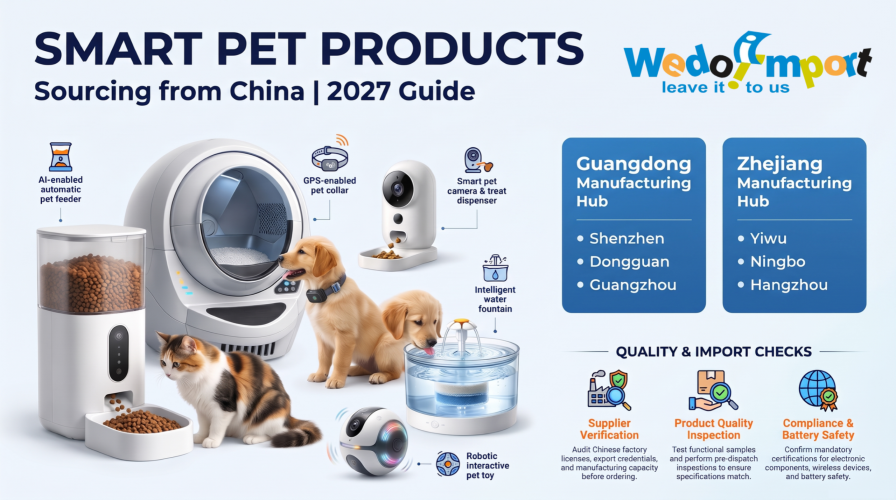
In this guide, we explore 10 smart pet product categories worth evaluating, China’s key manufacturing locations, the supplier verification process, and the quality and compliance considerations importers should understand before placing an order.
1. 10 Smart Pet Products Worth Evaluating for Import from China
The following product categories offer opportunities for businesses looking to build or expand a pet products portfolio. Their suitability will depend on your target market, competition, pricing, product differentiation, and ability to manage technical requirements.
1. AI-enabled and multi-pet automatic feeders
Smart automatic feeders are designed to dispense measured portions of pet food according to scheduled feeding times. More advanced models may include cameras, app connectivity, multiple feeding compartments, and pet identification features.
What to evaluate before sourcing:
- Feeding accuracy and portion consistency.
- Motor reliability and dispensing mechanisms.
- Camera quality and app functionality, if included.
- Food-contact material suitability.
- Backup power and feeding schedules during outages.
For private-label brands, consider whether the manufacturer supports customised branding, packaging, firmware, and app interfaces.
2. Automatic wet-food feeders with cooling systems
Unlike conventional dry-food dispensers, some automatic wet-food feeders incorporate cooling technology to help maintain food storage conditions.
These products may use thermoelectric cooling systems, sealed compartments, temperature controls, and scheduled feeding mechanisms.
What to evaluate before sourcing:
- Actual cooling performance under different ambient conditions.
- Temperature consistency over the intended storage period.
- Sealing and moisture protection.
- Food-contact material suitability.
- Cleaning and maintenance requirements.
Do not rely on a supplier’s advertised food-storage duration without reviewing product-specific testing and food-safety evidence.
3. Self-cleaning smart litter boxes
Self-cleaning litter boxes use mechanical systems to separate waste from clean litter, reducing the need for manual cleaning.
Advanced models may include weight sensors, infrared detection, app notifications, and automatic cleaning schedules.
What to evaluate before sourcing:
- Anti-pinch and motion-detection safety mechanisms.
- Sensor accuracy and reliability.
- Motor durability and repeated operating cycles.
- Waste separation performance.
- Cleaning access and maintenance.
- Noise levels during operation.
Safety is particularly important for products containing moving parts. Test the actual product’s safety mechanisms rather than relying only on a supplier’s demonstration.
4. GPS-enabled smart pet collars
GPS tracking collars help pet owners monitor the location and movement of their pets through mobile applications.
Depending on the model, they may use GPS, cellular networks, Bluetooth, Wi-Fi, or other positioning technologies.
What to evaluate before sourcing:
- Tracking accuracy and update frequency.
- Cellular network compatibility in your destination market.
- Battery life under real usage conditions.
- Waterproofing and durability.
- Subscription fees and connectivity arrangements.
- App availability and long-term software support.
A tracking device that works in the supplier’s demonstration environment may not perform equally well in your intended market.
5. Smart pet cameras and interactive treat dispensers
These devices combine cameras, mobile connectivity, and remote interaction features. Some allow pet owners to monitor their pets, communicate through two-way audio, or dispense treats remotely.
What to evaluate before sourcing:
- Camera resolution and night vision.
- Wi-Fi compatibility and connection stability.
- App usability and cloud-service arrangements.
- Data security and privacy practices.
- Motor and treat-dispensing reliability.
- Software updates and ongoing technical support.
Ask who owns and maintains the mobile application and what happens if the manufacturer changes its software provider.
6. Smart water fountains with filtration systems
Smart water fountains circulate and filter drinking water for pets. More advanced versions may include water-level monitoring, pump alerts, app notifications, and additional treatment features.
What to evaluate before sourcing:
- Pump reliability and replacement availability.
- Filter availability and recurring replacement costs.
- Water-contact material suitability.
- Leakage and electrical safety.
- Ease of cleaning.
- Noise during continuous operation.
Also assess whether replacement filters can be sourced consistently. A product that requires proprietary consumables may create long-term customer support challenges.
7. Smart pet health and activity collars
Wearable pet devices can monitor activity, sleep patterns, location, and other indicators. Some products advertise additional biometric monitoring features.
What to evaluate before sourcing:
- Sensor accuracy and consistency.
- Comfort, weight, and fit.
- Battery life and charging safety.
- Data interpretation and app reliability.
- Waterproofing.
- Whether advertised health features have been independently validated.
Be cautious about marketing a consumer tracking device as a medical diagnostic product unless the relevant claims and regulatory requirements have been established.
8. Temperature-controlled smart pet beds
Some smart pet beds combine conventional bedding materials with electronic heating or cooling components.
They may incorporate temperature controls, timers, sensors, or app-based settings.
What to evaluate before sourcing:
- Temperature regulation and overheating protection.
- Electrical insulation and cable durability.
- Material quality and cleaning requirements.
- Safety controls and automatic shut-off.
- Performance during extended use.
Request evidence of relevant electrical and product-safety testing before considering bulk production.
9. Pet grooming vacuum systems
Pet grooming vacuum systems combine grooming attachments with vacuum collection to capture loose fur during brushing.
These products may appeal to pet owners looking for convenient home grooming solutions.
What to evaluate before sourcing:
- Suction performance.
- Motor durability.
- Noise levels.
- Filter efficiency and replacement costs.
- Attachment quality.
- Ease of cleaning and maintenance.
Test the product with different coat types where relevant. A product that performs well on one type of fur may not deliver the same results on another.
10. Interactive robotic pet toys
Interactive robotic toys use motors, sensors, movement mechanisms, and sometimes mobile applications to engage pets.
Some products move autonomously, avoid obstacles, or dispense treats.
What to evaluate before sourcing:
- Mechanical durability.
- Battery safety and charging performance.
- Small-part and choking hazards.
- Sensor reliability.
- Material suitability for animal contact.
- Repairability and spare-part availability.
For these products, physical durability and safety testing should be part of the supplier evaluation process.
Found a Product Worth Exploring?
Finding a product is just the beginning. Let’s help you explore potential Chinese suppliers, evaluate sourcing options and understand what it takes to bring your product to market.
Discuss Your Sourcing Requirements →
We Do Import | Your Global Sourcing & Trade Partner
2. Where to Source Smart Pet Products in China
China has several manufacturing and supplier ecosystems that can be relevant to smart pet products. However, not every manufacturing city specialises in every component or finished product.
The best sourcing location depends on the product’s technical requirements, component availability, manufacturing process, and supplier capabilities.
Two useful starting points for researching smart pet hardware are Guangdong and Zhejiang.
Guangdong Province: Electronics, Connectivity and IoT Products
Key locations: Shenzhen and Dongguan.
Guangdong is a useful region to investigate when sourcing products that depend heavily on electronic components, wireless connectivity, PCB assembly, and smart-device integration.
Potential product categories include:
- GPS-enabled pet trackers.
- Smart cameras and treat dispensers.
- Bluetooth and Wi-Fi pet devices.
- Sensor-based wearables.
- Smart feeder electronics.
- Connected pet monitoring products.
Why consider Guangdong?
The region has a broad electronics manufacturing ecosystem, making it a practical starting point for businesses looking for suppliers of electronic components, connected devices, and related assembly services.
However, access to an electronics ecosystem does not automatically mean that a particular supplier can manufacture a complete, reliable pet product. Verify its actual production capabilities and component supply chain.
Zhejiang Province: Product Housing, Tooling and Mechanical Manufacturing
Key locations: Ningbo, Hangzhou and Yiwu.
Zhejiang can be worth investigating for products involving plastic housings, mechanical assemblies, consumer appliances, and accessories.
Potential product categories include:
- Automatic litter boxes.
- Pet grooming appliances.
- Automatic feeding systems.
- Smart water fountains.
- Plastic enclosures and product components.
- General pet accessories.
Why consider Zhejiang?
Depending on the product, businesses may find suppliers with relevant tooling, injection-moulding, mechanical assembly, and consumer-goods manufacturing capabilities.
As with Guangdong, verify the actual factory and its specialisation rather than assuming that every supplier in a particular city has the same capabilities.
Guangdong vs Zhejiang: Which should you consider?
| Sourcing requirement | Region to investigate |
|---|---|
| Wireless electronics and connected devices | Guangdong |
| PCB and electronic assembly | Guangdong |
| GPS and Bluetooth-enabled devices | Guangdong |
| Plastic housings and moulded components | Zhejiang |
| Mechanical product assemblies | Zhejiang |
| General pet accessories | Zhejiang and other relevant sourcing hubs |
Important: These are starting points for supplier research, not exclusive manufacturing boundaries. A finished product may involve components, tooling, software, and assembly sourced from multiple locations.
The right factory is more important than choosing a city based on its reputation.
3. What Importers Should Check Before Sourcing Smart Pet Products
A common sourcing mistake is evaluating a product primarily on its quotation and sample appearance.
With smart pet products, the more important questions often involve what is inside the product, how it performs after repeated use, and whether the supplier can support it after delivery.
Here are six areas worth investigating before committing to a purchase order.
1. Verify the actual manufacturer
Not every supplier presenting itself as a factory owns the production facilities or technical capabilities required for your product.
Some businesses are trading companies coordinating production through other manufacturers. This is not automatically a problem, but importers should understand who is responsible for manufacturing, quality, and after-sales support.
Before placing an order:
- Request the supplier’s business licence and registered company details.
- Check whether the registered business information matches the contracting entity.
- Ask for factory videos, production photographs, and a live walkthrough where possible.
- Identify which manufacturing processes are performed in-house.
- Ask whether key electronic components are purchased from other suppliers.
- Clarify who is responsible for product defects and warranty claims.
China’s National Enterprise Credit Information Publicity System is a useful starting point for checking registered business information:
A business registration check is only one part of supplier due diligence. It does not independently establish manufacturing quality or production capability.
2. Understand the electronics and software behind the product
A smart product is not simply a physical product with an application attached to it.
Its performance may depend on the quality of electronic components, firmware, mobile software, connectivity, cloud infrastructure, and ongoing technical support.
Ask the supplier:
- Which company develops and maintains the application?
- Does the product depend on a third-party cloud platform?
- Are firmware and software updates available?
- Can the app support your target market and languages?
- What happens if the supplier changes its software provider?
- Are spare parts and replacement electronic modules available?
For private-label businesses, also clarify whether the application can be branded and whether you will have continued access to the necessary software services.
A product that works during a sample demonstration but loses app connectivity after launch can create expensive customer-service and reputation problems.
3. Test the sample beyond its appearance
A sample approval should involve more than checking the colour, packaging, and external finish.
For smart pet electronics, evaluate the actual functions and components.
Depending on the product, consider testing:
- Motor performance over repeated cycles.
- Sensor accuracy and response.
- Battery charging and operating duration.
- Wireless connectivity and app stability.
- Water resistance where advertised.
- Temperature regulation where applicable.
- Mechanical durability.
- Noise levels.
- Safety mechanisms and automatic shut-off features.
For products with moving parts, test foreseeable operating and obstruction scenarios using an appropriate, safe testing procedure.
Record the approved sample’s specifications and retain reference photographs, videos, and test results.
This gives you a more objective benchmark when the bulk production arrives.
4. Check compliance for the destination market
Compliance requirements are not identical across countries. They depend on the product, its technical specifications, radio features, battery configuration, intended use, and destination market.
For example:
| Market or requirement | What importers should investigate |
|---|---|
| European Union | Applicable CE marking requirements, Radio Equipment Directive for relevant radio equipment, EMC and RoHS obligations. |
| United States | Applicable FCC equipment authorisation requirements for radio-frequency devices and other relevant product rules. |
| India | Applicable WPC ETA requirements for wireless equipment, BIS requirements for covered products, and relevant EPR obligations. |
| Lithium battery transportation | UN 38.3 testing and supporting documentation where applicable. |
Some important distinctions:
CE and RED: CE marking is not a universal product certificate. The manufacturer or responsible economic operator must establish conformity with the applicable EU legislation. Radio equipment may fall under the Radio Equipment Directive.
FCC: Applicable radio-frequency devices in the United States may require equipment authorisation under FCC rules. The exact route depends on the device.
RoHS: This concerns restrictions on certain hazardous substances in electrical and electronic equipment within its scope. It should not be treated as a substitute for product safety testing.
UN 38.3: This concerns testing of lithium cells and batteries for transportation. Ask for the applicable battery test summary and ensure the documents correspond to the battery used in the product.
India-specific requirements: WPC ETA, BIS registration or certification, EPR registration, and other obligations must be assessed against the exact product and applicable rules. Not every smart pet product automatically requires every approval.
For official starting points, refer to:
- WPC and Department of Telecommunications: https://dot.gov.in/
- Bureau of Indian Standards: https://www.bis.gov.in/
- Central Pollution Control Board: https://cpcb.nic.in/
- United Nations lithium battery transport guidance: https://unece.org/transport/dangerous-goods
Do not rely only on a supplier’s statement that a product is certified. Check the report, model number, manufacturer, testing scope, issuing laboratory, validity, and whether the document applies to the exact product being imported.
If you are importing into India or another regulated market, confirm the requirements before placing the order—not after the goods have been shipped.
5. Compare the approved sample with mass production
One of the most important sourcing risks is the difference between the approved sample and the actual production batch.
A sample may use higher-quality components or receive more attention than the bulk order.
To reduce this risk:
- Record the approved sample’s specifications.
- Confirm component brands and critical component specifications.
- Agree on acceptable defect levels.
- Document workmanship and packaging requirements.
- Arrange production-stage checks where appropriate.
- Conduct pre-shipment inspection before final payment or shipment release, according to your agreed terms.
For electronics, inspection should include functional testing rather than only visual checks.
A sampling plan such as AQL can help structure batch inspection, but AQL 2.5 should not be treated as a universal quality guarantee. The sampling standard, inspection level, defect classification, and acceptance criteria should be agreed before production.
6. Calculate the actual landed cost
A low factory quotation does not necessarily translate into a profitable import.
Your landed-cost calculation should consider:
- Product price.
- Customisation and tooling charges.
- Packaging and labelling.
- Sample and inspection costs.
- Domestic transportation in China.
- Consolidation and warehousing, where applicable.
- International freight and insurance.
- Customs duties and taxes.
- Port, handling, and clearance charges.
- Destination-market compliance costs.
- Spare parts, warranty, and after-sales support.
For products containing batteries or specialised electronics, transportation and documentation requirements may also affect freight costs.
Compare suppliers using the expected total cost of getting compliant, saleable products into your warehouse—not just the ex-factory price.
A Promising Supplier Doesn’t Always Mean a Reliable Manufacturer.
Before transferring your advance payment, verify the supplier’s business credentials, manufacturing capabilities, product specifications and supporting documentation. A little due diligence can help prevent expensive sourcing mistakes.
4. Six Questions to Ask a Chinese Pet Tech Manufacturer Before Ordering
Before committing to a supplier, ask questions that reveal how well the manufacturer understands its product and responsibilities.
1. Are you the actual manufacturer or a trading company?
Ask which processes are performed in-house and which are outsourced.
2. Can you provide the exact technical specifications and component details?
Request information about motors, sensors, batteries, wireless modules, and other critical components.
3. Can you provide product-specific test reports and compliance documents?
Check whether the documents apply to the exact model and intended destination market.
4. Can we approve a sample before mass production?
Make sure the approved sample and specifications become the reference for bulk production.
5. What happens if products fail inspection or arrive defective?
Agree on replacement, rework, refund, or other remedies, along with responsibility for related costs.
6. What after-sales and software support do you provide?
Clarify warranty periods, spare parts, firmware updates, app maintenance, and technical support.
A supplier’s willingness to answer these questions clearly can help you assess how professionally it manages its business.
5. How We Do Import Helps Businesses Source Products from China
Finding a supplier is only one part of the importing process.
For products involving electronics, sensors, batteries, and mechanical components, businesses need to consider supplier capability, product specifications, sample approval, quality checks, and shipping arrangements before committing working capital.
At We Do Import, we help businesses source reliable suppliers in China and coordinate the key stages of the import process.
Our approach focuses on making supplier selection and import planning more structured.
Supplier sourcing and verification
We help identify potential Chinese suppliers based on product requirements, manufacturing capabilities, specifications, and commercial expectations.
The objective is to help businesses evaluate suitable suppliers rather than simply choosing the lowest quotation.
Sample coordination and evaluation
Before moving into bulk production, samples can be coordinated for review against the buyer’s requirements.
For smart pet products, this may involve examining product functionality, material quality, component specifications, and other relevant features.
Production follow-up
Once an order is confirmed, production progress and agreed specifications need to be followed up.
Clear communication with the supplier helps identify potential delays or deviations before they become larger problems.
Quality inspection coordination
Quality checks should be planned around the product’s actual risks.
For smart pet electronics, relevant inspection points may include functionality, sensor operation, mechanical performance, packaging, and visible defects.
Where specialist testing or independent inspection is required, the scope and responsible service provider should be agreed in advance.
Consolidation and shipping coordination
When sourcing from multiple suppliers, consolidation can help coordinate shipments and documentation before international transportation.
The appropriate shipping arrangement depends on product dimensions, battery configuration, shipment volume, destination, and delivery requirements.
Import planning and customs coordination
Importers need to understand applicable duties, taxes, documentation, and destination-market requirements before dispatch.
We help coordinate the import process so businesses can plan the movement of goods from China towards their destination.
Explore our six-step sourcing and import service process to understand how we support businesses from supplier sourcing to delivery coordination
Planning to Source Smart Pet Products from China?
Don’t start sourcing without checking the essentials. Get our practical Smart Pet Products Sourcing Checklist on WhatsApp to help you evaluate suppliers, assess product quality, check compliance requirements and plan your imports more confidently.
Get Your Free Checklist on WhatsApp →
A practical resource from We Do Import | Your Global Sourcing & Trade Partner
Frequently Asked Questions About Sourcing Pet Products from China
1. Is China a good place to source smart pet products?
China is an important sourcing destination for a wide range of electronics, consumer products, components, and pet accessories. Businesses can investigate manufacturers across regions such as Guangdong and Zhejiang. However, supplier capabilities, product quality, pricing, and compliance should be evaluated individually.
2. Which Chinese cities should I consider for smart pet electronics?
Shenzhen and Dongguan in Guangdong are useful starting points for researching electronics, wireless devices, and connected products. Ningbo and other Zhejiang manufacturing locations may be relevant for mechanical assemblies, plastic components, and consumer appliances. The best location depends on the specific product and manufacturing process.
3. How do I find a reliable smart pet product manufacturer in China?
Start by checking the supplier’s business registration, manufacturing capabilities, product specifications, component sourcing, sample quality, and relevant test reports. Arrange factory verification or independent inspection where appropriate. Do not rely solely on a supplier’s website, marketplace profile, or quotation.
4. What certifications are needed to import smart pet products?
Requirements depend on the product and destination market. Wireless devices, electrical appliances, rechargeable batteries, and products with specific intended uses may have different compliance obligations. Importers should assess applicable CE/RED, FCC, RoHS, WPC ETA, BIS, EPR, and battery transportation requirements as relevant to the product and market.
5. Should I order samples before importing smart pet products in bulk?
Yes. Samples help you assess product functionality, materials, workmanship, dimensions, and packaging before committing to mass production. For electronic products, test the actual functions, sensors, connectivity, battery performance, and safety features. Keep the approved sample as a reference for bulk production.
6. Can a sourcing agent help with smart pet product imports?
A sourcing partner can help coordinate supplier identification, verification, sample evaluation, production follow-up, quality inspection, consolidation, and shipping arrangements. Before engaging one, confirm the scope of services, responsibilities, fees, reporting process, and any third-party inspection arrangements.
Don’t Let the Wrong Supplier Turn a Good Product Idea into an Expensive Mistake.
Whether you’re exploring smart pet products, comparing Chinese manufacturers or planning your first import order, We Do Import can help you navigate the sourcing process from supplier identification to shipment coordination.
Let’s Discuss Your Import Requirements →
22+ years of real trade experience | We Do Import
Final Thoughts: The Right Supplier Matters More Than the Lowest Quotation
Smart pet products offer interesting opportunities for businesses looking to enter or expand within the growing pet technology market.
But the success of an import business does not depend only on identifying a product with market demand.
It also depends on choosing suppliers who can maintain product specifications, deliver consistent quality, provide appropriate documentation, and support the product after the shipment arrives.
A smart feeder with unreliable dispensing, a GPS collar with poor connectivity, or a self-cleaning litter box with faulty safety sensors can quickly become an expensive business problem.
The objective should not be to find the cheapest supplier. It should be to find a supplier capable of delivering the product your customers expect, at a commercially viable total cost.
At We Do Import, we help businesses identify reliable suppliers in China and coordinate sourcing, quality checks, production follow-up, and import processes.
Whether you are launching a private-label pet brand, expanding an existing product range, or evaluating your first smart pet product order, the right sourcing process can make a significant difference.
Planning to source smart pet products from China?
Let’s discuss your product requirements, supplier expectations, and import plans.
- Website: https://www.wedoimport.com/
- WhatsApp: +91 92472 22237
- Email: [email protected]
We Do Import | Your Global Sourcing & Trade Partner
References and Further Reading
Use these resources to explore market trends, supplier verification, compliance, and international shipping requirements:
- Mordor Intelligence – Pet Tech Market
- China National Enterprise Credit Information Publicity System
- India Department of Telecommunications
- Bureau of Indian Standards
- Central Pollution Control Board
- UNECE – Transport of Dangerous Goods
- European Commission – CE Marking
- US Federal Communications Commission
Regulatory requirements can change and vary by product, model, destination, and intended use. Verify current requirements with the relevant authorities or qualified compliance professionals before importing.









Leave a Reply