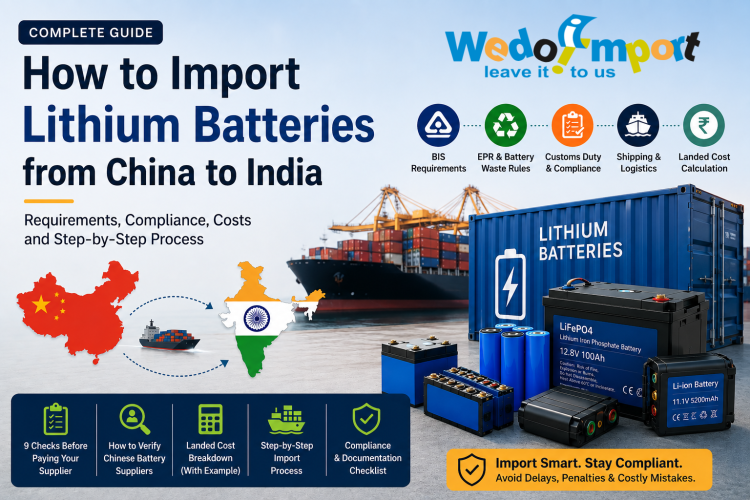
Importing Lithium Batteries from China to India in 2026: BIS Requirements, Costs & Complete Compliance Guide
India’s battery market is expanding rapidly, creating opportunities for businesses importing lithium-ion batteries, battery packs, power banks, energy-storage products and other battery-powered products from China.
But there is an important distinction between finding a competitive Chinese battery supplier and successfully importing a compliant battery into India.
For an importer, the real questions are:
- Does the exact battery fall under a mandatory Indian standard?
- Does the Chinese manufacturer have the required certification or documentation?
- Does the product need testing or rated-capacity verification?
- Does the import trigger Battery Waste Management Rules and EPR obligations?
- How should the battery be classified for customs?
- Can it be shipped by air or sea under the applicable dangerous-goods requirements?
- What will the actual landed cost be after duty, testing, logistics and compliance costs?
These questions need to be answered before you place the bulk order, not after the shipment reaches India.
This guide explains the key compliance, cost and sourcing considerations for businesses planning to import lithium batteries from China to India in 2026.
Important: Battery requirements depend on the exact product, chemistry, application, specifications, certification status, HS classification and current government notifications. This guide is for general information and should not be treated as a product-specific legal or regulatory determination.
Why Lithium Battery Imports Require More Planning
Lithium batteries are not an ordinary consumer product from an import-planning perspective.
Depending on the product, you may need to consider several different compliance layers:
Product safety
BIS requirements and applicable Indian Standards
Performance
Applicable testing and rated-capacity requirements
Transportation
Dangerous-goods classification, packaging, documentation and carrier requirements
Environmental compliance
Battery Waste Management Rules and applicable EPR obligations
Customs
HS classification, applicable customs duty, IGST and relevant notifications
Supplier compliance
Manufacturer capability, certification, test reports and product documentation
The important point is that these requirements are connected but not interchangeable.
A supplier having an international test report does not automatically mean that the product satisfies every Indian requirement applicable to your specific import.
If you’re still evaluating the broader import process, you can also refer to our complete guide to importing from China to India.
1. BIS Requirements for Lithium Batteries in India
One of the first questions an importer should answer is:
Does my exact battery/product fall under a mandatory BIS requirement?
For lithium systems used in portable applications, IS 16046 Part 2:2018 is an important Indian Standard covering safety requirements for portable sealed secondary lithium cells and batteries.
BIS’s current laboratory information shows active testing against IS 16046 Part 2 and related testing, including a rated-capacity test under IS 16047 Part 3.
However, don’t make the mistake of treating “lithium battery” as one universal compliance category.
The applicable requirement can depend on:
- battery chemistry
- cell versus battery pack
- intended application
- product design
- capacity
- whether it is supplied separately or incorporated into equipment
- applicable Indian Standard
- current BIS scheme/notification
What should you do before ordering?
Before making a bulk purchase, identify:
- Exact product/model
- Battery chemistry
- Rated voltage
- Rated capacity
- Cell configuration
- Intended application
- Applicable Indian Standard
- Manufacturer’s existing certifications
- Test reports
- Whether the exact product/model is covered by the relevant certification
This is where supplier verification becomes important.
For a broader explanation of the compliance checks involved when importing products from China, see our China-to-India import compliance guide.
2. The 2026 Rated-Capacity Verification Development
One of the developments importers should pay attention to in 2026 is the increasing emphasis on verification of rated capacity for lithium batteries.
BIS laboratory information currently lists testing under IS 16046 Part 2 together with a test for discharge performance at 20°C and rated capacity under IS 16047 Part 3. Several BIS laboratory entries show these requirements/testing capabilities becoming effective during 2026.
Why does this matter?
Because the capacity printed on a battery is not simply a marketing number.
If your supplier claims:
10,000 mAh
you need confidence that the product actually performs to the applicable requirements and that the documentation and testing correspond to the product you’re importing.
For an importer, this means compliance should be checked at the product and model level, rather than relying only on a supplier’s catalogue or quotation.
Before placing an order, ask your supplier for:
- applicable BIS certification details
- certificate/model information where applicable
- relevant test reports
- battery specifications
- rated capacity information
- cell manufacturer details
- product datasheet
- safety documentation
Don’t assume that a certificate belonging to one model automatically covers another model.
3. Battery Waste Management Rules and EPR
BIS isn’t the only compliance consideration.
India’s Battery Waste Management Rules, 2022 apply to batteries across chemistries, shapes, volumes, weights, material compositions and uses, subject to the exclusions specified in the Rules. The Rules establish the framework for producer responsibility and Extended Producer Responsibility (EPR).
CPCB maintains the battery-waste EPR framework and registration infrastructure.
This can be particularly important for businesses that:
- import batteries
- sell batteries under their own brand
- import products containing batteries
- place battery products on the Indian market
What this means for an importer
You should determine before importing whether your business falls within the applicable definition of producer and what registration/reporting/EPR obligations apply to your particular product and business model.
Don’t wait until you’ve already imported your first shipment to investigate this.
We Do Import also covers EPR as part of the broader China-to-India import compliance process.
4. Dangerous-Goods Transportation: Another Layer Importers Often Miss
Lithium batteries can also create transportation requirements that are separate from Indian product certification.
Depending on the battery, configuration and transport mode, requirements can include:
- dangerous-goods classification
- appropriate packaging
- shipping documentation
- battery specifications
- test documentation
- carrier approval
- applicable air/sea transport requirements
This is particularly important when you’re importing from China because the cheapest freight option isn’t necessarily the option available for your battery.
A shipment that looks straightforward at the sourcing stage can become more complicated once the freight forwarder receives the battery specifications and determines the applicable transport requirements.
Before booking freight, confirm:
Battery type → Watt-hour rating → UN classification → packaging → documentation → carrier acceptance → freight cost
This should be checked before your shipment is ready for dispatch.
If you’re consolidating multiple shipments or suppliers, our mixed container import service guide also explains why documentation and shipping arrangements can become more complicated for products such as lithium batteries.
5. How Much Does It Cost to Import Lithium Batteries from China?
There is no single “lithium battery import duty” that can safely be applied to every battery.
The applicable customs treatment can vary according to:
- exact HS classification
- product type
- end use
- applicable exemption/concession
- country of origin
- notification in force at the time of import
For example, CBIC tariff material contains different treatment for lithium-ion cells/batteries depending on their specific use and notification conditions. Some entries in the referenced 2025 notification were expressly time-bound to 31 March 2026.
This is why an importer should not calculate profitability using a generic “battery duty” percentage found online.
Your landed-cost calculation should consider:
| Cost Component | What to Check |
|---|---|
| Product cost | Supplier quotation |
| Testing/certification | Applicable to exact product |
| EPR/compliance | Applicable obligations |
| Freight | Air/sea + DG requirements |
| Insurance | Shipment value/risk |
| Customs duty | Exact HS code + current notification |
| IGST | Applicable rate |
| Customs clearance | CHA/clearance charges |
| Port/handling | Actual destination charges |
| Inland transportation | Port to warehouse |
| Compliance buffer | Unexpected requirements/costs |
The number that matters is not the factory price.
It’s:
Factory Price + Compliance + Freight + Customs + Clearance + Local Logistics = Actual Landed Cost
That is the number you should use when calculating your margin.
For a detailed explanation of how We Do Import approaches landed-cost calculations, see our China-to-India import cost and landed-cost guide.
6. Why Buying the Cheapest Chinese Battery Can Become Expensive
A supplier offering the lowest FOB price isn’t necessarily your cheapest supplier.
Imagine two suppliers:
Supplier A
Battery price: ₹X
No clear Indian compliance documentation
Uncertain testing
Unclear transport documentation
Supplier B
Battery price: ₹X + 8%
Relevant documentation available
Better traceability
Established testing
Clear shipping documentation
Supplier A may initially appear cheaper.
But if you later discover that:
- additional testing is required
- the product needs modification
- documentation doesn’t match
- freight cannot be booked as planned
- the model isn’t covered by the expected certification
- the shipment is delayed
your actual landed cost can be considerably higher.
This is why supplier verification should happen before commercial commitment, not after production.
You can also use our Chinese supplier verification checklist before committing to a new manufacturer.
7. How to Verify a Chinese Lithium Battery Supplier
Before sending a significant payment, check:
Company
- Business registration
- Factory address
- Manufacturing capability
- Years in operation
- Export experience
Product
- Battery chemistry
- Cell manufacturer
- Capacity
- Voltage
- Model number
- Datasheet
- Specifications
Compliance
- BIS-related documentation where applicable
- Test reports
- Certification/model information
- UN 38.3 documentation where applicable
- SDS/MSDS
- EPR-related information where relevant
Quality
- Sample testing
- Production inspection
- Final inspection
- Packaging verification
- Label verification
Shipment
- DG classification
- Packaging requirements
- Shipping documentation
- Carrier acceptance
The objective isn’t simply to determine:
“Is this supplier genuine?”
It is:
“Is this supplier capable of producing the specific product I require and supplying the necessary documentation for its importation into India?”
8. China-to-India Lithium Battery Import Process
A safer process looks like this:
Step 1 — Define the product
Identify chemistry, capacity, voltage, configuration and intended use.
Step 2 — Identify applicable compliance
Determine the relevant BIS standard/certification requirements and other applicable obligations.
Step 3 — Verify the supplier
Check the factory, product specifications and documentation.
Step 4 — Test the sample
Don’t approve bulk production based only on photographs or a catalogue.
Step 5 — Calculate landed cost
Calculate product + compliance + freight + customs + clearance + local logistics.
Step 6 — Confirm transportation requirements
Determine applicable dangerous-goods and carrier requirements before dispatch.
Step 7 — Conduct quality inspection
Check the goods thoroughly before they leave from the factory.
Step 8 — Prepare import documentation
Ensure commercial, technical and compliance documents are consistent.
Step 9 — Customs clearance
Use the correct classification and applicable customs treatment.
Step 10 — Complete post-import obligations
Where applicable, address EPR, reporting and other regulatory responsibilities.
For a broader six-step overview of the China-to-India import process, see our step-by-step China-to-India import guide.
9. The 9 Checks You Should Complete Before Paying Your Chinese Supplier
Use this as your pre-order checklist:
☐ Exact battery chemistry identified
☐ Exact model/specification confirmed
☐ Applicable BIS requirement checked
☐ Relevant certification/test documentation verified
☐ Rated capacity requirements checked
☐ UN 38.3 / transport documentation checked where applicable
☐ Battery Waste Management/EPR applicability checked
☐ HS classification and current customs treatment verified
☐ Complete landed cost calculated
If you cannot confidently tick these boxes, don’t rush into a bulk order.
10. Common Mistakes First-Time Battery Importers Make
Mistake 1: Choosing the supplier before checking compliance
The supplier looks good, the price looks good and the order is placed.
Only later does the importer discover a certification or testing problem.
Mistake 2: Treating an international test report as automatic Indian compliance
A test report can be useful evidence, but you still need to determine whether it satisfies the applicable Indian requirement for your exact product.
Mistake 3: Using a generic customs-duty percentage
Battery duty depends on classification, product/use and applicable notifications.
Mistake 4: Ignoring transport requirements
A battery that can be manufactured doesn’t automatically mean it can be shipped under every freight option.
Mistake 5: Checking compliance after production
By then, you’ve already committed capital.
Mistake 6: Calculating profit using FOB price
Your business earns money on the landed product, not the supplier quotation.
11. How We Do Import Helps Businesses Import Batteries from China
For a regulated product like lithium batteries, sourcing is only one part of the job.
We Do Import can help businesses coordinate the broader China-to-India import process, including:
Supplier Sourcing & Verification
Identify and evaluate suitable Chinese manufacturers based on product requirements, specifications and commercial criteria.
Compliance Assessment
Review the product and identify applicable BIS, testing, EPR and other compliance considerations before the order is finalized.
Quality Inspection
Coordinate product inspection before shipment so quality issues can be identified before the goods leave the factory.
For more detail, see our China supplier audit and quality inspection services.
Landed Cost Planning
Build the import cost around the product, freight, customs, compliance and clearance rather than relying only on the supplier’s price.
Logistics & Customs
Coordinate freight, documentation and customs-clearance requirements through the import process.
The objective is simple:
Don’t discover an import problem after you’ve already paid for the shipment.
Identify the risk before the order.
Frequently Asked Questions
Can I import lithium batteries from China to India?
Yes, but the applicable requirements depend on the exact battery, chemistry, application, specifications, certification requirements, customs classification and current regulations. A product-specific compliance check should be completed before placing a commercial order.
Is BIS certification required for lithium-ion batteries?
Certain lithium systems and battery products fall under applicable Indian Standards and BIS certification/testing requirements. For example, BIS identifies IS 16046 Part 2:2018 for portable sealed secondary lithium cells and batteries. The exact applicability should be checked against the product and its intended use.
Do imported batteries require EPR registration?
Battery Waste Management Rules, 2022 establish an EPR framework covering batteries and define producer responsibilities. Whether your business requires registration and which obligations apply depends on your role and product/business model.
What is the customs duty on lithium batteries imported from China?
There is no single universal rate that should be applied to every lithium battery. Customs treatment depends on the exact HS classification, product/use, applicable notification and other factors. CBIC tariff material contains different provisions for lithium-ion cells and batteries depending on their use.
Can I ship lithium batteries by air from China?
Potentially, but lithium batteries can be subject to dangerous-goods transport requirements. The applicable requirements depend on the battery type, configuration, rating, packaging and transport circumstances. Confirm the requirements with the carrier/freight specialist before booking the shipment.
What documents should I ask my Chinese battery supplier for?
Depending on the product, you may need product specifications, applicable BIS/certification documentation, test reports, SDS/MSDS, UN 38.3 documentation and other technical/shipping documents. The exact document set should be determined from the product and applicable regulations.
Ready to Import Lithium Batteries from China?
The biggest mistake isn’t paying slightly more for the wrong supplier.
It’s committing your money before knowing whether the product, documentation, compliance and landed cost actually work for India.
If you’re evaluating a Chinese lithium battery supplier or planning your first battery import, send us your product specification or supplier details on WhatsApp.
We can help you understand what needs to be checked before you commit to the order.
[WhatsApp CTA — Check My Battery Before I Order]
Official Sources & References
Bureau of Indian Standards (BIS)
BIS laboratory information for IS 16046 Part 2:2018 and related testing, including rated-capacity testing under IS 16047 Part 3.
Central Pollution Control Board (CPCB)
Battery Waste Management Rules, 2022 and the battery EPR framework.
Central Board of Indirect Taxes and Customs (CBIC)
Customs tariff notifications and applicable customs provisions.
DGFT
For import policy, notifications and foreign-trade requirements.









Leave a Reply