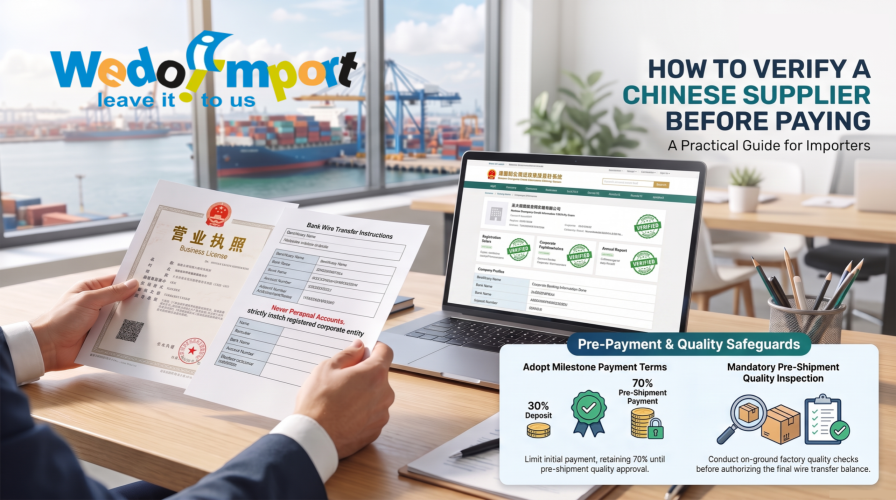
How to Verify a Chinese Supplier Before Paying: A Practical Guide for Importers
Finding a Chinese supplier is easier than ever. Online directories, trade platforms, referrals and virtual meetings make it possible to connect with manufacturers without travelling to China. However, finding a supplier and verifying that the supplier is suitable for your business are two very different things.
A supplier may have an impressive website, competitive prices and professional sales representatives. Yet these signals alone cannot establish whether the company is legitimate, whether it can manufacture your product to the required specifications, or whether your payment will reach the correct business.
For importers, the consequences of skipping due diligence can include inconsistent product quality, production delays, unexpected costs, compliance issues and payment disputes.
At We Do Import, we believe that successful sourcing begins with informed supplier selection. Before committing money to a Chinese supplier, importers should verify the business identity, understand the manufacturing arrangement, evaluate product quality and document the commercial terms.
This guide explains how to approach these checks, what warning signs deserve attention and how to make a more informed sourcing decision.
Why supplier verification matters before making a payment
Supplier verification is not simply about identifying fraudulent businesses. It is about determining whether a particular supplier is capable of meeting your requirements and whether the risks of the proposed transaction are acceptable.
Consider three common situations.
- A supplier is a legally registered company but outsources production to a factory you have never evaluated.
- A manufacturer produces an excellent sample but cannot maintain the same quality during bulk production.
- A legitimate supplier requests payment to a bank account that does not match the previously agreed commercial arrangement.
Each situation requires a different type of verification. A business registration check alone will not resolve all three.
The objective is to establish a chain of evidence connecting the company you have investigated, the product you have approved, the contract you have agreed to and the party receiving your payment.
1. Start by confirming the supplier’s legal identity
Prior to engaging in discussions regarding a substantial order, it is advisable to solicit from the supplier their comprehensive legal entity designation in Chinese, their business licence documentation, and their Unified Social Credit Code, where such documentation is applicable.
China’s National Enterprise Credit Information Publicity System is an important starting point for checking available company registration information.
You can access it here: National Enterprise Credit Information Publicity System.
Depending on the available records, review the company’s registered name, registration status, legal representative, registered address and declared business scope.
Compare and check these details with the information provided by your supplier. If the English company name differs from the Chinese legal name, ask for clarification rather than assuming they represent the same entity.
Pay particular attention to the business that will sign your contract and receive your payment. A supplier’s trading name, manufacturing partner and contracting entity may be different, but the relationship should be transparent and documented.
Remember that registration confirms information about a business; it does not guarantee its reliability, financial stability or product quality.
Not Sure Your Supplier Is Reliable?
Before you transfer an advance payment, discuss your supplier and sourcing requirements with our team.
2. Understand who will actually manufacture your product
Not every supplier advertising a product online owns a factory. Some businesses manufacture products themselves, while others source from manufacturing partners or coordinate production through a network of factories.
Neither model is automatically better. What matters is understanding the supplier’s role and verifying the capabilities relevant to your order.
Start by asking where your product will be manufactured, which production stages are handled in-house and whether any processes will be subcontracted.
For customized products, discuss the machinery, materials, tooling, production methods and quality-control procedures required to meet your specifications.
A live video walkthrough can help you understand the facility, but it should be treated as supporting evidence rather than definitive proof. For significant orders, an independent factory audit or site inspection may be appropriate.
How to assess manufacturing capability
Look beyond photographs of machinery or general statements about production capacity. Ask the supplier to explain how it will manufacture your specific product, what materials it will use, how quality will be controlled and how it will handle production problems.
Request evidence of comparable products or production runs where available. If the supplier uses subcontractors, clarify who supervises those operations and who remains accountable for the finished goods.
A supplier’s demonstrated capacity to produce a single sample does not inherently guarantee their capability to reliably manufacture and deliver thousands of units on a consistent basis. Production capability must be evaluated against the actual quantity, specifications and timeline of your order.
3. Make sure the documents tell a consistent story
Once you understand the supplier’s identity and manufacturing arrangement, check whether the commercial documents are consistent.
Relevant documents may include the business licence, quotation, proforma invoice, purchase order, sales contract and payment instructions.
Compare the legal names, product descriptions, quantities, prices and agreed delivery terms.
If a trading company is exporting goods manufactured by another business, the documents should make the arrangement understandable. A difference between the manufacturer and exporter is not automatically suspicious; an unexplained difference between the contracting party and payment beneficiary deserves closer investigation.
Ask for written clarification and supporting documents when something does not match.
Company stamps, signatures and professionally formatted documents should not be treated as conclusive proof of authenticity. Where the transaction is significant, consider independent verification of important documents and the identities of the parties involved.
4. Check the supplier’s physical operations
A registered address may be an office, warehouse or administrative location rather than a manufacturing facility.
Ask the supplier to identify the production address and explain how the business operates across its different locations.
You can compare the address with available business records, maps and other independent evidence. A live video call may help you inspect relevant production areas, machinery, materials and finished products.
For a high-value or technically complex order, an independent factory audit can provide more reliable evidence than a sales presentation alone.
Exercise prudence when depending solely upon standardized manufacturer photography, outdated video content, or visual materials that lack verifiable connection to the supplier’s genuine operational activities.
The level of verification should reflect the potential consequences of getting the decision wrong.
5. Evaluate the product before approving bulk production
A sample is one of the most useful tools available to an importer, but it must be evaluated against clear requirements.
Check the dimensions, materials, finish, functionality, packaging and other characteristics relevant to your product. For regulated goods, confirm the applicable testing and documentation requirements before approving the sample.
Once satisfied, document the approved specifications. Photographs, measurements, material details and written acceptance criteria can help establish what the supplier has agreed to produce.
This becomes more important when a product is customized.
For example, if you approve a sample made from a particular material, the purchase order should clearly identify that material. Otherwise, a disagreement about the finished product may become difficult to resolve.
Why sample approval doesn’t guarantee bulk quality
Bulk production introduces variables that may not be visible in a single sample. Materials can change, subcontractors may be involved, and production processes may not be consistent.
For this reason, agree on the quality-control process before production begins. Depending on the product and order value, this may involve pre-production checks, inspections during manufacturing and a pre-shipment inspection.
A sample should serve as a documented reference standard, not simply as evidence that the supplier can produce one good unit.
Finding a Factory Is Only the First Step
The right sourcing decision involves more than price. Discuss your product specifications, supplier requirements and quality expectations with We Do Import.
6. Check certificates and test reports carefully
Suppliers may provide quality-management certificates, product test reports, declarations of conformity or other documentation.
The important question is not simply whether a document exists, but whether it is genuine, current and relevant to the product you intend to import.
Check the issuing organization, document scope, validity dates, covered product models and manufacturing location. Where possible, verify the document directly with the issuing organization or through its official verification service.
Also establish the requirements of your destination market. A factory’s quality-management certification does not automatically demonstrate that a specific product complies with the safety, labelling or certification requirements of the country where you intend to sell it.
For regulated product categories, verify requirements with the relevant authority or a qualified compliance professional before placing the order.
7. Investigate the supplier’s relevant experience
Years in business, customer references and export experience can provide useful context, but they should be considered alongside other evidence.
A supplier may have manufactured products for years without having experience with your particular specification, packaging, production quantity or destination market.
Ask about comparable projects, relevant production processes, quality-control procedures and experience handling orders of a similar scale.
Where appropriate, request references from customers who agree to be contacted or examples of redacted quality documentation.
A supplier may legitimately protect customer confidentiality. The absence of publicly named clients is therefore not proof of misconduct. Instead, evaluate the overall consistency and credibility of the evidence provided.
8. Verify payment instructions before transferring funds
Payment verification is one of the most important stages of the process.
Verify the complete name of the designated beneficiary and conduct a comparative analysis against both the contracting entity and the documented payment arrangement. If the supplier uses an export company or another legitimate collection entity, obtain a clear explanation and supporting documents.
Be especially cautious about last-minute changes to bank details.
If you receive a message requesting payment to a new account, contact the supplier through a separately verified communication channel. Do not rely solely on replying to the message that announced the change.
You should also understand the protections and risks associated with your chosen payment method. Inquire with your financial institution regarding appropriate safeguards and procedures for substantial cross-border fund transfers.
An advance payment is not inherently evidence of a problem, but it should be supported by a verified counterparty, clear contractual terms and a payment arrangement you understand.
Get the free Chinese Supplier Verification Checklist
You now know why checking a supplier involves more than reviewing a business licence or requesting a product sample. Keeping track of these details across several suppliers can be difficult, particularly when comparing quotations and preparing your first purchase order.
We Do Import has a practical supplier-verification resource designed to help importers organize their checks before committing money to an overseas supplier.
Use it to review the supplier’s business identity, manufacturing capabilities, product quality, payment information and potential warning signs.
Verify Your Chinese Supplier Before You Pay
Don’t rely on a quotation or business licence alone. Get our practical Chinese Supplier Pre-Payment Verification Checklist to help you review company details, manufacturing capabilities, product quality, payment information and potential warning signs before placing an order.
What the checklist covers
✓ Company registration and supplier identity
✓ Factory capabilities and product quality
✓ Bank details and payment-related risks
✓ Essential checks before approving your order
Get the Free Checklist on WhatsApp →
Prepared by We Do Import | Your Global Sourcing & Trade Partner
The checklist is intended to support your due diligence, not replace independent verification or guarantee a risk-free transaction.
9. Agree on payment terms and production milestones
Once the supplier has passed the relevant checks, document the commercial agreement before production begins.
The contract or purchase order should identify the product specifications, quantity, price, packaging, production timeline, inspection arrangements and agreed delivery responsibilities.
Where commercially appropriate, payment milestones can be linked to clearly defined stages. For example, an agreement may cover an initial deposit, production progress, inspection and final payment under the negotiated terms.
There is no single payment structure suitable for every transaction. The right arrangement depends on the order value, supplier relationship, product risk, negotiating position and available payment protections.
Also confirm the applicable delivery rule and named place where relevant. The International Chamber of Commerce’s Incoterms® 2020 regulations establish specific obligations, financial liabilities, and risk allocations between purchasing parties and supplying parties; however, these provisions do not serve to authenticate a supplier’s credibility or ensure the quality standards of delivered merchandise.
Refer to the official ICC Incoterms rules and seek appropriate legal or trade advice for important transactions.
10. Confirm destination-market compliance before production
A supplier’s ability to manufacture a product does not automatically mean that the product can legally be imported or sold in your destination country.
Prior to initiating large-scale manufacturing operations, it is essential to ascertain the pertinent regulatory standards and specifications applicable to your product and its designated market segment.
Depending on the category, these may include product safety standards, testing, certification, labelling, packaging, permits, customs classification or other regulatory requirements.
Ask the supplier for relevant documentation early, then confirm that it applies to the exact product model and intended destination.
This is particularly important for regulated products, where discovering a compliance issue after manufacturing can result in delays, additional costs or goods that cannot be sold as planned.
Do not rely solely on broad assurances such as “international quality” or “certified worldwide.” Request specific evidence and verify it against the relevant requirements.
11. Make sure the production schedule is realistic
A supplier may be legitimate and technically capable but still struggle to meet your required delivery date.
Discuss raw-material availability, tooling requirements, production capacity, subcontracting and current commitments before accepting the proposed timeline.
For complex orders, agree on milestones covering material procurement, sample approval, production, inspection and shipment readiness.
Ask how delays will be communicated and what happens if the supplier misses an agreed deadline.
A realistic production plan should account for the actual product and order quantity rather than rely on a generic lead-time promise.
12. Establish quality-inspection and dispute procedures
Supplier verification should continue throughout the transaction because production conditions and delivery arrangements can change.
Before production starts, agree on how quality will be assessed, what constitutes a defect, when inspections will take place and how non-conforming goods will be handled.
For significant orders, consider whether independent inspection is justified. The scope should reflect the product’s complexity, the potential cost of defects and the consequences of receiving unsuitable goods.
An inspection provides evidence about the goods examined at a particular stage; it does not guarantee that every unit is defect-free.
Also document how changes to specifications, materials, production locations and delivery schedules must be approved. Clear procedures can reduce misunderstandings and make disputes easier to manage.
Five warning signs that should prompt further investigation
Some inconsistencies have legitimate explanations, but these situations deserve additional scrutiny:
- The supplier refuses to provide reasonable information about its legal identity.
- The contracting party and payment beneficiary differ without a clear, documented explanation.
- The supplier’s manufacturing assertions lack substantiation through pertinent documentation and verification.
- The supplier pressures you to transfer funds before completing agreed checks.
- The supplier demonstrates a pattern of modifying specifications, payment terms, or delivery obligations without providing adequate justification for such alterations.
None of these signs alone establishes fraud in every situation. The appropriate response is to pause, investigate the discrepancy and obtain independent evidence before proceeding.
When a professional sourcing partner can help
Supplier verification can require language support, technical knowledge, local coordination and the ability to assess evidence beyond a sales presentation.
A professional sourcing partner may be useful when you are evaluating several factories, developing a customized product, managing a larger order or coordinating sample approval, production follow-up and quality inspections.
The partner should explain which checks it performs, how suppliers are evaluated, how findings are documented and what responsibilities remain with you as the buyer.
Working with a sourcing partner does not remove the need for due diligence. It should help you make better-informed decisions and coordinate the process more effectively.
How We Do Import supports supplier sourcing
We Do Import helps businesses source products from reliable suppliers in China and coordinate the steps involved in moving from supplier selection to delivery.
Our sourcing process can include supplier identification, sample confirmation, production follow-up, quality-inspection coordination, consolidation and shipment arrangements, depending on the agreed scope.
We believe the important question is not simply whether a supplier can offer a competitive price. It is whether the supplier, product, commercial terms and delivery plan are appropriate for your business.
If you are evaluating Chinese suppliers or preparing an import order, explore our sourcing and import services or contact We Do Import to discuss your requirements.
Frequently asked questions
Can I verify a Chinese Supplier for free?
Start with official business registration information, the supplier’s business license, document consistency checks and direct questions about manufacturing capabilities. Additional checks may be appropriate for high-value or complex orders.
Is a Chinese supplier’s business license enough?
No. A license helps establish the company’s registered identity, but it does not guarantee manufacturing capability, product quality, financial reliability or safe payment arrangements.
Is it safe to pay a Chinese supplier in advance?
Advance payments are common in international trade, but the risks depend on the supplier, contract, payment method and transaction. Verify the counterparty, document the terms and independently confirm payment instructions before transferring funds.
How can I verify a Chinese factory remotely?
One may integrate official registration verification, real-time video demonstrations, product-specific documentation, specimen assessment, and impartial third-party evaluations as circumstances warrant. Remote checks have limitations, especially when important claims cannot be independently corroborated.
Should I use a sourcing agent to verify suppliers?
A sourcing agent may help coordinate supplier checks, sample evaluation, production follow-up and inspections. Before engaging one, clarify the scope of its services, how verification is performed and how potential conflicts of interest are handled.
Planning Your Next Import from China?
Get clarity on supplier sourcing, samples, production follow-up, quality inspections and shipment coordination before moving forward.
Final thoughts
Conducting due diligence on a Chinese supplier prior to payment involves establishing a comprehensive understanding of the enterprise, its offerings, and the commercial transaction in question.
Check the legal entity, understand who will manufacture the goods, validate the specifications, confirm the beneficiary, document the commercial terms and establish an appropriate inspection process.
Verify the business. Validate the product. Document the agreement. Control the payment risk.
These steps cannot eliminate every risk, but they can help you identify unanswered questions before they become expensive problems.
If you need support with sourcing products from China, contact We Do Import to discuss your product requirements and the steps involved in supplier selection and import coordination.
References and further reading
- China National Enterprise Credit Information Publicity System — official enterprise information resource.
- International Chamber of Commerce: Incoterms® rules — information on delivery responsibilities, costs and risks.
- U.S. International Trade Administration: Company and Partner Risk — general guidance on foreign business-partner due diligence.
This article provides general commercial information and is not legal, banking or product-compliance advice. Verification procedures and import requirements vary by transaction, product and destination market.







Leave a Reply